At the 2026 World Cup, Faith Was Never Far From the Field
- By WRN Editorial Staff --
- 20 Jul 2026 --
The 2026 FIFA World Cup ended Sunday, July 19, with Spain defeating Argentina 1-0 after extra time at New York New Jersey Stadium, but the tournament’s religious story was larger than any single match. Across the month-long competition, players and fans brought faith into public view through prayer, gestures of gratitude, religious identity, food practices and debates over inclusion.
For many viewers, the most striking image came from Spain’s Lamine Yamal, whose name was sometimes misspelled online as “Lamin.” Yamal, a Muslim forward whose father is Moroccan, drew global attention earlier in the tournament when he performed sujood after scoring. Religion News Service described the gesture as a Muslim expression of gratitude to God, performed before millions on football’s largest stage.
After Spain won the final, social media clips again focused on Yamal pausing in prayer while tension unfolded elsewhere on the pitch. Major match reports confirmed that the final whistle was followed by ugly scenes, including shoving and confrontations involving Argentine players; The Associated Press reported that Leandro Paredes shoved Spanish players Eric García and Gavi as celebrations began. Against that backdrop, Yamal’s quiet posture became, for many fans, a visual contrast between gratitude and anger.
Yamal was not alone. Muslim players across the tournament made visible acts of devotion. Hyphen reported that Mohamed Salah of Egypt and Sweden’s Yasin Ayari also performed sujood during the World Cup, helping bring a practice familiar to Muslims into a wider global conversation. The gesture is not a performance for spectators so much as an embodied act of humility: kneeling and bowing in thanks to God.
Christian expressions of faith were just as visible. After Germany’s 7-1 victory over Curaçao in Houston, players from both teams gathered in a prayer circle at full time. German midfielder Felix Nmecha and defender Jonathan Tah joined Curaçao players in a moment that spread quickly online. Nmecha later said that opponents on the field could still be brothers in faith after the match, according to Gulf News.
The U.S. team also developed a visible postgame prayer rhythm. Defender Mark McKenzie, though not a regular starter, became known for leading teammates in prayer after matches. The Houston Chronicle reported that what began with a few players grew into a larger midfield huddle, with McKenzie describing the practice as a way to stay grounded after wins, losses or draws.
Catholic faith appeared through players, coaches and national traditions. Croatia’s Luka Modrić, playing in his fifth World Cup, has long been open about his Catholic devotion, and AP noted that Croatian players gathered for Mass before traveling to the United States. Spain coach Luis de la Fuente has also been described in reports as deeply religious, and after the final he spoke of destiny while praising his players’ discipline and unity.
The tournament also made room for religious representation beyond Christianity and Islam. New Zealand midfielder Sarpreet Singh became the first Sikh to play in the men’s FIFA World Cup, a milestone RNS highlighted as meaningful for Sikh, Punjabi and Indian-heritage footballers hoping to see themselves reflected on the sport’s biggest stage.
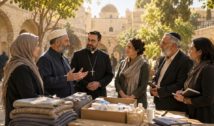
Faith was present among fans, too. In Mexico City, Catholic supporters reportedly visited the Metropolitan Cathedral to pray during the tournament, while Jewish communities in host cities organized kosher food, Shabbat meals and prayer gatherings. Chabad reported World Cup-related Shabbat hospitality near MetLife Stadium and kosher support for fans in Miami.
The 2026 World Cup also showed that religion in public life can be complicated. A planned Pride-themed match in Seattle involving Egypt and Iran drew objections from faith and political leaders in those countries, while FIFA emphasized that the tournament was intended to welcome people from all backgrounds. Such disputes revealed the harder side of pluralism: global sport brings together communities whose religious, cultural and political commitments do not always align neatly.
Still, the broader religious story of the 2026 World Cup was not one of division. It was one of visibility. Muslim players bowed in thanks. Christian players prayed with opponents. Catholic athletes carried long-standing devotional habits into competition. A Sikh player made history. Jewish and Muslim fans looked for kosher and halal food, prayer space and community in unfamiliar cities.
Football is often called the world’s secular religion, but the 2026 World Cup showed something more precise: the sport has become a stage where real religions are neither hidden nor uniform. They are personal, public, sometimes contested, and often quietly constructive. In a tournament remembered for Spain’s triumph and Argentina’s disappointment, some of its most human moments came when players stopped performing for the crowd and turned, however briefly, toward God.