Christian Aid Leaders Unite Around a Simple Message: Share What Can Feed the World
- By WRN Editorial Staff --
- 06 Jun 2026 --
Three major Christian humanitarian organizations have joined voices in a new appeal that frames hunger not only as a policy crisis, but as a moral challenge communities can answer together.
On June 4, the World Council of Churches announced that its general secretary, Rev. Prof. Dr Jerry Pillay, had co-signed an open letter with Alistair Dutton of Caritas Internationalis and Andrew Morley of World Vision International. The WCC described it as the first time leaders of the three large faith-based organizations have issued such a common public stand on hunger and malnutrition.
The appeal calls on governments, multilateral institutions, and faith communities to protect humanitarian access, safeguard child nutrition programs, defend food supply chains, and give peacebuilding priority over militarization. Its constructive force lies in its simplicity: hunger is not inevitable when people and institutions choose cooperation over scarcity.
The timing is deliberate. The letter comes ahead of a June 9 online event connected to the Prayer and Action Against Hunger Coalition’s 2026 campaign, “Give your loaves and fish,” a theme drawn from the Gospel story of a small offering becoming enough for a crowd. The campaign asks churches and communities to consider what they can put into circulation: food, advocacy, money, land, time, relationships, and public pressure.
The need remains severe. The World Food Programme says 318 million people were already facing crisis levels of hunger or worse in 2026. The broader picture is mixed but still urgent: according to the UN’s State of Food Security and Nutrition in the World 2025, about 673 million people experienced hunger in 2024, even as global hunger declined slightly from recent years and continued rising in parts of Africa and western Asia.
That tension is exactly where faith-based action can matter. The new appeal does not pretend that prayer alone will repair broken food systems, armed conflict, displacement, climate shocks, or unaffordable prices. Instead, it links spiritual conviction with practical responsibility: keep aid moving, protect children’s nutrition, support local food resilience, and address the causes that keep families hungry.
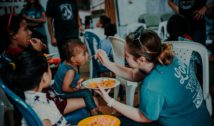
For local congregations, the message is accessible. A church does not have to be a global agency to participate in the work. It can support a food pantry, host a community meal, fund a nutrition program, amplify credible hunger campaigns, reduce food waste, or build partnerships with farmers, schools, refugee groups, and civic organizations already serving vulnerable neighbors.
The hopeful part of the story is not that hunger is easy to solve. It is that large Christian institutions are choosing to speak together, and to invite ordinary communities into action that is both spiritual and concrete. In a world where crises often feel too large to touch, “loaves and fish” becomes more than a biblical image. It becomes a reminder that shared resources, offered in trust, can still become the beginning of repair.
Suggested categories/tags: Christianity, Humanitarian Aid, Global Hunger, Interfaith and Ecumenical Cooperation, World Council of Churches, Caritas Internationalis, World Vision, Faith in Action
Featured image: faith-groups-hunger-illustration.jpg
Image caption: An editorial illustration of diverse hands sharing bread, fish, grain, and vegetables around a common table, symbolizing faith communities working together against hunger.
Alt text: Diverse hands place bread, fish, grain, and vegetables on a shared table in a hopeful illustration about faith-based action against hunger.