


Geneva side event links forced conversion, child marriage, education, and EU pressure
At a side event held during the 62nd session of the United Nations Human Rights Council in Geneva, parliamentarians, human rights defenders, and civil society representatives warned that forced religious conversion through marriage in Pakistan has become one of the most urgent freedom of religion or belief crises facing minority women and girls.
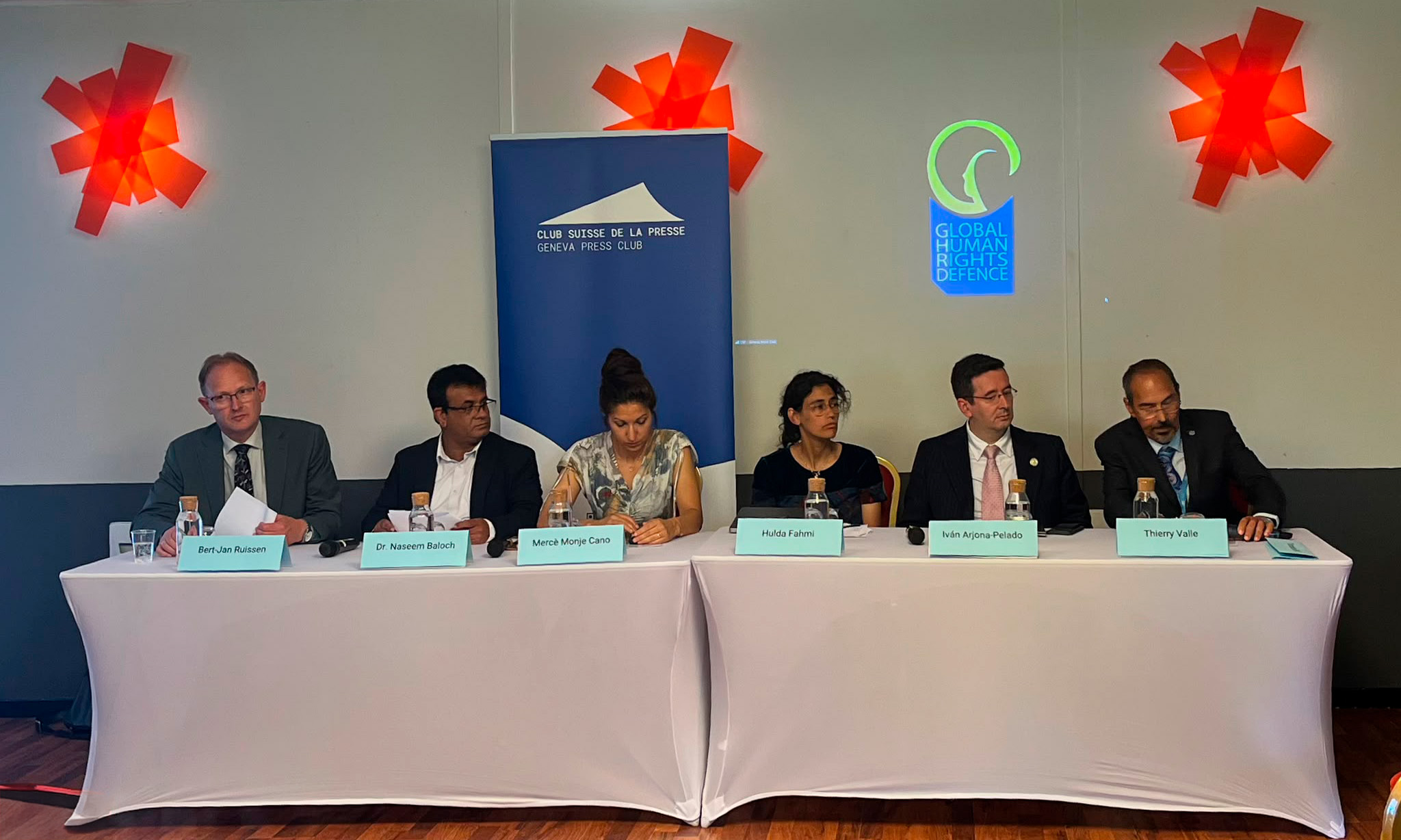
The conference, titled “Forced Conversions and Minority Women in Pakistan: A Human Rights Emergency,” was hosted on July 2 at the Geneva Press Club and co-organized by CAP Freedom of Conscience and Global Human Rights Defence. The discussion focused on reports of Hindu, Christian, Sikh, and other minority girls being abducted, pressured into conversion to Islam, and married in circumstances that speakers said make free consent impossible.
A crisis framed as freedom of conscience
Opening the event, Renata Ferreira of Global Human Rights Defence said the meeting was intended to “raise awareness, amplify the voices of those affected, and discuss ways to strengthen international action” against forced conversion and forced marriage. Thierry Valle, president of CAP Freedom of Conscience, moderated the session and framed the issue as one that sits at the intersection of religious liberty, women’s rights, child protection, and international accountability.
The concern is not new, but speakers said the present moment is significant. UN human rights experts have warned of “continued and widespread patterns” of abduction and forced religious conversion through marriage affecting women and girls from minority communities in Pakistan. In 2025, according to figures cited by UN experts and repeated during the Geneva event, approximately 75 percent of recorded victims were Hindu and 25 percent Christian, with nearly 80 percent of documented incidents occurring in Sindh province.
For many participants, the central issue was the absence of meaningful consent. A change of religion, they argued, cannot be treated as voluntary when it follows abduction, isolation from family, threats, forged age documents, or pressure from alleged abductors. Nor can a marriage involving a child be reconciled with international standards requiring full and free consent.
European Parliament pressure builds
Bert-Jan Ruissen, a Dutch member of the European Parliament and co-chair of the European Parliament Intergroup on Freedom of Religion, Belief and Conscience, told participants that he had raised two concerns directly with Pakistan’s ambassador in Brussels: the abduction and forced marriage of young girls, and Pakistan’s blasphemy laws.
Ruissen said Pakistan’s relationship with the European Union, including its access to the EU’s GSP+ trade preference scheme, should not be separated from human rights performance. Pakistan has benefited from GSP+ since 2014 after ratifying 27 international conventions covering human rights, labor rights, environmental standards, and good governance. The EU has described the scheme as a special incentive arrangement, granting Pakistan preferential access to large parts of the European market while requiring implementation of those conventions.
“Pakistan has to show serious progress,” Ruissen said, arguing that cooperation with Islamabad would become difficult if concerns over forced marriage and blasphemy laws were not taken seriously. He also told the conference that the European Parliament was preparing to debate forced marriage in Pakistan, including the case of Maria Shahbaz, a Christian girl whose reported abduction, conversion, and marriage have drawn international attention.
The Dutch MEP cautioned against treating legal reform as sufficient in itself. He noted that Punjab had moved to raise the legal age of marriage to 18, but said “new laws are not enough” if courts continue to disregard birth certificates or rely on statements made under pressure. “Let us not be satisfied just with some changes which look good,” he said, “but don’t change the situation in reality.”
MEP Tomislav Sokol, speaking by video, also tied the issue to EU policy. Earlier this year, Sokol submitted a written question to the European Commission concerning false accusations of blasphemy in Pakistan. In his Geneva message, he said allegations of forced conversion through marriage require investigation, victim protection, and accountability for perpetrators. He urged the European Commission to use GSP+ dialogue with Pakistan to seek “concrete progress before 2027.”
From individual cases to a pattern
Hulda Fahmi of Jubilee Campaign said forced conversion cases should be understood not only as religious freedom violations but also as violations involving child protection, sexual exploitation, trafficking risks, and, in some cases, slavery-like conditions. She referred to research by Jubilee Campaign and Voice for Justice examining 100 reported cases involving Christian girls and women between January 2019 and October 2022.
That report, she said, found that 61 percent of the victims in the sample were under 18. The age gaps between girls and the men who abducted or married them were often extreme. In one case cited by Fahmi, a 40-year-old man abducted a nine-year-old girl; in another, a 37-year-old man abducted a 13-year-old.
Fahmi said perpetrators often rely on false age documents, disputed marriage certificates, and the cooperation or passivity of police, clerics, and local officials. Families may hesitate to file complaints because of fear, social stigma, distrust of authorities, or threats from the accused and their networks. Even when families obtain legal help, she said, courts may refuse to return girls to their parents after an alleged conversion, reasoning that a return to a Christian or Hindu home could endanger the girl’s new religious status.
Such reasoning, speakers argued, reverses the logic of protection: instead of treating the child as a possible victim of coercion, the legal system treats the alleged conversion as the overriding fact.
Pakistan’s legal framework and its gaps
Dr Nazir Ahmad, a human rights defender speaking from Pakistan by video, offered one of the event’s more measured assessments. He noted that Pakistan has ratified major international human rights treaties and has taken some positive legal steps, including minimum-age marriage laws in Sindh, Punjab, Balochistan, and Islamabad Capital Territory.
But he said the persistence of documented cases shows that the problem lies in the social and structural conditions that allow abuse to recur. He identified feudal power relations, poverty, gender inequality, limited education and employment opportunities, and barriers to justice as conditions that make minority girls especially vulnerable.
Ahmad also addressed the religious dimension directly. Some religious actors, he said, have publicly endorsed conversions in reported cases, creating an environment in which perpetrators believe they will receive social approval. Yet he emphasized that many Islamic scholars reject coercion, pointing to the Qur’anic principle that there is “no compulsion in religion.”
His recommendations were practical: enforce minimum-age marriage laws, establish transparent legal procedures for conversions linked to marriage, provide victims with legal aid and shelter, expand education and economic opportunities for minority girls, and strengthen political participation by religious minorities.
Sindh, poverty, and political exclusion
Mercè Monje Cano, secretary-general of the Unrepresented Nations and Peoples Organization, focused on Sindh, where many documented forced conversion cases occur. She argued that child marriage and forced conversion are “two faces of the same crisis,” shaped by religion but also by political exclusion, poverty, climate stress, and weak local accountability.
Monje said climate change has intensified vulnerability. Floods, droughts, and collapsing livelihoods place families under economic pressure, making girls more exposed to early marriage and exploitation. She also linked the issue to governance, arguing that local institutions in Sindh have not been strong enough to protect vulnerable communities or reflect their interests.
For Monje, the issue cannot be solved if treated only as a narrow religious freedom question. “Everything is linked,” she said, calling for coalitions that connect freedom of religion or belief, women’s rights, minority representation, climate vulnerability, and political accountability.
Baloch women and coercion as a political tool
Dr Naseem Baloch, chairman of the Baloch National Movement, widened the discussion further by drawing parallels between forced conversion and the coercion faced by Baloch women under state pressure. A former enforced-disappearance and torture victim now living in exile in France, Baloch described forced conversion as a question of power over the body and conscience of a woman.
“Can there be any freedom of religion when a child is afraid?” he asked. “Can there be any consent when a girl is under pressure?”
Baloch said minority girls and Baloch women face different but connected forms of domination. One may be attacked in the name of religion, the other in the name of national security, but both are denied freedom and dignity. He said Baloch families of disappeared activists are often pressured, surveilled, or used publicly to discredit relatives. He cited his own sister, who he said was forced to appear at a press conference against him.
That, he argued, follows the same logic as forced conversion: the appearance of consent is manufactured under pressure. “When a state uses fear to make a sister speak against her brother, that is not consent,” he said. “That is coercion.”
Education as an early warning system
Victoria Walczyk of Global Human Rights Defence introduced the organization’s latest report, “Educating Intolerance,” which examines Pakistan’s education policies and school textbooks in relation to freedom of religion, equal citizenship, and minority rights.
Walczyk said violence and discrimination do not begin only in courts or police stations. They begin in the ideas children absorb in school. When textbooks present national identity through one dominant religious narrative and give little space to the history, culture, and contributions of minorities, she argued, children are less likely to see minority citizens as equal members of society.
The report calls for removal of discriminatory content, the creation of an independent curriculum review commission with minority representation, stronger human rights and peace education, improved teacher training, and fuller representation of minority communities throughout the curriculum.
Her remarks echoed concerns raised by Ruissen, who said EU-supported education programs in Pakistan must be scrutinized to ensure that European funding does not reinforce discrimination. The European Union has previously reported on Pakistan’s GSP+ obligations and development relationship, including education cooperation, making curriculum reform a matter of both domestic policy and international partnership.
Article 18 and the work of civil society
Iván Arjona-Pelado, representing the Foundation for the Improvement of Life, Culture and Society, placed the discussion in the framework of Article 18 of the Universal Declaration of Human Rights, which protects freedom of thought, conscience, and religion. He said the forced conversion of a child violates not only religious liberty but also dignity, equality, family life, education, and other basic rights, regardless of in which country it happens.
Arjona-Pelado warned against despair, saying civil society must continue documenting abuses, educating the public about human rights, supporting victims, and pressing authorities to apply principles that already exist in international law. The challenge, he said, is not primarily the creation of new principles but the consistent and courageous application of those already recognized.
“No one else owns that conscience but yourself,” he said, emphasizing that freedom of conscience belongs equally to a child born into a Hindu, Christian, Muslim, or any other family.
A test for law, diplomacy, and conscience
By the end of the Geneva conference, a clear thread had emerged: participants were not calling only for condemnation. They were asking for enforcement. That means police who register complaints promptly, courts that test evidence of age and consent rigorously, shelters that protect victims from abductors, prosecutors who pursue perpetrators, and diplomats who treat freedom of religion or belief as a core human rights issue rather than a secondary concern.
The most immediate test cases may be individual girls such as Maria Shahbaz and Amber Nadeem, whose names speakers invoked as symbols of a wider system. But the deeper test is institutional. Pakistan has enacted some reforms and has made international commitments. The question now is whether those commitments can protect a frightened child when family, police, courts, clerics, and political pressure collide.
For the Geneva participants, the issue is not whether religious conversion is legitimate. In a free society, conversion must be protected. The issue is whether a child can be taken from her home, separated from her community, married to an older man, and then presented before authorities as if fear were faith and coercion were consent.
That question now sits not only before Pakistan’s courts and lawmakers, but also before the European Union, the United Nations, and international civil society. As Chloé Kaouadji of Global Human Rights Defence said in closing, the concern must be carried forward “at the EU level, at the UN, or more at a local level,” until the women and girls whose voices are silenced are no longer treated as footnotes in someone else’s political bargain.