U.S. Military Cuts Faith Identity List
- By WRN Editorial Staff --
- 06 Jun 2026 --
The Pentagon says the change simplifies chaplaincy records. Minority-faith advocates say it may make some service members harder to see.
For decades, a service member who identified as Wiccan, pagan, atheist, humanist or Unitarian Universalist could record that identity directly in U.S. military personnel systems. That small administrative choice carried more weight than it might appear: it helped chaplains, commanders and the military itself understand who was serving, and what kinds of spiritual or ethical support might be needed.
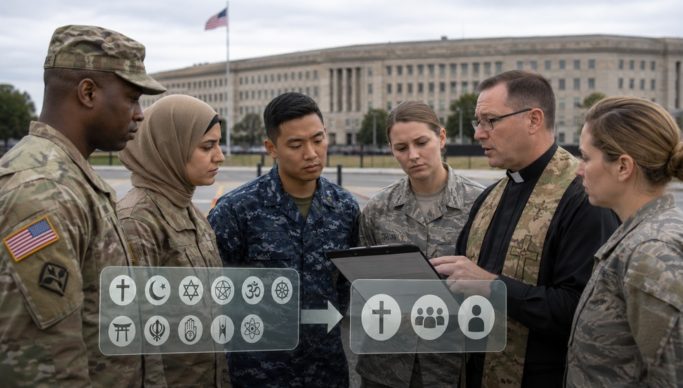
Now the Pentagon has sharply reduced that list. According to reporting by the Associated Press, the Department of Defense has cut more than 200 religious preference codes to 31, folding a number of minority beliefs and nonreligious identities into broader categories such as “other religions” or “no religion.”
The department presents the change as a matter of order. Critics see something more delicate: a change in how the state sees minority belief inside one of its most powerful institutions.
From recognition to “other”
The revised list still includes several major world religions and Christian traditions, among them Catholicism, Islam, Judaism, Hinduism, Buddhism, Sikhism, the Bahá’í Faith and The Church of Jesus Christ of Latter-day Saints. But separate identifiers for Wicca, paganism, atheism, humanism and Unitarian Universalism have been removed.
Defense Secretary Pete Hegseth had signaled the change in a Pentagon announcement on chaplaincy reforms, saying the previous system had grown beyond its original purpose. The stated aim is to give chaplains a simpler and more useful way to understand religious affiliation across the force.
That explanation may satisfy administrators. It has not satisfied everyone affected by the change.
The question is not whether the Pentagon has banned any belief. It has not. Service members remain free to hold, practice or reject religion. The sharper question is whether a belief that no longer has a name in the system becomes easier to miss in practice.
Why a code matters
Military religious preference codes are not public honors. They are data. But in large institutions, data shapes attention. If a commander can see that a unit includes several members of a particular faith, that may influence chaplaincy planning, accommodation requests, training and pastoral support.
For minority communities, this kind of visibility has often been hard won. Wiccans and pagans in the U.S. military have spent years seeking equal treatment, including recognition of religious symbols and access to appropriate spiritual care. A service member who belongs to a small tradition may not expect the military to understand every ritual or belief in advance. But the presence of a named category can at least say: this community exists here.
Being moved into “other religions” changes that signal. It does not erase the person, but it does blur the institutional view.
The same concern applies to nonreligious service members. Atheists and humanists are not simply people without a religious label; many understand their worldview as a positive ethical identity. Treating them only as “no religion” can miss that distinction, especially when chaplaincy services include counseling around grief, conscience, moral injury and meaning.
A chaplaincy built for a changing force
The U.S. military chaplaincy has long served a population more diverse than the country’s older religious assumptions. Its chaplains are ordained or endorsed by particular traditions, but they are expected to support the free exercise rights of all service members, not only those who share their faith.
That makes accuracy important. A simplified list may be easier to manage, but simplicity can become a problem if it hides the very diversity chaplains are meant to serve.
The Pentagon argues that broader categories are enough. Pentagon spokesperson Sean Parnell told AP that the move was not a judgment on the validity of any religion or belief, but a practical adjustment to restore the codes to their intended function.
Critics are likely to judge the reform by what happens next. Will chaplains receive clear guidance on minority beliefs? Will service members still be able to request specific accommodations without friction? Will the department track whether the new categories obscure communities that were previously counted?
Those questions matter because religious freedom in uniform is not theoretical. It appears in requests for worship space, dietary accommodation, leave for holy days, access to literature, end-of-life rites and pastoral care during deployment. It also appears in quieter moments, when a service member facing fear, loss or moral conflict wants to speak with someone who will not treat their beliefs as an administrative inconvenience.
The politics of being counted
The change arrives in a tense American moment, when public arguments over religion, secularism and national identity have become unusually charged. That context does not automatically make the Pentagon’s decision hostile. But it does explain why a technical personnel change can draw immediate suspicion.
For majority faiths, the difference may barely register. Their names remain visible. For smaller communities, the move can feel like another reminder that recognition is conditional, fragile and easily reversed.
Religious liberty protections are strongest when they are boringly consistent: the same rule for large churches, small temples, nature-based religions, new religious movements and those who claim no religion at all. The challenge for the Pentagon is to show that the shorter list will not produce narrower care.
That will require more than assurances. It will require practical safeguards, transparent procedures and a chaplaincy culture attentive enough to notice those who have disappeared from the menu but not from the military.
The dispute over 31 categories is therefore not really about paperwork. It is about whether a pluralist institution can simplify its systems without simplifying its people.