


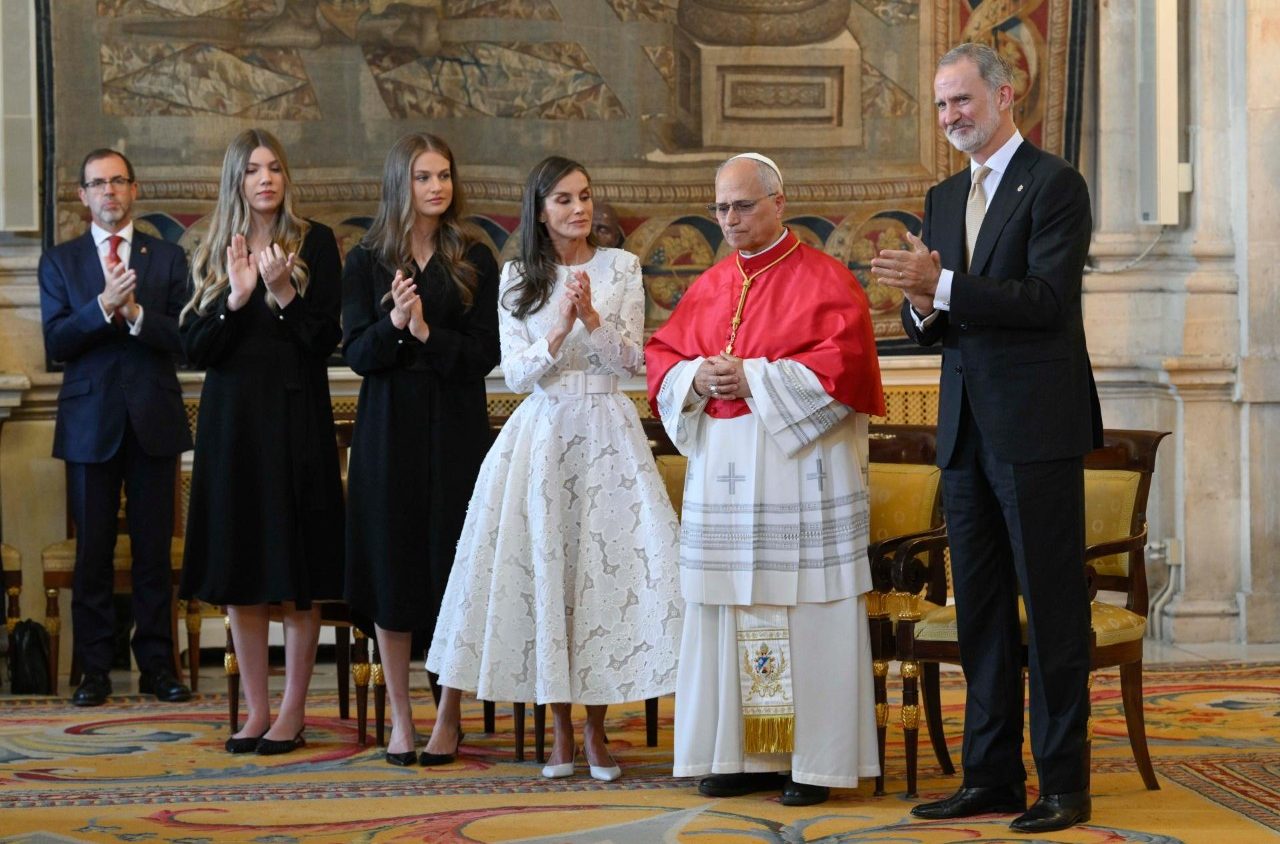
Madrid, Barcelona, Montserrat and the Canary Islands form the heart of the Pope’s June 6–12 journey.
Pope Leo XIV has begun a six-day apostolic journey to Spain that will take him from Madrid to Barcelona, Montserrat, Gran Canaria and Tenerife, combining state protocol, major public liturgies, meetings with young people, encounters with migrants and a highly symbolic Mass at Barcelona’s Sagrada Família.
The trip, officially scheduled from June 6 to 12, 2026, is the first papal visit to Spain in 15 years and one of the most ambitious early journeys of Leo XIV’s pontificate. The Vatican’s official programme sets out a dense itinerary across four Spanish regions, with public events in stadiums and squares as well as quieter meetings with religious communities, charity workers, prisoners and migrants.
Spain is not simply another Catholic country on the papal map. It is a nation where Catholicism remains deeply woven into public culture, education, art and local identity, while religious practice has declined sharply over recent decades. The Pope’s route reflects that tension: royal palaces and cathedrals, youth vigils and urban charity projects, Gaudí’s unfinished spiritual masterpiece and the migration routes of the Atlantic.
Madrid: state welcome, young people and public faith
The journey opened on Saturday, June 6, with the Pope’s arrival at Adolfo Suárez Madrid-Barajas Airport, followed by an official welcome at the Royal Palace. King Felipe VI and Queen Letizia received the pontiff before a courtesy visit and a meeting with authorities, civil society and the diplomatic corps.
The Madrid programme places the Pope at the intersection of monarchy, government, Church and street-level social service. Later on the first day, Leo XIV is scheduled to visit the staff and beneficiaries of the “CEDIA 24 Horas” social project, a Catholic-run initiative linked to care for vulnerable people in the city. The day closes with a prayer vigil with young people in Plaza de Lima, a setting chosen less for institutional solemnity than for public encounter.
On Sunday, June 7, the Pope will celebrate Mass in Plaza de Cibeles, one of Madrid’s most recognizable civic spaces. The Mass is linked to the feast of Corpus Christi, traditionally one of the most visible expressions of Catholic devotion in Spain. In the afternoon, Leo XIV will hold a private meeting with members of the Augustinian Order at the Apostolic Nunciature, an event with personal resonance for a pope whose own religious formation is connected to the Augustinian tradition.
That same evening, the Pope is expected at Madrid’s Movistar Arena for a meeting titled “Building Networks with the World of Culture, Art, Economy and Sport.” The title suggests a broader ambition than internal Church conversation. It places the visit in dialogue with a Spain whose religious inheritance is visible not only in worship, but in literature, architecture, music, education, social action and public debate.
Politics and bishops before the journey moves east
Monday, June 8, will be one of the most politically watched days of the visit. According to the Holy See Press Office schedule, Leo XIV will meet Spain’s prime minister at the Apostolic Nunciature before addressing members of the Spanish Parliament at the Congress of Deputies.
The Pope will then meet the bishops of Spain at the offices of the Spanish Episcopal Conference. That encounter comes at a delicate moment for the Spanish Church, which continues to face questions about secularization, religious education, migration, the role of Catholic institutions in public life and the long aftermath of clerical abuse cases.
Later that day, Leo XIV will pray before Our Lady of Almudena at Madrid’s cathedral before meeting the diocesan community at the Santiago Bernabéu Stadium. The choice of venue is striking: a football stadium turned, for one evening, into a vast gathering place for Catholic Madrid.
Barcelona and Montserrat: Gaudí, prison and devotion
On Tuesday, June 9, the Pope will meet volunteers at IFEMA Madrid before flying to Barcelona. His first public stop in Catalonia will be midday prayer at the Cathedral of the Holy Cross and Saint Eulalia, placing the visit within the older ecclesial heart of Barcelona before the programme turns toward larger public gatherings.
That evening, Leo XIV is scheduled to lead a prayer vigil at the Lluís Companys Olympic Stadium. As in Madrid, the event is designed for a large public audience and is expected to draw young people, families, Church groups and pilgrims from across Catalonia and beyond.
Wednesday, June 10, brings one of the most unusual combinations of the trip. In the morning, the Pope will visit Brians 1 penitentiary center, a stop that gives the day a social and pastoral dimension before it moves into the high symbolism of Montserrat and the Sagrada Família.
At noon, Leo XIV will recite the Rosary at the Abbey of Our Lady of Montserrat, one of Catalonia’s most beloved religious sites. Montserrat is not only a monastery; it is a spiritual and cultural landmark closely tied to Catalan identity. A papal visit there inevitably carries meanings that go beyond liturgical devotion.
Later in Barcelona, the Pope will meet diocesan charity and welfare organizations at the Church of Sant Agustí. The day concludes with Mass in the Basilica of the Sagrada Família, where the Pope will mark the inauguration of the tower of Jesus Christ. The basilica, designed by Antoni Gaudí and still one of the world’s most recognizable Christian architectural projects, has become a global symbol of faith, beauty and endurance. Vatican News has highlighted the Sagrada Família event as one of the central moments of the journey, noting the Pope’s role in blessing the basilica’s tallest tower during this visit.
The Canary Islands: migration at the center
The final part of the trip moves from mainland Spain to the Canary Islands, where migration becomes the dominant theme. On Thursday, June 11, the Pope will fly from Barcelona to Gran Canaria, arriving at Gando Air Base before travelling to the port of Arguineguín.
Arguineguín has become closely associated with the arrival of migrants and asylum seekers crossing the Atlantic route from West Africa. By placing a meeting with organizations working with migrants at the center of the Canary Islands programme, the Vatican is giving strong visibility to one of Spain’s most urgent humanitarian and political challenges.
After that encounter, Leo XIV will meet bishops, priests, deacons, religious, seminarians and pastoral workers at the Cathedral of Saint Anne in Las Palmas de Gran Canaria. In the evening, he will celebrate Mass at Gran Canaria Stadium, another large-scale public liturgy in a setting more often associated with sport than worship.
On Friday, June 12, the Pope will travel to Tenerife. His morning begins with a meeting with migrants at the Las Raíces center, followed by an encounter with organizations working for integration in the Plaza del Cristo de La Laguna. The programme then moves to the port of Santa Cruz de Tenerife, where Leo XIV will celebrate the final Mass of the journey.
The farewell ceremony is scheduled for Tenerife Norte-Los Rodeos Airport before the Pope departs for Rome. By then, the visit will have moved through the ceremonial heart of Spain, the cultural and religious landscape of Catalonia, and the Atlantic frontier where migration, poverty, policy and human dignity meet.
A journey through Catholic Spain and modern Spain
The Spanish Episcopal Conference announced earlier this year that the Pope had accepted the invitation of King Felipe VI and the Church in Spain. The final itinerary now shows how carefully the journey has been balanced. It is neither only a pilgrimage nor only a state visit. It is a public reading of Spain through Catholic eyes: monarchy, parliament, bishops, youth, prisoners, migrants, artists, volunteers and local communities all appear in the same week.
The timing also matters. Spain’s Catholic culture remains visible in processions, shrines, schools, charities, feast days and architecture, but the country is socially and politically more plural than at any previous papal visit. Leo XIV arrives in a Spain where Catholic memory is powerful, Catholic practice is uneven, and public arguments over religion, secularism and social policy remain lively.
That may be why the route is so wide. Madrid offers the language of institutions. Barcelona and Montserrat offer the language of culture and devotion. The Sagrada Família offers beauty made stone. The Canary Islands offer a direct encounter with people on the move, and with those who receive them.
For Catholics in Spain, the visit is a rare national moment of visibility. For non-Catholics and secular Spaniards, it is also a test of how the Church presents itself in a plural society. Pope Leo XIV’s itinerary suggests a message less focused on nostalgia than on presence: the Church in palaces and prisons, cathedrals and ports, stadiums and migrant centers, still trying to speak to a country that knows Catholicism well, but no longer hears it in only one way.