L Ron Hubbard’s Star: Villa Estrella & Gran Canaria’s Unexpected Link to Global Scientology
- By WRN Guest --
- 24 May 2026 --
This article was first published in the Blog of Michel Jorge Millares, where you can see the photos he used and published (in Spanish), and many other articles related to the Canary Islands.
Michel Jorge Millares is a Canarian journalist, writer, and cultural researcher whose work focuses on the history, identity, tourism, and social memory of the Canary Islands. He holds a degree in Journalism from the Universidad Complutense de Madrid and a Master’s in Journalism from the Universidad de Las Palmas de Gran Canaria. He has curated major cultural and tourism commemorations, including the 50th anniversary of Maspalomas Costa Canaria, World Tourism Day in Maspalomas with the World Tourism Organization, the 50th anniversary of the Feria del Atlántico, and the 40th anniversary of the Gran Canaria Tourism Board. He was also a precursor of the International Tourism Forum Maspalomas Costa Canaria and has directed the Maspalomas Summer University.
Las Palmas, SPAIN, May 23, 2026. By Michel Jorge Millares. Thousands of Scientologists around the world have an unexpected point of reference in Gran Canaria: a house in Telde where L. Ron Hubbard recorded one of the most important messages in the history of this religious organization in 1967. A few weeks ago, the residence known as Villa Estrella (Estrella Villa) reopened fully restored, transformed into the tenth international sanctuary dedicated to the memory and legacy of the founder of Scientology.
“The background noise that you hear is not in actual fact tape noise. It is the wind, howling up a cliff and hitting over the area where I am sitting. Out before me here is the wide blue sea with ships passing by, a few fleecy clouds overhead and the bright sun shining down.”
Thus begins Ron’s Journal 67, a recording made personally in Telde on September 20, 1967, and later distributed among Scientologists worldwide. The message was not merely a personal reflection. In it, Hubbard announced the creation of the Sea Organization, or Sea Org, according to a review by Spain’s Pluralism and Coexistence Foundation, a structure conceived within Scientology as a religious brotherhood inside the organization and through which, according to Francisco Díez de Velasco, professor of the history of religion at the University of La Laguna, Scientology would complete its formation as a religious movement — recognized as such in Spain since 2007. The choice of Gran Canaria was no accident.
L. Ron Hubbard (1911–1986) was one of the most singular figures of the 20th century, and one about whom countless pages have been written. A prolific author of popular pulp fiction — especially adventure, Westerns, and science fiction — author of Dianetics: The Modern Science of Mental Health, and founder of Scientology, he also developed a deep connection with the sea and navigation. Gran Canaria played a significant role in that stage of his life.
His relationship with the islands deepened through several visits during the 1960s. He arrived in search of the healthier climate that had been recommended to him in the United Kingdom. What he found, however, was much more than that: a city at one of its brightest moments of tourist attraction and sporting, cultural, and even space-age vitality. One of NASA’s main stations was operating actively in Maspalomas as part of the programs that led to humankind’s first steps on the Moon. He also found volcanic landscapes, exceptional light, and an Atlantic setting that would eventually become part of the symbolic imagery of the organization he was building.
That island period unfolded in several episodes. In January 1965, Hubbard travelled from England to Spain, passed through Cádiz, and later moved to Gran Canaria, where he stayed for several weeks. He would return again in 1966 and 1967, the year in which he got to the islands with the yacht Enchanter and later aboard the ship Avon River.
It was precisely from the Canary Islands that the future maritime and organizational structure of international Scientology would begin to take shape.
Beyond the religious or ideological dimension of the figure, there is a lesser-known and particularly interesting side to Hubbard from a cultural perspective: he was passionate about photography. And Gran Canaria became one of his great visual settings.
During his stays, he travelled through different parts of the archipelago and photographed landscapes, everyday scenes, ports, villages, and popular celebrations. He visited Lanzarote, Fuerteventura, Tenerife, and La Gomera, as well as numerous corners of Gran Canaria.
The images taken at that time show an island very different from today’s: American tourists attending flamenco shows, improvised themed parties, the expanding Port of La Luz, lonely roads leading to Maspalomas, and — as an unexpected gift — an unusual snowfall on the island’s peaks, which he also captured in his photographic record.
He also photographed churches in Arucas and Agüimes, urban scenes in Las Palmas de Gran Canaria, and coastal landscapes where the Atlantic light seems to take center stage.
For Ron Hubbard, photography was not a secondary activity. He was deeply interested in cameras, their mechanisms, and their technical possibilities. He reviewed equipment, analyzed lenses, and maintained contact with manufacturers interested in his observations and suggestions for improvement. He also understood photography as a tool for emotional and artistic communication.
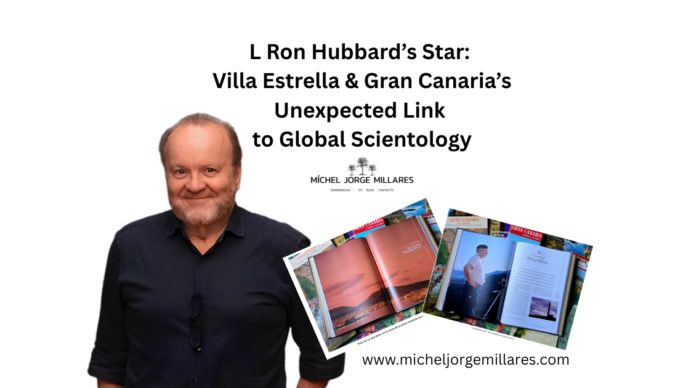
It is no coincidence that one of the chapters in the book L. Ron Hubbard: Photographer, Writing with Light, dedicated to his time in the Canary Islands, is titled “A Photographic Holiday.”
The reopening of Villa Estrella also confirms a little-known phenomenon: the emergence of cultural and commemorative tourism linked to international figures associated with Gran Canaria.
In the case of L. Ron Hubbard, the house in Telde now forms part of an international network of sites preserved by Scientology in various countries, including the United States, the United Kingdom, South Africa, and Zimbabwe. But it is not the only example.
The municipality of Telde had already been attracting interest among admirers of the writer Sanmao — Chen Ping, 1943–1991 — a cult author with millions of Asian readers who lived in Gran Canaria during some of the happiest, and also most dramatic, episodes of her life.
This type of visitor does not belong to conventional mass tourism. In many cases, these are travelers motivated by cultural memory, biography, literature, or spirituality. It is a quiet, dispersed, and deeply emotional form of tourism that finds places imbued with meaning in the islands.
The story of Ron Hubbard also invites reflection on the role the Canary Islands have played in contemporary international history.
It is often forgotten that some of the most significant figures of the last century passed through the islands. From Christopher Columbus to the astronauts of Apollo XI; from Winston Churchill to Gregory Peck, John Huston, and Leo Genn during filming linked to the world of Moby Dick.
Also present in memory are episodes such as the stay of Jacqueline Kennedy and Aristotle Onassis in the Port of La Luz, or the presence on the island of Nobel Prize-winning writer Eugene O’Neill.
Gran Canaria has functioned for decades as an Atlantic stopover, a climate refuge, a tourism laboratory, and a meeting point between continents. Yet the archipelago itself often seems to overlook the international dimension of its own history.
There is a certain insular tendency to diminish the significance of those events and figures that have left their mark on the Canary Islands. As if the geographical condition of a peripheral archipelago made it difficult to recognize just how deeply these islands have been connected to some of the great cultural, scientific, and political narratives of the contemporary world.
Islanders’ collective memory sometimes suffers from the same problem as their territory: a certain “miniature syndrome.”
And yet, stories like that of L. Ron Hubbard demonstrate precisely the opposite. From a home facing the Atlantic in Telde, a message was recorded in 1967 that would eventually become part of the symbolic memory of thousands of people scattered across the globe.
Rarely has a seemingly discreet corner of the world, such as the coast of Gran Canaria, been so closely connected to a global story.