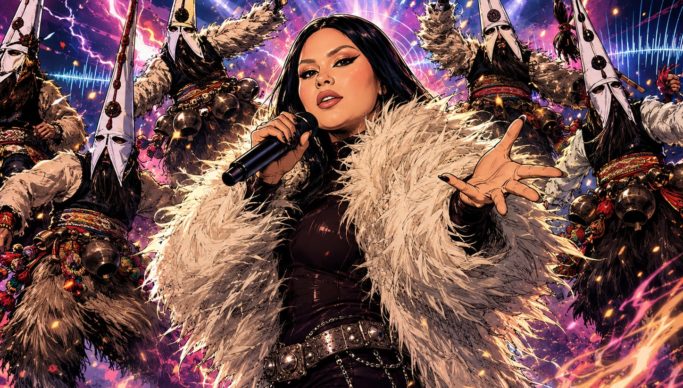
‘Beautiful Chaos’: How DARA’s Eurovision Winner ‘Bangaranga’ Resurrected an Ancient Balkan Ritual
- By WRN Editorial Staff --
- 21 May 2026 --
For a music culture often defined by corporate glitter and geopolitical friction, the intersection of modern pop and ancient mysticism has delivered something entirely different: a high-octane spiritual exorcism. At the 70th anniversary edition of the Eurovision Song Contest in Vienna, Bulgarian pop sensation DARA made history by securing her country’s first-ever victory with her chart-topping track “Bangaranga”.
While casual listeners danced to its explosive, electro-pop beats, theologians and cultural anthropologists noticed something deeper. Beneath the modern production lies the beating heart of an ancient, sacred ritual designed to shake and cleanse the human spirit.
When Pop Meets the Sacred
The word “bangarang” famously originated in Jamaican Patois to describe a loud commotion, noise, or riotous chaos. However, DARA has repurposed the word to describe an internal, metaphysical state. Following her spectacular 516-point victory, she explained that “bangaranga is a special energy that everyone has got in themselves, a feeling that everything is possible.”
The singer has explicitly described the track as “pop music with folklore bones.” Rather than running from chaos, the song leans directly into it, transforming overwhelming noise into an intentional tool for spiritual liberation and internal awakening.
The Bones of the Kukeri
The raw, kinetic energy of “Bangaranga” is directly inspired by Kukeri, a centuries-old spiritual tradition practiced across Bulgaria and the wider Balkan region.
In its traditional form, the Kukeri ritual involves villagers who don massive, striking outfits made of long-haired goat fur, heavy copper bells, and grotesque wooden animal masks. They march through villages during the winter and pre-Lenten seasons, leaping and dancing in a deafening cacophony. The purpose of this intentional, overwhelming chaos is strictly spiritual: to scare away evil spirits, banish the coldness of winter, and invite fertility, health, and light back into the community.
A Modern Exorcism for Inner Demons
If institutional religion relies on dogmatic structures, primal spirituality relies on the shaking of the soul. DARA’s “Bangaranga” acts as a modern-day evolution of this concept. Instead of warding off literal village spirits, the song addresses the internal, modern demons of mental health.
DARA has openly shared that the lyrics were written as a therapeutic way to process her own diagnosis of anxiety and Attention Deficit Hyperactivity Disorder (ADHD), a theme she previously explored in her raw 2025 album ADHDARA. The lyrics of the song contrast these internal forces directly:
“Welcome to the riot / I’m an angel, I’m a demon, I’m a psycho for no reason… I’m a mover for a freedom / Let me light you up.”
The visual presentation of the song replicates the heavy, rhythmic frenzy of the ancient festival. It uses industrial bass lines, flashing lights, and intense choreography to channel what Bulgarian tradition calls “beautiful chaos”—using noise and fire as a force for ultimate good to chase away whatever darkness has settled over the mind.
The Syncretic Survival of Faith
What makes this spiritual undertone so compelling for observers of world religions is its resilience. The Kukeri ritual possesses deep pagan roots linked to ancient Thracian celebrations of ecstasy, fertility, and renewal. Yet, rather than being wiped out by the spread of formal religion, it underwent a syncretic evolution, surviving alongside Eastern Orthodox Christianity. Today, it remains a beloved cultural mainstay, frequently documented by regional outlets like Balkan Insight and protected under global initiatives like the UNESCO Intangible Cultural Heritage lists.
By bringing this energy to the global digital stage via the Official Eurovision Song Contest platform, DARA has proven that humanity’s oldest spiritual impulse—to beat drums, wear masks, and make a joyful, roaring noise to conquer fear—remains alive, well, and deeply relevant even in the secular world of modern pop.
Related Coverage from WorldReligionNews.com: