Pope Leo XIV Links Confession to Responsibility for War
- By WRN Editorial Staff --
- 14 Mar 2026 --
Pope Leo’s latest appeal turns a private sacrament into a public moral question for Christian leaders in a time of conflict.
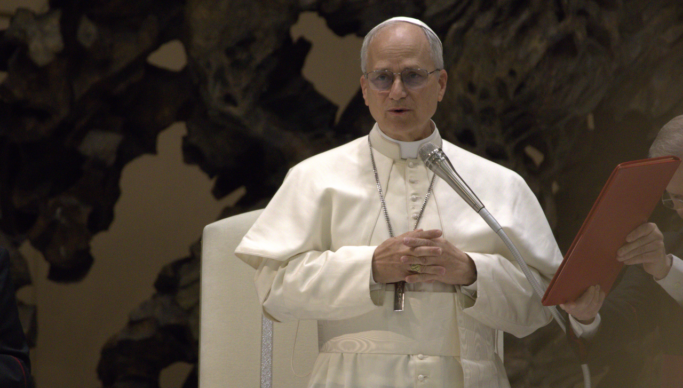
Pope Leo XIV has delivered one of the sharpest religion-and-politics interventions of his pontificate so far, asking whether Christians who carry grave responsibility for war have the humility to examine their conscience and go to confession. The remark came in a Vatican address on 13 March to priests and future confessors, but its significance reaches well beyond the confessional. At a moment when the Middle East conflict continues to widen, the Pope’s question landed not as an abstract theological reflection, but as a direct challenge to the moral self-understanding of political power.
In his official address to participants in the Course on the Internal Forum, Leo said the Sacrament of Reconciliation is a “workshop of unity” because it restores unity with God and helps foster peace within the human family. Then came the line that quickly drew international attention: “One might well ask: do those Christians who bear grave responsibility in armed conflicts have the humility and courage to make a serious examination of conscience and to go to confession?” Vatican News highlighted the same question as the heart of the speech, while Reuters reported it as a pointed message to Christian leaders involved in starting wars.
A moral question in wartime
The timing is what makes the statement especially powerful. Reuters noted that Leo’s comments came against the backdrop of the Iran war that began on 28 February, after joint U.S.-Israeli airstrikes, and amid growing fears of a broader regional spillover. In the days before his confession speech, the Pope had already urged an end to bombing, called for dialogue, and warned that the conflict could spread further, including into Lebanon. On 11 March he again appealed for peace and lamented the suffering of civilians, including children. Taken together, those statements show a pontiff moving steadily from general appeals for peace toward a more explicit moral interrogation of those who authorize violence.
Leo did not name any leader, country or military alliance. That restraint matters. It preserves the universal reach of his message and keeps it within the Church’s longstanding habit of moral teaching rather than partisan naming and shaming. Yet the absence of names did not dilute the force of the intervention. On the contrary, it made the question broader and harder to dismiss. The Pope was not speaking only to one cabinet, one capital or one war room. He was asking whether a Christian ruler, minister or commander can invoke the language of faith while bypassing the discipline of conscience that faith demands.
Why confession became political
To non-Catholics, confession can seem like an intensely private sacrament concerned with personal failings rather than public decisions. Leo’s speech pushed against that narrow understanding. He argued that reconciliation with God is also tied to reconciliation with others and, ultimately, to peace among peoples. Vatican News summarised his argument in striking terms: only a reconciled person can live in an “unarmed and disarming way.” In other words, the Pope was not treating confession as spiritual therapy for private guilt. He was presenting it as a school of moral realism, one that strips away rhetoric, ideology and self-justification.
That framing is deeply Catholic, but it also speaks to a wider public debate. In many democracies, religious identity still plays a visible role in political life. Leaders speak of providence, values, civilization and moral duty. Some openly identify as practicing Christians. Leo’s intervention suggests that public declarations of faith carry obligations, not just symbolism. If a leader claims Christian conviction, the Pope is effectively saying, then that conviction must survive the hardest test of all: scrutiny before God over decisions that cost human lives.
The tension inside Catholic tradition
The Catholic Church is not simply pacifist in the absolute sense. Its moral teaching has long allowed for the possibility of legitimate defense under strict conditions. The Catechism of the Catholic Church says the damage inflicted by an aggressor must be lasting, grave and certain; peaceful means must have proved ineffective; there must be serious prospects of success; and the use of arms must not create evils greater than the evil to be eliminated. It also insists that even when war breaks out, not everything becomes lawful between belligerents. Leo did not rehearse that framework line by line, but his call for examination of conscience fits squarely within it.
That is why the speech matters beyond a single headline. It does not abolish Catholic just war reasoning, but it does raise the moral threshold for invoking it. It suggests that leaders cannot hide behind abstractions such as security, necessity or deterrence without confronting the spiritual weight of what they are authorizing. In that sense, the Pope’s message was not merely anti-war. It was anti-evasion. He was calling for responsibility that is personal, not only institutional; penitential, not only strategic.
More than a Vatican soundbite
There is also a pastoral layer to the story. Leo delivered these remarks to priests and seminarians learning the ministry of confession, urging them to treat the sacrament not as a formality but as a living source of conversion and social renewal. That context matters because it shows he was speaking first to the Church itself. Before Christians can challenge rulers, the speech implies, the Church must recover its own seriousness about sin, mercy and moral truth. The Pope was warning against a Christianity that speaks easily about identity and civilization but less convincingly about repentance.
For World Religion News readers, the significance lies precisely in that overlap between the spiritual and the geopolitical. Religion is often discussed either as a private comfort or as a public identity marker. Leo’s intervention points to a third possibility: religion as moral accountability in public life. Whether political leaders heed that challenge is another matter. But the question is now on the table, in unmistakably religious terms. At a time when bombs, drones and retaliatory threats dominate headlines, the Pope has inserted an older and less fashionable word into the conversation: conscience. That may not stop a war. But it does make it harder for believers to wage one without asking what their faith requires of them first.