Interfaith Delegation Brings a Listening Mission to Syria’s Fragile Recovery
- By WRN Editorial Staff --
- 07 Jul 2026 --
A recent interfaith humanitarian mission to Syria is offering a cautious but hopeful sign of what faith communities can contribute in places still carrying the wounds of conflict.
From June 11 to 19, 2026, a delegation of Muslim, Christian, and Jewish faith leaders from the United States traveled to Damascus, Homs, and Aleppo as part of a mission organized by MedGlobal’s Humanitarian Faith Initiative. The group set out not as a political delegation, but as a listening and humanitarian presence: meeting Syrian faith counterparts, visiting religious heritage sites, engaging public officials, and raising support for communities affected by years of war.
The Institute for Global Engagement, which took part in the trip, described the visit as an effort to listen to Syrians across religious and political lines at a pivotal moment in the country’s transition. The delegation met with senior government figures as well as leaders from Syria’s historic religious communities, including communities whose sacred sites and social bonds have been damaged by displacement, violence, and mistrust.
The positive significance of the visit lies partly in its simplicity. In a region where religious identity has too often been exploited by political and militant forces, this mission placed religious leaders in a different role: as bridge-builders, witnesses, and advocates for human dignity. MedGlobal said the delegation planned to support peacebuilding and humanitarian work while visiting sites sacred to Muslims, Christians, and Jews.
That shared presence matters because Syria’s recovery remains deeply fragile. A May 2026 country update from the U.S. Commission on International Religious Freedom warned that religious freedom conditions in Syria have continued to face serious threats, including sectarian violence and inadequate protections for minority communities. Against that backdrop, interfaith efforts should not be overstated. A delegation cannot solve Syria’s political or security challenges. But it can help keep coexistence, accountability, and community protection on the public agenda.
The mission also connected with renewed attention to Syria’s diverse religious heritage. Recent reporting in The Jerusalem Post noted that a visit by Rabbi David Saperstein to Damascus, as part of an American delegation, drew attention to efforts to preserve Jewish sites and rebuild ties with members of the Syrian Jewish diaspora. Such preservation work is not only about buildings. It is also about memory, belonging, and the possibility that Syria’s future can make room for the fullness of its past.
Other faith-based leaders have also been pursuing dialogue in the region. A June report from Christian Daily International described a Baptist World Alliance regional tour through Egypt, Lebanon, Syria, and Jordan focused on Christian unity, interfaith dialogue, religious freedom, and encouragement for communities under economic and social strain.
For readers outside Syria, the lesson is not that interfaith work is easy. It is that constructive religious leadership often begins with showing up carefully: listening before speaking, honoring grief without inflaming it, and treating each community’s sacred memory as part of a shared human inheritance.
In that sense, the June delegation represents a modest but meaningful model. Muslim, Christian, and Jewish leaders traveled together not to erase their differences, but to place those differences in service of a common task: helping people rebuild lives, protect neighbors, and imagine peace as something more practical than a slogan.
Suggested tags/categories: Interfaith, Syria, Humanitarian Aid, Religious Freedom, Peacebuilding, Muslim-Christian-Jewish Relations, Faith and Public Life
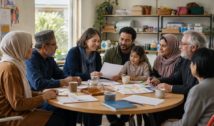
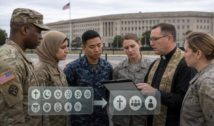
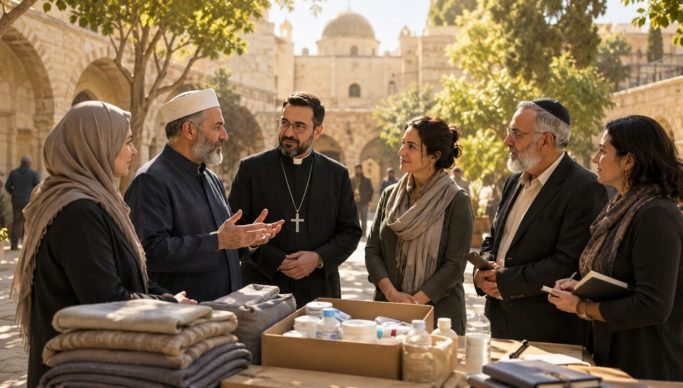
Image caption: An editorial illustration of interfaith leaders gathered around humanitarian supplies, symbolizing shared support for Syrian communities recovering from conflict.
Alt text: Muslim, Christian, and Jewish community leaders stand together around a table with blankets and medical supplies in a sunlit Middle Eastern courtyard.