Ramadan Meets a New Islamophobia Surge
- By WRN Editorial Staff --
- 14 Mar 2026 --

As Muslims mark one of the holiest periods of the year, a fresh wave of anti-Muslim rhetoric in U.S. politics is raising alarms far beyond Washington.
A new religion-and-public-life story has taken shape in the United States just as Ramadan enters its final stretch and the world approaches the International Day to Combat Islamophobia on March 15. Over the last several days, some Republican lawmakers in Congress have faced mounting criticism after posting or defending statements about Muslims that advocacy groups, Democratic lawmakers and many Muslim Americans have described as openly anti-Muslim. The controversy is not only political. It has become a test of how religion is being discussed in public life at a moment of heightened tension, fear and global conflict.
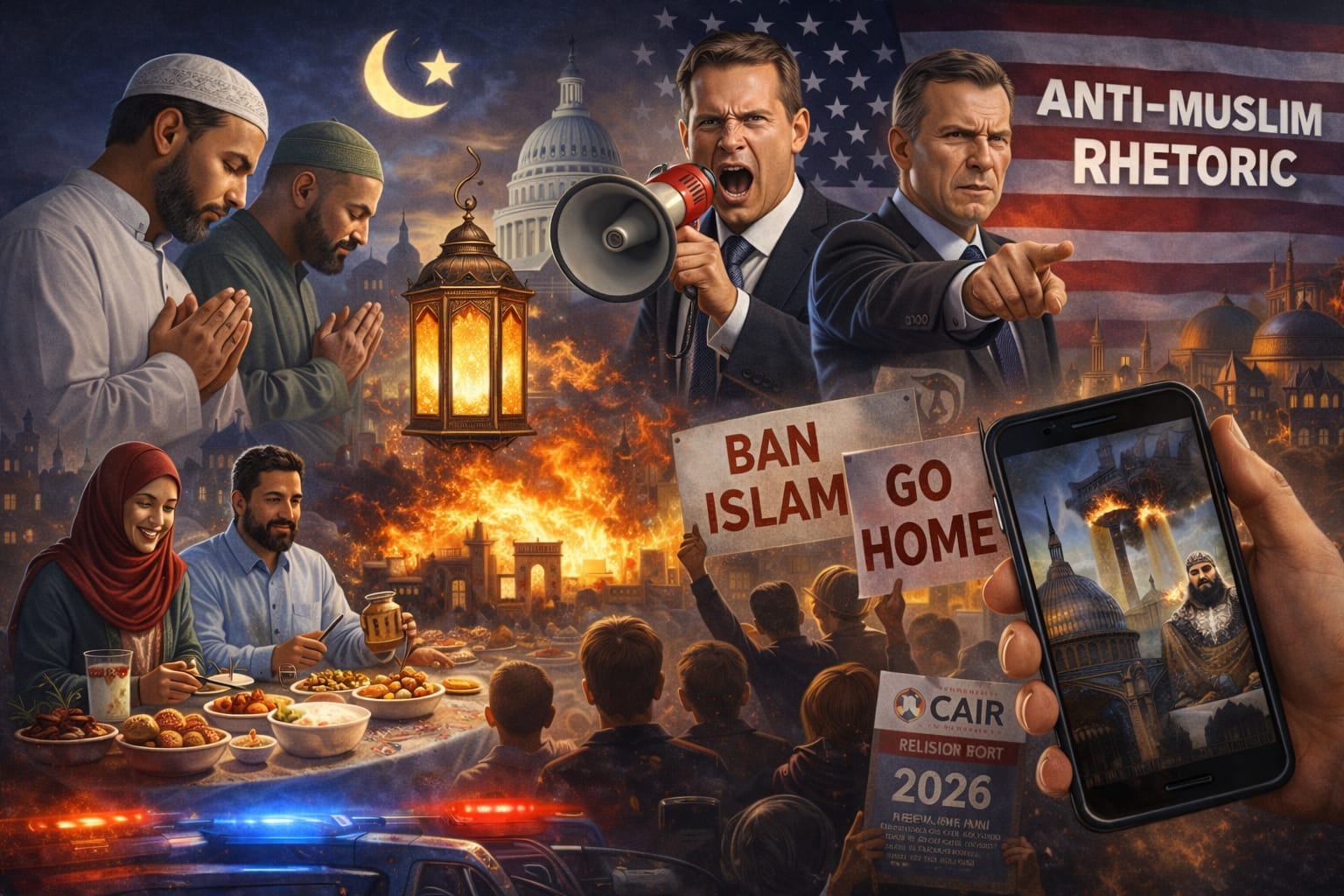
According to Reuters and the Associated Press, the sharpest outrage centered on posts aimed at New York City Mayor Zohran Mamdani, described by Reuters as the city’s first Muslim mayor. Senator Tommy Tuberville shared an image linking Mamdani’s Ramadan iftar appearance with imagery from the September 11 attacks, while Representative Andy Ogles had earlier written that “Muslims don’t belong in American society,” later escalating his remarks further. Reuters reported that at least four members of Congress posted language that many Muslim Americans and Democrats viewed as Islamophobic.
The backlash was immediate. Senate Democratic leader Chuck Schumer called Tuberville’s post “mindless hate,” while Michigan Congressman Shri Thanedar introduced a formal House resolution to censure Ogles and remove him from the Homeland Security Committee. In a public statement, Thanedar said Ogles’ remarks disrespected religious freedom and America’s diversity. The Council on American-Islamic Relations, or CAIR, went further, saying Tuberville had become the first U.S. senator it had designated an “anti-Muslim extremist.”
A sharper public mood during a sacred month
The reason this story matters to religion reporting is not simply that politicians are being rude or inflammatory. It is that the rhetoric is landing during Ramadan, the month in which Muslims fast, pray, gather for worship and share meals at sunset. Public images of iftar, prayer and Muslim civic life would ordinarily be signs of visibility and inclusion. Instead, some of those same images have become targets for political attack. That shift has been felt acutely by Muslim communities who say they are once again watching ordinary expressions of faith treated as suspect.
The wider backdrop is also deeply charged. Reuters and AP both noted that the controversy has unfolded amid the ongoing war involving Iran, rising domestic tension and recent violent incidents, including an attack at a synagogue in Michigan and a deadly shooting in Virginia involving a man with a prior Islamic State-related conviction. That context has intensified fear across multiple faith communities. The result is a climate in which Muslims and Jews alike are confronting a familiar and dangerous pattern: acts of violence or geopolitical conflict are followed by sweeping religious suspicion, collective blame and harder rhetoric in public debate.
That is one reason the numbers released this week by CAIR drew so much attention. In its new 2026 civil rights report, the organization said it received 8,683 complaints in 2025, the highest single-year total it says it has recorded since beginning its reporting in 1996. Reuters reported that the complaints covered anti-Muslim and anti-Arab incidents and that the total slightly exceeded the previous year’s record. Whether one agrees with every aspect of CAIR’s framing or not, the report has become an important marker in the current discussion because it suggests that anti-Muslim hostility is not an isolated online phenomenon but part of a broader pattern affecting work, education, travel and public life.
More than a partisan dispute
It would be easy to treat this only as another clash in American political culture. But religion has made the story larger than that. The controversy touches fundamental questions that matter well beyond the United States: Can elected officials single out a religious minority without reshaping how the public sees that minority? What happens when expressions of faith become visual triggers for suspicion? And how should democracies respond when religious belonging is treated not as a protected freedom, but as evidence of disloyalty?
Those questions are especially resonant because American Muslims are neither a marginal nor invisible community. Reuters, citing the 2020 U.S. Religion Census, noted that there are roughly 4.5 million Muslim Americans. They include elected officials, teachers, doctors, business owners, police officers, students and religious leaders. Yet the latest controversy suggests how quickly that ordinary civic presence can be rhetorically recast as a threat when politics turns toward fear.
The reaction from Republican leadership has itself become part of the story. AP reported that House Speaker Mike Johnson distanced himself from some of the language used by colleagues but stopped short of directly condemning it, instead pointing to concerns about “Sharia law” in the United States. Reuters similarly reported that Johnson declined to explicitly denounce Ogles’ remarks. That matters because silence, hesitation or partial rebuke from senior officials can shape the moral tone of a party just as surely as the original statements do.
For World Religion News readers, the larger significance is clear. This is not only about one senator, one congressman or one mayor. It is about the fragility of religious pluralism when public officials begin speaking as if one faith community’s visibility is inherently suspect. It is also about the timing: the controversy has erupted during Ramadan and on the eve of a UN observance specifically created to confront anti-Muslim hatred. That juxtaposition gives the story a moral force that goes beyond party strategy.
In the end, the dispute is a reminder that religious freedom is tested not only in courts or constitutions, but in the language public leaders choose when tensions rise. Ramadan is meant to be a season of prayer, discipline and reflection. This year, for many Muslims watching events in the United States, it has also become another measure of how quickly belonging can be challenged — and how urgently pluralist societies still need to defend it.