Telde’s Holy Week Processions Offer History, Faith and Atmosphere

Telde’s Holy Week Processions Offer History, Faith and Atmosphere

There are bigger Holy Week celebrations in Spain, and there are louder ones too. But Telde offers something different: a more intimate, deeply local experience in which devotion, heritage and urban memory still move through streets that have carried processions for generations. In this Gran Canaria city, Holy Week is not just a religious calendar item. It is a way of reading the town itself, from the founding district of San Juan to the commercial heart of San Gregorio, with each route telling part of Telde’s story.

That is part of what makes the processions here so attractive to a visitor. San Juan is the historic nucleus of Telde, with origins tied to the late 15th century, and its basilica is one of the oldest churches in the Canary Islands. Around it stand the civil and religious buildings that shaped the city’s early life. A short walk away, San Francisco adds whitewashed walls and old cobbled lanes, while San Gregorio brings a different character: a lively urban centre anchored by a neo-classical church and one of Telde’s most important devotional images, the Virgen de los Dolores.

A tradition rooted in the city’s memory

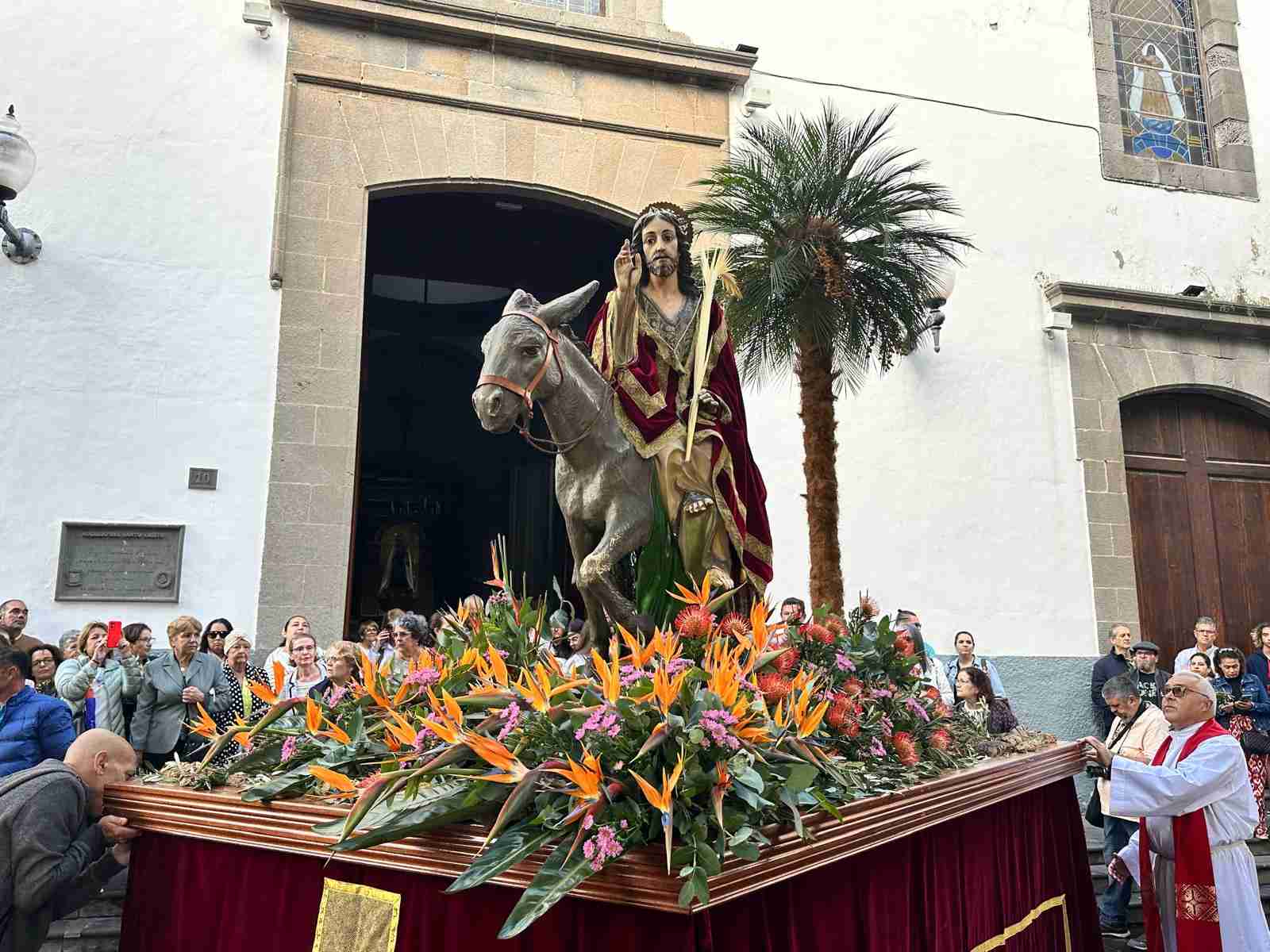
The processional tradition in Telde runs deep. Historical accounts collected locally recall that San Juan once had at least four major Holy Week processions, including La Burrita on Palm Sunday and the much-attended Soledad or Silencio procession. In San Gregorio, a 19th-century Auto Sacramental dramatized scenes such as the Last Supper, the Agony in the Garden, the Via Crucis and the Crucifixion. By the early 20th century, those live representations were gradually replaced by sculptural images carried through the streets, giving the celebrations an even stronger visual and devotional identity.

This long memory is one reason Telde’s Holy Week has special appeal today. In 2025, the city recovered the La Burrita procession after 40 years, reconnecting San Juan and San Gregorio through a shared route and a more unified celebration. That recovery gave added momentum to the city’s Holy Week and renewed interest in its historic public devotion.

The key procession to see in April 2026

For visitors planning a trip this April, the most significant date is Friday, 3 April 2026. According to the published programme for this year’s Holy Week in the Basílica de San Juan Bautista, the day begins with a youth Via Crucis from San Juan to San Francisco in the morning. But it is in the late afternoon and evening that the atmosphere intensifies.

That is when the Magna Procesión del Santo Entierro takes place, bringing together one of the most solemn and visually striking moments of Telde’s Holy Week. After the liturgies in San Gregorio and San Juan, the faithful converge on the Basílica de San Juan Bautista for the Holy Burial procession along its customary route. It is followed by the Procesión del Silencio, accompanying the Virgin Mary in a setting marked by candlelight, reverence and the quiet weight of tradition.

For anyone who wants to experience the city’s Holy Week at its most moving, this is the procession not to miss. It combines religious depth with the beauty of Telde’s old quarter, where the sound of footsteps, music and prayer acquires a different resonance among historic streets and church façades.

More than a religious event

Holy Thursday, on 2 April 2026, offers a more contemplative side of the celebration, with evening liturgies of the Lord’s Supper and the traditional Hora Santa in both San Juan and San Gregorio. Holy Week in Telde is also accompanied this year by the 18th Cycle of Sacred Concerts, one of the city’s established cultural features for the season.

That broader setting matters. Telde is not only a place of churches and processions. It is also one of Gran Canaria’s most historically important municipalities, with a strong urban identity, a rich local culture and easy access to the coast. Official tourism information highlights the appeal of combining heritage with beaches such as Melenara, Salinetas and La Garita, as well as the city’s gastronomy and traditional neighbourhood life.

In practical terms, the city is also preparing for a larger flow of people. Telde’s council has announced reinforced cleaning and municipal services during Holy Week, especially in the town centre and coastal areas. It is a small but telling sign that these celebrations are not only for residents, but also form part of the city’s public and cultural welcome.

Why come to Telde this Holy Week?

For travellers in Gran Canaria looking for something more rooted and atmospheric than a large-scale tourist spectacle, Telde offers a compelling alternative. Its Holy Week processions bring together faith, architecture, memory and local identity in a way that feels genuine rather than staged.

You can spend the day exploring the old quarters of San Juan and San Francisco, follow the processions as evening falls, and still end the night near the sea. That combination of devotion, history and island setting gives Telde a character all its own.

There may be more famous Holy Week destinations in Spain. But for those who want tradition at close range, in a city where the streets themselves seem to remember, Telde this April is well worth the visit.