David Trimble Marks Two Years chairing RFI
- By WRN Editorial Staff --
- 05 Mar 2026 --
From an interim appointment in 2024 to a presidency shaped by global FoRB crises and U.S. education battles.
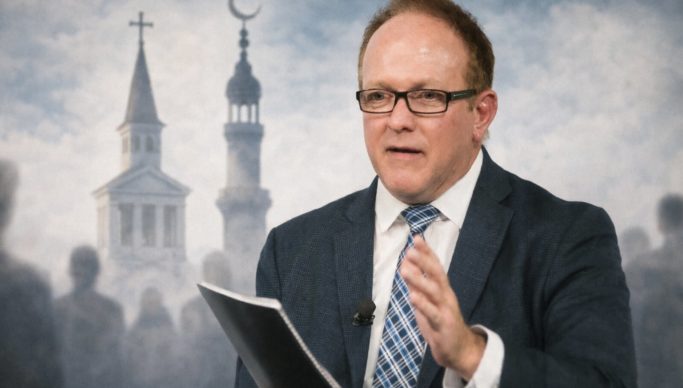
On March 5, 2024, the Religious Freedom Institute (RFI) announced that David K. Trimble would step in as interim president. Two years later—March 5, 2026—the Washington, D.C.-based nonprofit now presents Trimble as its president, underscoring a leadership transition that happened more by institutional practice than by headline. A growing body of documentation—such as USCIRF’s annual reporting—has kept FoRB violations on the policy agenda, even as governments and societies argue over where the line sits between security, equality, and conscience.
RFI’s mandate is broad—freedom of religion or belief (FoRB) for “everyone, everywhere”—and Trimble’s tenure has leaned into a two-track approach: expand education programs meant to form future leaders, while engaging in policy advocacy from Hong Kong to Nigeria and the U.S. Supreme Court docket.
From interim to established leadership
Trimble’s March 2024 appointment followed the departure of RFI’s previous president, Eric Patterson, who left to lead the Victims of Communism Memorial Foundation, according to RFI. At the time, Trimble was already vice president for public policy and education, and RFI highlighted a résumé that includes a Juris Doctorate from Texas A&M University School of Law and a Master of Divinity from Southwestern Baptist Theological Seminary.
While RFI’s announcement explicitly used the word “interim,” the institute’s current leadership materials describe Trimble simply as “President”—a signal that the organization settled into a longer-term arrangement even without a separate, prominent “permanent” press release.
Education as strategy: Pepperdine partnership and seminars
One visible marker of that settled leadership is RFI’s deepened partnership work with universities. In October 2024, Pepperdine University and RFI announced a formal partnership to advance religious freedom, noting the agreement was signed on September 9 by Trimble and Pepperdine’s Danny DeWalt.
The collaboration has played out through “Statesmanship and Religious Freedom” seminars. Pepperdine’s April 2025 recap of a Malibu-campus session described a three-day program built around discussions with scholars and meetings with public officials and civil society leaders—designed, the university said, to inspire “faith-driven action” while grappling with the real-world frictions of pluralism and law.
By mid-2025, the effort had turned international. Pepperdine’s newsroom report on the inaugural Swiss seminar at the Château d’Hauteville listed Trimble among session leaders, alongside figures drawn from diplomacy, academia, and human rights work.
Coalitions beyond Washington: Panama and the Article 18 network
Trimble has also appeared in wider FoRB coalitions that blend religious leaders, lawmakers, diplomats, and civil society groups. In September 2024, the fourth edition of the Faith and Freedom Summit at the Latin American and Caribbean Parliament (Parlatino) in Panama City drew international participants and featured a message from UN Special Rapporteur on FoRB Nazila Ghanea, according to Human Rights Without Frontiers. Media coverage around the summit listed Trimble among speakers, alongside voices such as USCIRF commissioner Maureen Ferguson.
Beyond events, Trimble’s name appears in the policy “infrastructure” of the FoRB world. The Article 18 Alliance lists him on its Council of Experts, alongside former UN Special Rapporteur Heiner Bielefeldt—placing him inside a network that frames religious freedom as a core human right grounded in international law.
Africa and the push to scale religious freedom advocacy
Africa has emerged as a major focus of RFI’s global work. In February 2025, Pepperdine, RFI, and the International Religious Freedom Summit jointly announced IRF Summit Africa, scheduled for June 16, 2025 in Nairobi. RFI later described the convening as a “defining moment,” quoting Trimble on the need for “a concerted effort” to confront “enormous threats to people of faith in Africa.”
Policy flashpoints: Hong Kong and Nigeria
Coalitions and seminars are only part of the portfolio. The other is advocacy tied to specific legal moments—especially when religious practice runs into security policy.
In March 2024, RFI published a statement on Hong Kong’s proposed “Article 23” domestic security law, linking to a joint letter coordinated by Hong Kong Watch. RFI warned that provisions could threaten religious freedom and, in particular, the confidentiality of the Catholic Sacrament of Penance (confession)—a concern framed as a test of whether religious rites can survive tightening national security regimes.
In February 2026, RFI urged swift passage of the Nigeria Religious Freedom and Accountability Act of 2026 (H.R. 7457), describing violence and repression affecting both Christians and Muslims and calling for stronger U.S. tools and oversight. The institute quoted Trimble arguing that “decisive action is needed now” to secure peace in Africa’s most populous country.
Domestic cultural debates: education, parental rights, and campuses
Trimble’s public profile has also grown through U.S. domestic debates where religion, education, and identity politics collide. In February 2025, RFI reported that Trimble spoke at the Religious Freedom in America Conference and focused on what he described as threats to religious freedom in education, including disputes over parental opt-out rights and religious charter schools. RFI’s account also says he addressed the post-October 7, 2023 surge of antisemitism on elite college campuses and argued for stronger coalitions across religious student groups.
In his own writing, Trimble has framed these issues as part of a longer argument about the place of conscience in public life. In Religious Freedom Day 2025, he warned the right would remain “highly contested” and pointed to parental rights and medical conscience rights as key battlegrounds. In Religious Freedom Day 2026, he returned to the theme of religious liberty as a foundational freedom grounded in human dignity.
What two years suggest
Two years is a short span for a Washington institute, but long enough to reveal a governing instinct. Under Trimble, RFI has treated religious freedom as both a global security issue and a domestic question of conscience—building student programs with partners like Pepperdine, while staking out positions on legislation and legal disputes.
As RFI enters its third year under the same leader, the central test is whether its twin bet—education plus advocacy—can translate into measurable protections for believers and non-believers alike, in a world where the right to worship, change one’s religion, or not believe at all is increasingly contested.