Bridges of Harmony: Interfaith Music in Sofia
- By WRN Editorial Staff --
- 27 Feb 2026 --
A Royal Palace concert for UN World Interfaith Harmony Week brought Orthodox chant, classical repertoire, and sacred poetry into one shared program.
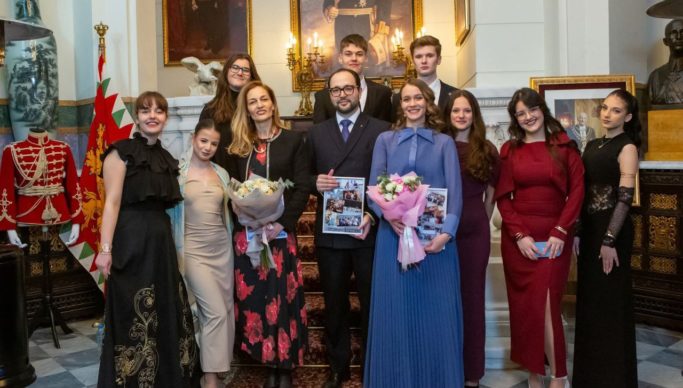
SOFIA, Bulgaria — On February 21, 2026, the concert “Bridges of Harmony” took place at the Royal Palace “Vrana,” where an interfaith-themed program blended music, poetry, and traditional dance linked to Orthodox Christian, Catholic, Jewish, Muslim, and Armenian traditions. The event was organized by BRIDGES – Eastern European Forum for Dialogue as part of the United Nations World Interfaith Harmony Week, a global observance that encourages initiatives aimed at dialogue and cooperation across religions and beliefs.
“Bridges of Harmony” was held in partnership with Palace “Vrana” and the Tsar Boris and Queen Goanna Foundation, with support from the Embassy of the Republic of Austria in Sofia. The most detailed public account of the evening was published by Angelina Vladikova in The European Times. Vladikova is also chair of BRIDGES, the association that organized the concert. Another prominent BRIDGES figure, Petar Gramatikoff, serves on the organization’s Board of Trustees and has long been active in interfaith initiatives and religious-freedom networks.
Guests, partners, and a palace setting
Organizers said the palace venue carried symbolic weight for an event centered on religious coexistence. In her remarks, Vladikova pointed to what she called the “deep symbolism” of holding the concert at a place where two functioning chapels—Orthodox and Catholic—coexist on the grounds. That framing matched the evening’s stated aim: to show harmony not only as a musical idea, but as a social metaphor in which distinct identities remain intact while contributing to a shared civic space.
Among the guests named in the published account were His Very Reverend Archimandrite of the Ecumenical Throne, Father Haralampi (Nichev), as well as diplomats including Turkey’s Ambassador Mehmet Sait Uyanık and China’s Ambassador Dai Qingli. Representatives of religious communities, ministries, public figures, and civil-society partners also attended.
His Royal Highness Prince Boris Saxe-Coburg-Gotha, described as both host and a member of the BRIDGES board, welcomed attendees and highlighted the partnership with the Tsar Boris and Queen Goanna Foundation, offering special thanks to Dr. Ivaylo Shalafov for his support, according to the report.
Youth at the center of the program
One of the concert’s defining features was the emphasis on young performers. The program included children and youth connected to the BRIDGES community, presented as participants shaping the event rather than simply appearing as a symbolic “next generation.” Even the evening’s hosting was shared between two young leaders: Silvia Trifonova and Ahmed Gorelski, described as representatives of the Orthodox and Muslim communities. After each performance, they thanked the participating communities for their partnership and support.
The official welcome began in the foyer, where harpist Aleksandrina Kushincharova played to set what organizers described as an atmosphere of solemnity and continuity. From there, the program moved into its opening sequence: Orthodox chants—“Our Father,” “Tebe Poem,” and “Rejoice, O Virgin Theotokos!”—performed by students of the Sofia Theological Seminary “St. John of Rila,” under the direction of Stoyan Malinov.
From Mozart to marimba, then into dance and poetry
The concert’s structure was deliberately plural, moving across styles and traditions without collapsing them into a single aesthetic. The classical repertoire featured prominently. A piano quartet from the National Music School “Lyubomir Pipkov”—Ralitsa Nedyalkova (violin), Nona Kuteva (viola), Luiza Stefanova (cello), and Tsvetelina Milanova (piano)—performed the first part of Mozart’s Piano Quartet in E-flat major, with organizers noting that 2026 marks a notable Mozart anniversary year.
The program then shifted to “Ave Maria” (attributed in the account to Giulio Caccini), performed by Yoanna Baruch from the Jewish community, accompanied by pianist Yana Stoyanova—both students at the National Music Academy “Pancho Vladigerov.”
A percussion duo—Agleya Kaneva and Alexander Vichev from the musical school “Dobrin Petkov”—followed with marimba works by Johann Sebastian Bach and Sergei Rachmaninoff, as well as a solo marimba arrangement of Rimsky-Korsakov’s “Flight of the Bumblebee.”
The second half began with Armenian dance. The Armenian Dance Group “YAN,” linked in the published account to the Armenian General Benevolent Union (AGBU) “Parekorzagan” in Plovdiv, performed traditional repertoire—an inclusion that broadened the concert beyond music into embodied cultural expression.
The Islamic spiritual tradition was represented through poetry associated with Mevlana Jalaluddin Rumi, recited by young participants from different religious communities—Adelina Cholakova, Ivayla Ivanova, Mehmed Halil, and Ahmed Gorelski—accompanied on piano by Boris Petkov. The program also included a solo piano performance by Petkov (“Bewitched, Bothered and Bewildered”), followed by Kaneva joining him to sing “Smile.”
The evening closed with “Mnogaya Leta,” performed again by the seminarians, restoring a liturgical soundscape to conclude a program built around shared presence and mutual recognition.
Interfaith harmony as a yearly civic ritual
BRIDGES framed the concert as more than a cultural showcase—describing it as a ceremonial act of encounter and dialogue, supported by institutional and diplomatic partnership. Several religious leaders who could not attend sent messages of support, the report said.
One message cited in the published account came from United Religions Initiative (URI) board chair Eric Roux, who praised the young performers for using their talents “in service of humanity.” BRIDGES has highlighted URI as a key part of its international interfaith connections, alongside participation in other dialogue networks.
The organization also placed “Bridges of Harmony” within an ongoing arc of public interfaith programming. BRIDGES’ 2024 concert “Gift of Love,” organized for the same UN week, received the First Prize of the World Interfaith Harmony Week awards, according to the official prize site. BRIDGES said it intends to apply again with “Bridges of Harmony,” continuing a model in which interfaith cooperation becomes a recurring public event rather than a one-off response to crisis.
After the formal program, guests and performers continued conversations informally, with the report noting partnerships with Restaurant “Komat” and Red Church as part of the evening’s extended hospitality.
In a European moment when religious difference is often discussed through politics, migration debates, or security concerns, the Sofia concert offered a different public language: an event where communities share a stage, keep their distinct voices, and still build something coherent together—one performance at a time.