Eileen Gu’s Quiet Turn Toward Buddhism in the Spotlight
- By WRN Editorial Staff --
- 26 Feb 2026 --

After global fame and Olympic pressure, the freestyle skiing star has spoken—briefly but pointedly—about faith, ego, and learning to tune out the noise.
When Gu Ailing—known internationally as Eileen Gu—drops into a halfpipe, the world tends to hold its breath. Cameras track every rotation. Commentators dissect every landing. Online, fans and critics argue over everything from technique to identity. Yet one of the most revealing glimpses into Gu’s interior life did not come during a medal ceremony or a press conference. It arrived in a short, almost offhand response during a social-media Q&A in May 2022, when she was asked how she deals with self-doubt.
Gu’s answer was not about sponsorships or grit clichés. It was about belief—and release.
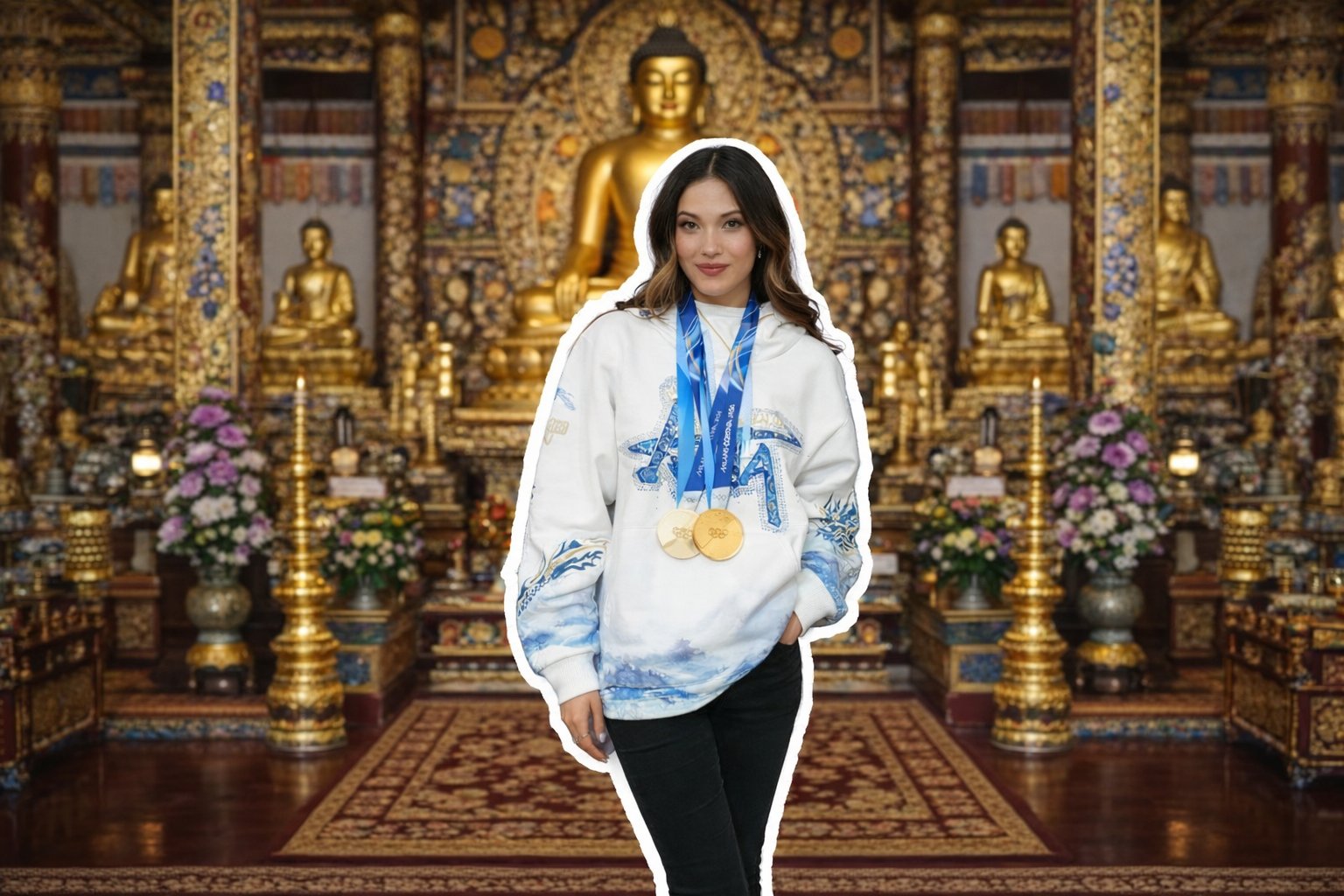
“I recently embraced Buddhism,” she wrote, adding that she was trying to “let go of the self” and step back from “outside opinion and reputation,” according to a report published by Malaysia’s Sin Chew Daily on May 13, 2022. In the same exchange, she encouraged the questioner not to live in fear of failure, but to focus on the work in front of them.
For a celebrity athlete whose life is routinely judged in public, the sentiment landed with unusual force: a young woman describing a spiritual practice not as a label, but as a discipline—an attempt to loosen the grip of ego and the endless need to satisfy strangers.
A sentence that echoed far beyond sport
Gu has never tried to present herself as a religious spokesperson. Her comment about Buddhism was brief, and she has not offered a detailed map of her personal practice in public. But that is part of what made it so striking. In a culture where athletes are often expected to give definitive answers—about politics, identity, meaning—Gu’s language was both candid and modest. She did not claim enlightenment. She described an effort: “working on” letting go.
The timing also mattered. Her statement came after the Beijing 2022 Winter Olympics, where she became a global phenomenon. But chronology is not causation: Gu’s comment does not prove why she embraced Buddhism, only that she publicly shared it in May 2022. What is clear is that the disclosure offered a rare piece of self-definition from someone more accustomed to being defined by others.
Pressure, grief, and the search for steadiness
That dynamic—public expectation versus private steadiness—followed Gu into the Milano Cortina 2026 Winter Games. In Livigno, she added to her résumé and to the relentless attention that comes with it. Reuters reported that she arrived at the halfpipe competition already holding two silver medals at these Games and then pushed through setbacks, including a fall in qualification, to reach the final (Reuters, Feb. 19, 2026).
Three days later, she made history. Reuters reported that Gu won gold in the women’s halfpipe, securing her sixth Olympic medal and becoming the most decorated Olympic freestyle skier in history—only to learn shortly after the victory that her grandmother had died (Reuters, Feb. 22, 2026).
It was a moment of raw contradiction: triumph intertwined with loss. Gu’s tears in that aftermath—widely covered across sports media—were a reminder that elite performance does not cancel human vulnerability. If anything, it heightens the need for tools that can hold both joy and pain at once.
Buddhism, as it is often understood in popular terms, is sometimes reduced to calm aesthetics: incense, silence, “good vibes.” But Gu’s 2022 remark points toward something more demanding: a practice of detachment from ego and from reputation. In the language of modern celebrity, that can sound almost radical.
“Evidence,” not slogans: a modern kind of spiritual posture
Gu’s public persona has long included an almost clinical approach to mindset—what she eats, how she trains, how she schedules, how she recovers. That practicality shows up even in interviews that are not explicitly about religion. In a January 2026 profile, TIME described her as wary of making sweeping claims without doing deep homework—an approach that reflects her careful, often analytical style when pressed on big questions beyond sport.
In other words, Gu’s spirituality—at least as she has signaled it publicly—does not appear to be about adopting a perfect identity. It looks more like adopting a method. A way to meet attention without becoming consumed by it. A way to be celebrated without being owned by the celebration.
That posture resonates with a generation raised under constant evaluation. Gu is a star, but also a young adult navigating the same ambient pressures many people feel: the sense that a single mistake can define you, that your image is always on trial, that you must be “something” legible to everyone else.
Refusing a single box—and what that has to do with faith
Gu’s life has been framed as a set of polarities: Chinese and American, athlete and model, student and celebrity. During Beijing 2022, an Associated Press analysis noted how the frenzy to “explain” her choices often revealed as much about other people’s assumptions as it did about Gu herself (AP, Feb. 15, 2022).
Gu has been consistent in rejecting the idea that she must choose one identity that cancels the rest. In one widely circulated interview from that period, she said people sometimes don’t know what to do with someone “when they’re not fitting in a box” (NBC16, Feb. 18, 2022).
Seen through that lens, her Buddhist statement reads less like a sudden twist and more like an extension of a long-running theme: refusing to let external narratives dominate the inner life. If the world insists on reducing her, Buddhism—at least as she described it—offers a vocabulary for refusing reduction. Not by fighting every opinion, but by loosening the need to be approved.
What her Buddhism is—and what it isn’t
It is tempting, in celebrity culture, to turn a single quote into a full spiritual biography. But the available public record does not support that. Gu has not outlined a formal affiliation, a specific tradition, or a detailed practice routine in mainstream reporting. Her May 2022 comments provide a clear data point—she said she had embraced Buddhism and described why its approach to ego and outside reputation mattered to her (Sin Chew Daily)—but they do not amount to a manifesto.
That restraint may be intentional. In many Buddhist cultures, quiet practice is valued over public proclamation. And in a media environment that monetizes every identity marker, keeping faith from becoming content can itself be a form of integrity.
Why her words matter now
At a time when mental health has become an unavoidable conversation in sports, Gu’s brief acknowledgment of Buddhism adds a different dimension to the discussion. It suggests that for some athletes, the tools they reach for are not only psychological but spiritual—frameworks that offer meaning, humility, and a way to live with uncertainty.
Gu’s fame makes her an unlikely gateway to these themes. Yet that may be exactly why the moment mattered: a young woman at the center of international attention pointing, however softly, toward the idea that attention is not the same as truth—and that the self is not something to inflate for the crowd.
In the end, what makes Gu’s religious comments compelling is not their grandiosity but their honesty. They read like something many people might wish to say, if they had the courage: that the opinions of strangers can become a cage, and that freedom may begin with learning—day by day—to let that cage fall away.