Vatican Deepens Its AI Warning
- By WRN Editorial Staff --
- 07 Mar 2026 --
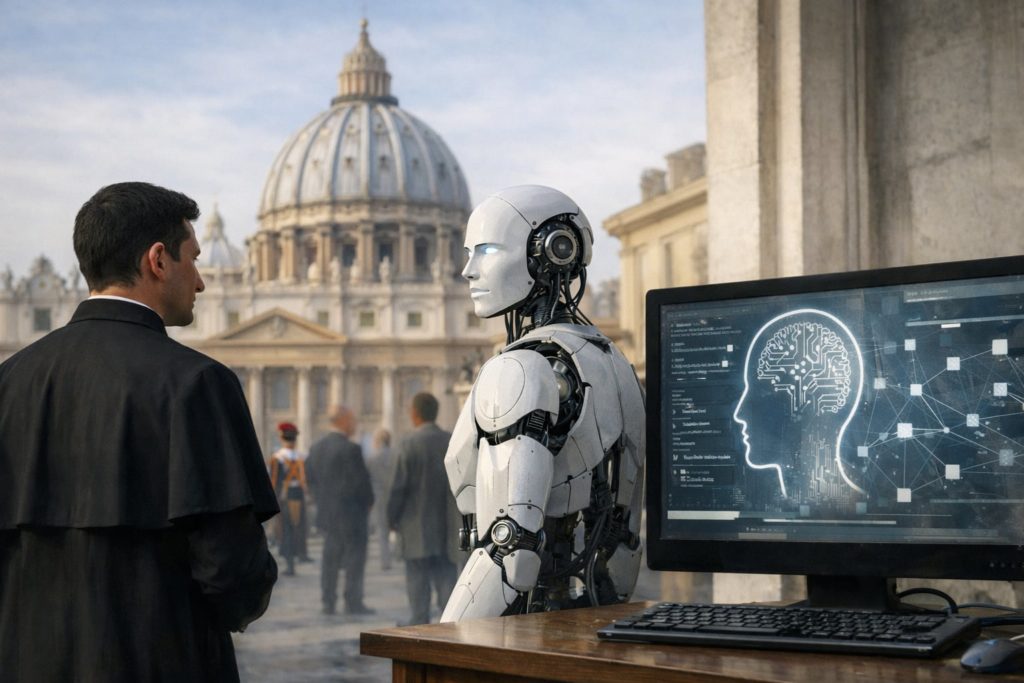
A new theological text argues that humanity’s future cannot be handed over to machines, even as religious communities increasingly experiment with artificial intelligence.
The Vatican has added a new layer to the global religion-and-technology debate with the release of “Quo vadis, humanitas?”, a major reflection from the International Theological Commission that confronts artificial intelligence, posthumanism, and the meaning of the human person. Published on March 4 and highlighted by Vatican News, the document argues that no technological advance can replace the relational, moral, and spiritual dimensions at the heart of human life.
:contentReference[oaicite:0]{index=0}
For World Religion News readers, the significance lies not only in the Catholic Church’s latest intervention, but in what it says about a broader moment. Artificial intelligence is no longer a distant policy topic. It is already entering classrooms, workplaces, political discourse, media systems, and increasingly religious life itself. As Reuters recently reported, faith communities around the world are experimenting with AI for everything from sermon preparation to spiritual chatbots and simulated religious conversations. The Vatican’s new text is therefore arriving at a moment when the question is no longer whether religion will engage AI, but how.
:contentReference[oaicite:1]{index=1}
A wider theological intervention
The new reflection does not read like a narrow technical memo. It is a broad theological and anthropological intervention, rooted in the Catholic tradition but aimed at the contemporary cultural moment. The document was prepared by the International Theological Commission, later authorized for publication after approval from Pope Leo XIV on February 9, according to the Holy See’s press office and the text itself. It takes the 60th anniversary of Gaudium et spes as a point of departure and asks an urgent question that increasingly echoes far beyond church circles: where is humanity going?
:contentReference[oaicite:2]{index=2}
Its answer is clear. Human flourishing, it argues, cannot be reduced to efficiency, computation, optimization, or technical enhancement. The human person is not simply a problem to be engineered or upgraded. Instead, the text presents humanity as embodied, relational, vulnerable, morally responsible, and open to transcendence. That framework is what allows the Vatican to challenge both transhumanist ambitions and the idea that digital systems can become substitutes for conscience, wisdom, or spiritual meaning.
:contentReference[oaicite:3]{index=3}
That point was underscored in outside Catholic coverage as well. National Catholic Reporter, citing the same Vatican release, noted the commission’s warning that a civilization ruled by machines risks turning technology into a counterfeit object of trust. The concern is not merely about gadgets or software. It is about what happens when human beings begin to hand over judgment, meaning, and even hope to systems that cannot love, repent, forgive, or assume responsibility.
:contentReference[oaicite:4]{index=4}
Not a rejection of technology
Importantly, the Vatican is not calling for a retreat from modern tools. In that sense, the new text is consistent with the Church’s recent line on AI. The Holy See’s 2025 note Antiqua et nova already argued that artificial intelligence should complement, not replace, human intelligence. Pope Leo XIV has continued that emphasis. In his 2026 message for World Communications Day, he urged people to preserve real human voices and faces in an age shaped by digital systems and machine mediation.
:contentReference[oaicite:5]{index=5}
That makes the latest document best understood as a sharpening of an existing Vatican position rather than a sudden change of course. The Church sees technological innovation as capable of serving education, communication, medicine, and even cultural preservation. But it also insists that technology must remain ordered to the human good and subject to moral discernment. Once efficiency becomes the highest value, the Church suggests, society begins to lose sight of the person.
:contentReference[oaicite:6]{index=6}
That tension is visible well beyond theology faculties. Concerns about surveillance, manipulation, misinformation, and social control have become part of mainstream debates about AI governance. Vatican coverage of the new reflection emphasized precisely those anxieties, warning that rapid technological development can intensify forms of domination while weakening responsibility and human encounter. The fear is not simply that machines may become more capable, but that people may become less human in the process.
:contentReference[oaicite:7]{index=7}
From doctrine to daily religious practice
The document also arrives as religious communities are already testing the pastoral and symbolic boundaries of AI. Some clergy use generative tools for drafting or research. Some believers experiment with chatbot-based spiritual guidance. Others see AI-generated devotional content, synthetic religious imagery, and algorithmically shaped preaching as signs of a new religious frontier. Reuters found that such experimentation is spreading across denominations and traditions, even where leaders remain cautious about authority, authenticity, and the risk of spiritual shortcuts.
:contentReference[oaicite:8]{index=8}
The Vatican’s answer to that emerging landscape is neither panic nor enthusiasm. It is discernment. The new text suggests that religion’s task in the AI age is not only to react to new tools, but to defend a deeper vision of what a person is. That includes embodiment, memory, relationship, moral freedom, and an orientation toward others that no machine can replicate. In practice, that may encourage Catholic institutions to become more selective about where they adopt AI and more vocal about the lines they do not want crossed.
:contentReference[oaicite:9]{index=9}
Why this matters beyond Catholicism
Although the document is explicitly Catholic, its implications are broader. Many religious traditions are wrestling with similar questions: can a machine mediate wisdom, or only information? Can automated systems assist religious life without distorting it? What happens when spiritual authority becomes entangled with software built by corporations whose priorities are speed, scale, and market power rather than truth or human dignity? Those are not internal church questions anymore. They are becoming public questions for schools, governments, media, and faith communities alike.
:contentReference[oaicite:10]{index=10}
That is why this Vatican intervention matters now. At a time when AI is often discussed in terms of productivity, competition, and innovation, the Church is trying to pull the debate back toward anthropology and ethics. It is asking whether technological progress that weakens responsibility, dilutes relationships, or tempts people to outsource judgment can really be called progress at all.
:contentReference[oaicite:11]{index=11}
For believers and non-believers alike, that may be the most important element of the message. The Vatican is not claiming that machines are evil, nor that the future must be feared. It is saying that the future remains a moral question before it is a technical one. And in an age increasingly fascinated by artificial intelligence, that may prove to be one of religion’s most enduring contributions to the public conversation.
:contentReference[oaicite:12]{index=12}
::contentReference[oaicite:13]{index=13}