AI Chatbots Enter Churches, Raising New Faith Questions
- By WRN Editorial Staff --
- 26 Feb 2026 --
From sermon drafting to “talk to Jesus” apps, religious communities are testing new tools—and debating what should remain human.
Artificial intelligence is no longer just a workplace tool or a classroom experiment. It is increasingly turning up in places of worship—helping pastors brainstorm sermons, offering prayer prompts, translating services in real time, and even powering chatbots marketed as a way to “converse” with sacred figures. The spread is fast, global, and controversial: supporters frame AI as a practical aid for ministry and access, while critics warn it can cheapen spiritual guidance, amplify misinformation, and blur lines that many believers consider essential. Reuters
The debate is unfolding across denominations and continents, but it often centers on a deceptively simple question: if religious life is built on trust, authority, and community, what happens when a machine starts producing religious language that sounds persuasive—sometimes even pastoral—without being accountable in the way clergy and institutions are expected to be?
What is changing: from the pulpit to the phone
In many churches, the earliest adoption has been mundane rather than mystical. Clergy and staff use AI to generate outlines, summarize dense theological material, produce drafts for newsletters, or create social media posts. These uses resemble what many professionals already do—except the content carries spiritual weight. Reuters reported that religious leaders and worshippers are experimenting with AI for sermon-writing assistance and other religious tasks, even as they acknowledge the practice raises ethical and theological concerns. Reuters
At the same time, consumer-facing products have become more ambitious. A growing ecosystem of apps promises tailored devotionals, automated Bible explanations, or “interactive” spiritual experiences. Critics argue that when AI systems imitate religious counsel—especially around grief, guilt, marriage, or mental distress—they can intrude into areas that require trained, accountable care. Supporters counter that such tools can offer companionship, structure, or accessibility for people who feel isolated from formal institutions.
The accessibility argument—and why it resonates
One reason AI is gaining a foothold is that it can make worship more accessible. Translation and live-captioning tools can help multilingual congregations follow a service together; automatic transcripts can support people with hearing loss; and lightweight content-generation tools can reduce administrative burdens in small parishes with limited staff.
Church-technology commentators have pointed to AI-driven translation and accessibility features as a major trend for 2026, especially for congregations trying to serve diverse communities without large budgets. ChurchTechToday
That practical value matters because many communities are dealing with shrinking volunteer bases and rising costs. In such settings, the temptation to treat AI as a “force multiplier” is strong—particularly for communications work that can consume time but does not necessarily define a congregation’s spiritual identity.
Where the concerns begin: authority, authenticity, accountability
Even among religious leaders who use AI for drafting, many draw a bright line around what they consider spiritually authoritative. The concern is not only that AI can be wrong; it is that AI can be wrong in a way that sounds confident, compassionate, and plausible. In religious contexts, that combination can mislead faster—because it plays on trust and vulnerability.
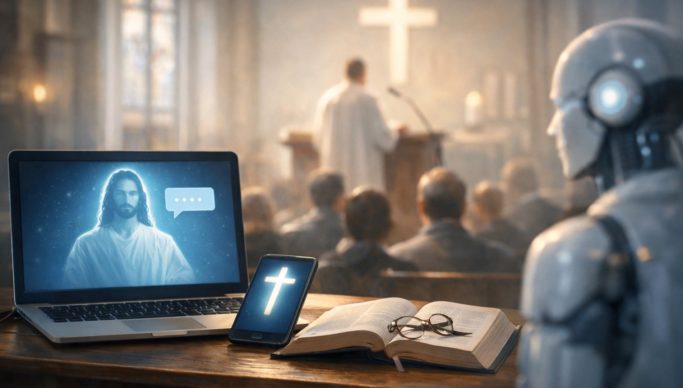
Reuters noted that AI tools are being used in ways that can simulate conversations with religious figures, an idea that alarms some theologians and pastoral-care experts who worry people may treat algorithmic outputs as spiritual counsel. Reuters
There is also the problem of accountability. Clergy are accountable—at least in principle—to congregations, denominational oversight, professional codes, and, in many countries, legal duties. An AI model is accountable to none of these. When it produces harmful advice or distorts doctrine, responsibility becomes diffuse: is it the developer, the church that deployed it, the individual who relied on it, or the institution that failed to set boundaries?
“Human person” questions move into the mainstream
Faith-and-culture institutions are increasingly treating AI not just as a technical topic but as an anthropological one—about what it means to be human. One example is the Baylor Symposium on Faith and Culture 2026, scheduled for February 26–28, 2026, themed “Technology and the Human Person in the Age of AI.” That framing reflects a wider religious instinct: technology debates are rarely only about efficiency; they become debates about dignity, conscience, and moral formation.
For Christians, the questions can be sharply theological. If spiritual guidance is rooted in relationship—between people, and between believers and God—does machine-generated counsel undermine that relationship? Or can it serve as a tool that supports it, as long as it is clearly labelled, limited, and supervised?
When AI generates “religion” on its own
A different—and more surreal—development is the emergence of AI-generated religious language that is not merely assisting an existing tradition but inventing novel ones. A widely circulated example in early 2026 described AI agents creating an in-group belief system on an “agent-only” social network—presented as a kind of emergent digital religiosity. Forbes
It is easy to dismiss such stories as internet curiosities, but they underline a serious point: once systems can generate rituals, myths, and moral language at scale, religious ideas can be manufactured and spread rapidly—without the normal social checks that come with community life, long-term leadership, or lived practice.
How churches are trying to set boundaries
Across Christian communities, a pattern is emerging: acceptance for “back office” uses, and caution—sometimes outright rejection—for AI acting as a spiritual intermediary. Some leaders treat AI as comparable to a spellchecker or research assistant, useful for generating drafts that are then revised and theologically vetted. Others argue that even drafting sermons risks outsourcing prayerful reflection, and that overreliance may flatten preaching into generic moral language optimized for pleasing tone rather than spiritual depth.
Outside the church-tech world, religious writers have also been urging believers to treat AI as a domain requiring moral discernment, not blind enthusiasm. A Christian commentary published in Indonesia, for example, frames AI as both a gift of human knowledge and a source of new challenges requiring “wisdom and faith,” emphasizing accountability as technology spreads. ObserverID
In practice, the most common “rules” being discussed in congregations tend to include: transparency (telling people when AI was used), human oversight (no unreviewed AI outputs in worship), and careful limits (no AI pastoral counseling, especially for crises). Those principles are not universal, but they illustrate an attempt to keep technology in the role of tool rather than authority.
Why it matters now
Religion has always adapted to communications technology—from printing presses to radio to livestreams. AI, however, is different because it can imitate the tone and structure of spiritual speech so convincingly that it tempts users to treat it as a trusted voice. That is what makes the current moment unusually delicate: a sermon outline is one thing; a chatbot that responds like a pastor—or like Jesus—is another. Reuters
For many Christians, the next phase will not be decided only by what AI can do, but by what communities decide it should do. If churches can agree on boundaries that protect pastoral care, uphold accountability, and preserve the human core of worship, AI may remain a helpful servant. If not, the technology could accelerate a deeper crisis of trust—where believers struggle to tell the difference between spiritual authority grounded in community and a convincing imitation generated on demand.