An Atheist Writer Followed Pope Franics to Mongolia
- By WRN Editorial Staff --
- 24 Feb 2026 --
Javier Cercas’ European Book Prize-winning work turns a Vatican trip into a searching conversation about faith, death, and what Europe still expects from religion.
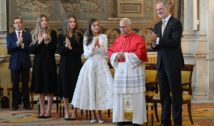
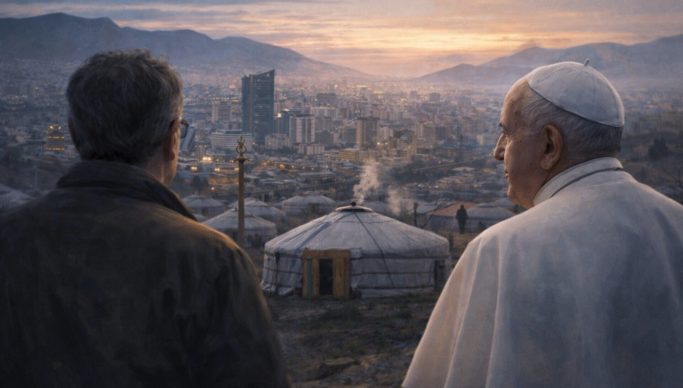
When Spanish novelist Javier Cercas accepted an invitation from the Vatican to travel with Pope Francis, he did so as a self-described atheist with little interest in devotional certainties. The result—El loco de Dios en el fin del mundo (released internationally under variations of the title “God’s Madman at the End of the World”)—has now become one of Europe’s most talked-about religion-and-literature crossovers, winning the European Book Prize (Jacques Delors) and prompting renewed debate about the Catholic Church’s place in a rapidly secularising continent.
In interviews following the award, Cercas has described the book as neither a conversion story nor an attack. Instead, it is a literary investigation—part travel narrative, part portrait of Pope Francis, part philosophical inquiry—shaped around a starkly human question he wanted to put directly to the pontiff: whether his mother might see his father again after death. That detail, reported in Spanish media coverage of the prize, gives the project its emotional engine: not “Is God real?” in the abstract, but “What do we do with grief, love, and longing when certainty is unavailable?” (Cadena SER’s report on the award and the book’s premise).
A Vatican invitation—and a writer’s conditions
According to accounts published around the prize announcement, the Vatican’s invitation offered Cercas unusual access: to accompany Pope Francis on a journey to Mongolia, with freedom to observe and write. For a writer known for blending reportage-like detail with literary framing, the setup was irresistible—yet risky. He was entering a world saturated with internal language, ritual choreography, and spiritual assumptions that many contemporary European readers no longer share. The tension becomes the point: what happens when a sceptical narrator walks inside the Church’s moving machinery and tries to describe it without either reverence or sneer?
That approach aligns with Cercas’ long-standing interest in how societies construct truth—especially when memory, ideology, and myth compete. It is also why the book has been discussed as timely beyond Catholic circles. In a February interview with Euronews, Cercas connects his Vatican experience to wider European anxieties: misinformation, polarisation, and the struggle to speak about meaning without collapsing into propaganda. Religion, in that reading, is not just a private matter—it is a public language that millions still understand, even if many no longer practice.
Mongolia is not a conventional stage for a European debate about Catholicism. That is precisely why it works as a narrative device. A papal trip to a small Catholic community on the edges of global Catholic geography highlights what Francis’ papacy has often emphasised: the Church’s “peripheries,” where institutional power is thinner and presence is more relational. For a European writer, the journey becomes a mirror—forcing questions about whether Europe’s religious inheritance is a living tradition, a cultural memory, or simply a political shorthand used in identity battles.
In media descriptions of the book, the travel structure allows Cercas to move between the intimate and the geopolitical: the logistics of a papal entourage; conversations about belief and disbelief; and the Church’s global ambitions in a century where Christianity is growing fastest outside Europe. The book’s focus on mortality and eternal life—flagged in Euronews’ coverage—keeps the narrative anchored in themes that do not require religious commitment to recognise as real: fear of loss, hope for reunion, and the human tendency to build stories around endings (Euronews interview).
The European Book Prize
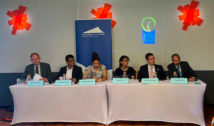
The European Book Prize (often referred to with the Jacques Delors name) was created to highlight books that illuminate European realities—its values, tensions, and political imagination. In announcing Cercas as laureate, Spanish outlets noted that the award ceremony took place at the European Parliament in Brussels and included a jury chaired by writer Andrei Kurkov, underlining the prize’s explicitly European framing (El País report). The Parliament’s own multimedia coverage describes the book as reflecting on faith and mortality—an unusually direct pairing for an EU-branded cultural prize (European Parliament multimedia page).
That setting matters. In an era when religion is often discussed through the narrow lenses of identity politics, migration, or extremism, a major European prize honouring a book about a pope—and doing so in the heart of EU institutions—signals something else: that religion remains part of Europe’s intellectual conversation, not only its conflicts. It also suggests a hunger for narratives that can treat belief as a serious subject without turning it into a culture-war slogan.
Faith without easy answers
One reason the book has drawn attention across belief lines is its refusal to settle into a predictable arc. Cercas is neither writing a devotional testimony nor constructing a takedown. Instead, he uses the encounter to test the vocabulary of faith against modern doubts—especially the doubt that there is any shared vocabulary left. What, after all, does “eternal life” mean to someone who does not claim to believe in it? And what does it mean to a pope addressing a Europe that increasingly lives as if the afterlife were irrelevant?
In that way, the book fits a growing genre of “religion as lived experience” writing—works that approach churches, rituals, and theological claims as cultural systems that still shape people’s moral imagination. The twist here is the narrator’s position: the outsider who is close enough to see the machinery, but distant enough to describe it in a language accessible to secular readers.
For Catholic readers, the appeal may lie in a portrait of Pope Francis and the Church’s contemporary dilemmas: credibility after abuse scandals, internal doctrinal tensions, and questions about how to speak to younger generations. For non-religious readers, the appeal may be more anthropological and existential: how a massive institution narrates death, hope, and meaning—and why those narratives persist even when belief declines.
And for Europe as a whole, the book arrives at a moment when questions once thought settled have returned. Debates about secularism, education, identity, and migration often carry religious undertones, even when they avoid religious language. Cercas’ project suggests that pushing religion out of public discussion does not make it disappear—it simply makes societies less able to talk honestly about the values and fears that religion has long addressed.
In the end, the most provocative thing about a sceptical writer traveling with a pope may not be what it says about Catholicism. It may be what it says about Europe: that even in an age of disaffiliation, many still want to ask old questions in new forms—and still look, sometimes unwillingly, toward religious traditions for words that might hold.