Allies, Not Bedfellows: The Global Imperative of Political-Religious Boundaries
- By WRN Editorial Staff --
- 13 Feb 2026 --
In the shadow of the Vatican’s diplomatic corridors, where the dome of St. Peter’s Basilica dominates the Roman skyline, a curious ritual unfolds each week. The Holy See’s Secretary for Relations with States meets with ambassadors from secular nations not to dictate policy, but to negotiate the space where moral conviction meets legislative necessity. It is a choreography centuries in the making: two powerful forces acknowledging each other’s existence, occasionally joining hands for common causes, yet meticulously preserving the invisible line that separates the City of God from the City of Man.
This delicate balance—what theologians increasingly call “cooperative autonomy“—has never been more critical. From the pulpits of Lagos to the parliaments of Jakarta, societies grapple with a fundamental question: How can religious institutions and political structures collaborate for the common good without either becoming the instrument of the other? The answer, illustrated across continents, suggests that the health of civilizations depends not on the divorce of faith and power, but on their disciplined refusal to sleep in the same bed.
The Architecture of Separation: Historical Foundations
The Peace of Westphalia in 1648 established the modern nation-state partly by removing religious warfare from the political toolkit, yet it did not exile religion from public life. Instead, it recognized that when theological authority and temporal power merge, both become corrupted—the former losing its transcendent critique, the latter gaining an unaccountable divine mandate.
Contemporary Indonesia offers a compelling case study in navigating this tension. With the world’s largest Muslim population alongside significant Christian, Hindu, Buddhist, and Confucian minorities, the archipelago operates under Pancasila, a state philosophy that mandates belief in one God while forbidding the establishment of any specific religious law as state policy. Religious leaders serve on the Indonesian Ulema Council (MUI) and similar bodies, advising the government on ethical matters ranging from economic development to environmental stewardship.
Yet when politicians attempted to use religious identity as a bludgeon in recent Jakarta gubernatorial elections, the constitutional courts intervened, reaffirming that while faith informs citizenship, it cannot be weaponized for partisan control. The system is imperfect—religious minorities still face discrimination—but it demonstrates a workable model where spiritual guidance exists as counsel, not command.
African Models: Mediation Without Dominion
In Africa, where colonial borders often forced together hostile faith communities, the distinction between political leadership and religious authority has become a matter of survival. Nigeria, perennially strained by tensions between its Muslim north and Christian south, has developed sophisticated mechanisms for maintaining this boundary through the Nigerian Inter-Religious Council (NIREC).
Comprising leading Christian and Muslim clerics alongside government representatives, NIREC does not govern; rather, it mediates. When ethno-religious violence erupted in Plateau State in recent years, it was religious leaders—operating independently of political parties—who brokered ceasefires and established community truth-telling forums. Their credibility derived precisely from their refusal to serve as rubber stamps for political elites.
Conversely, when Nigerian politicians have ignored this boundary—such as former President Buhari’s controversial statement that he would favor northern Muslims in appointments—the resulting erosion of trust nearly fractured the republic. The lesson resonates across the continent: Ghana’s National Peace Council, Kenya’s Interfaith Council, and South Africa’s Truth and Reconciliation Commission all succeeded because religious leaders maintained prophetic distance from state power, speaking truth to presidents without seeking portfolios in their cabinets.
European Solutions: Cooperative Separation
Germany presents a unique “cooperative separation” wherein religious communities register as public corporations, collecting taxes on behalf of the state while maintaining independence from political parties. This arrangement has produced the German Ethics Council, which advises parliament on bioethics, stem cell research, and artificial intelligence.
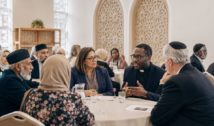
The Council includes bishops, rabbis, and imams serving alongside philosophers and scientists. They debate, influence, but do not decide. When Germany legalized same-sex marriage in 2017, religious leaders vocally opposed the measure from their advisory positions, but no church claimed the authority to veto the Bundestag. The system preserves religious voice without granting religious veto—a distinction lost in France’s aggressive laïcité, which often forces faith underground, and in Poland’s current entanglements, where the Catholic Church’s political alignment has sparked a backlash threatening religious liberty itself.
The United Kingdom offers perhaps the most paradoxical arrangement: an established church whose bishops sit in the House of Lords by constitutional right, yet wield influence through moral suasion rather than legislative muscle. When the Lords Spiritual speak—whether opposing welfare cuts or environmental degradation—their interventions carry weight precisely because they cannot be dismissed as partisan maneuvering.
During the 2020 pandemic, while the government crafted lockdown policies, the Church of England’s leadership maintained independence, at times challenging the closure of churches as an overreach of state power. The confrontation was not a constitutional crisis but a constitutional conversation, demonstrating how established religion can function as a check rather than a cheerleader for the regime.
The American Experiment: Prophetic Distance
Across the Atlantic, the American experiment continues to evolve in its understanding of these boundaries. The First Amendment’s Establishment Clause was designed not to sanitize politics of religious influence, but to prevent the “corruption of both” that James Madison warned against.
The Civil Rights Movement of the 1960s remains the gold standard for this relationship: Martin Luther King Jr. operated as a religious leader mobilizing moral conviction to transform law, yet he never sought to establish a theocracy. The churches provided the organizing infrastructure and ethical framework; the political system provided the legislative mechanisms. When King marched from Selma to Montgomery, he demanded that America live up to its constitutional promises, not that it adopt his theology as state doctrine.
Contrast this with the recent rise of “Christian nationalism” in some American circles, where the blurring of ecclesiastical and electoral boundaries has alarmed even conservative theologians who recognize that when the church becomes a political action committee, it loses its capacity to speak to those outside its fold.
Middle Eastern Innovation: Accommodative Secularism
In the Middle East, where the fusion of religion and state has often seemed inevitable, the United Arab Emirates presents a counter-narrative. The creation of the Ministry of Tolerance in 2016 and the subsequent Abraham Accords signaled a state strategy that promotes religious values—specifically coexistence and interfaith dialogue—without enforcing theological uniformity.
Religious leaders advise on social policy while the state maintains a civic framework neutral between faiths. This “accommodative secularism” differs sharply from Iran’s model, where the Guardian Council of clerics wields veto power over legislation, demonstrating the practical difference between religion advising power and religion wielding power.
The Dangers of Fusion: Lessons from Myanmar and Afghanistan
The dangers of these boundaries dissolving are visible worldwide. When political leaders capture religious authority, as in Myanmar where Buddhist nationalism has been weaponized against the Rohingya, faith loses its redemptive capacity and becomes ethnic cleansing’s justification. The close alignment between the military and Buddhist nationalist movements against the Rohingya minority demonstrates how the instrumentalization of sacred authority enables genocide.
Conversely, when religious institutions capture state power, as seen in the Taliban’s Afghanistan, the result is not moral renewal but totalitarian control dressed in theological language. Both scenarios illustrate why politics and religion must remain distinct even while maintaining respectful dialogue.
The Path Forward: Institutional Humility
The path forward requires what we might term “institutional humility.” Political leaders must resist the temptation to don clerical vestments for electoral advantage, recognizing that when they instrumentalize the sacred, they ultimately diminish it. Religious leaders, for their part, must resist the siren call of direct governance, understanding that the moment they grasp the levers of state coercion, they cease to be prophets and become politicians.
In an era of rising authoritarianism and identity-based polarization, the maintenance of this boundary is not a matter of secular hostility toward faith, nor of religious retreat from public life. Rather, it is the condition for their mutual flourishing. The church, mosque, synagogue, and temple must remain free to challenge the state when it violates human dignity; the state must remain free to protect pluralism when religious communities disagree.
They must work together, as allies against poverty, injustice, and despair—but they must not go to bed together, lest they wake up to find that neither recognizes itself in the morning. As the global community confronts climate catastrophe, refugee crises, and technological disruption, the world needs the moral imagination of religion and the organizational capacity of politics. It needs them distinct, dignified, and dialoguing.
The sacred and the civic are not enemies, but they are not spouses either. They are neighbors, separated by a fence that allows for conversation over the garden wall, but preserves the integrity of both houses. In that respectful distance lies the hope for a just world.