South Asian Lutheran churches meet in Kathmandu to strengthen shared identity within global communion
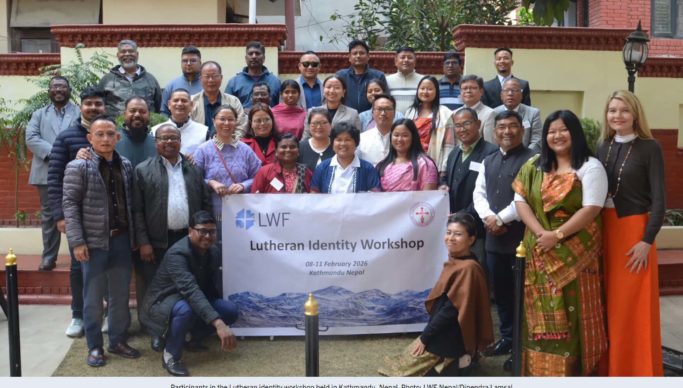
Church leaders from Nepal and India gathered in Kathmandu this month for a regional workshop hosted by the Nepal Evangelical Lutheran Church and convened by the Lutheran World Federation (LWF). The February 7–11 seminar focused on Lutheran theological foundations and what “communion” means in practice for churches that differ widely in language, worship traditions, and social context.
The meeting brought together 45 participants from the Nepalese host church and two Indian member churches that joined the LWF in 2025: the Bodo Evangelical Lutheran Church and the Manipur Evangelical Lutheran Church. Organizers framed the event as part of a wider effort to help newer and smaller churches feel connected to a global Lutheran family—an emphasis that has become more visible as the LWF expands in parts of Asia and Africa while many churches in Europe and North America face different demographic pressures.
“Walking alongside” newer member churches
In the LWF’s account of the workshop, the theme of accompaniment was central: the federation described its role as “walking alongside” member churches so they can deepen their Lutheran identity and strengthen bonds of mutual recognition across the communion. The Kathmandu gathering was also presented as an example of internal cooperation among LWF departments, linking theological formation with questions of leadership, mission, and community service.
For participants, the focus on identity was not only theological, but practical. South Asian Lutheran communities often operate as small minorities within religiously diverse societies, where Christian denominations are shaped by local cultures, regional histories, and varying relationships with state institutions. In that setting, leaders said, clarifying what unites them can be a way to build resilience as well as coherence.
Theology, freedom, and public witness
Speakers at the workshop included faculty and church leaders involved in Lutheran education and ecumenical coordination. The LWF report highlights contributions from Rev. Dr Songram Basumatary, principal of Gurukul Lutheran Theological College and Research Institute in Chennai, who emphasized Lutheran unity in “common confession,” and from Rev. Dr Joshuva Peter, executive secretary of the United Evangelical Lutheran Churches in India, who connected Lutheran teaching to a call to serve others.
Participants discussed classic Lutheran themes—grace, faith, freedom, and service—and how those ideas translate into daily church life. In the LWF’s telling, these themes were also positioned as a counterweight to discrimination and exclusion present in many societies, suggesting a link between confessional identity and public ethics. The workshop explored how shared beliefs can be expressed through diverse forms of worship and spirituality, rather than requiring uniform cultural expressions.
From regional diversity to a shared framework
One of the workshop’s recurring questions was how churches can remain recognizably Lutheran while also being deeply rooted in their own cultures. South Asia’s Lutheran communities span multiple linguistic and ethnic contexts, with different musical traditions, leadership styles, and patterns of community engagement. Participants reflected on this diversity not as a threat to unity, but as a reality that requires intentional communication and common learning.
The LWF emphasized that identity formation is not a one-time event but an ongoing process, particularly for churches that are still developing seminaries, catechetical programs, and leadership training pipelines. That challenge, leaders noted, is often intensified by geographic distance between congregations and the practical constraints of ministry in rural or economically pressured communities.
Grassroots formation and the “Small Catechism”
For the Bodo Evangelical Lutheran Church, described by LWF as among the newest members of the communion, the workshop appears to have sparked a concrete plan for grassroots teaching. Bishop Isahak Mosahari told participants he hoped to bring Lutheran identity teaching to every level of church life—from households to pastors to congregations—using the Small Catechism as a key resource for home and parish formation.
The interest in household-level religious education reflects a wider trend in many Christian communities where institutional structures are limited: building shared language and practices can begin in families and small groups. In that sense, the workshop’s emphasis on identity was paired with a strategy for continuity—ensuring that Lutheran teaching is not confined to leadership circles but becomes part of everyday discipleship.
A new annual “membership day” and a call to action
Among the initiatives emerging from the meeting was a commitment by the Bodo church to mark June 16 each year as an LWF “Membership Day,” dedicating time for prayer and celebration of its connection to Lutheran communities worldwide. The move suggests a desire to make global belonging visible at the congregational level, especially in contexts where local Christians may feel isolated or overshadowed by larger religious majorities.
Leaders from Nepal also framed the workshop as a prompt for tangible change. Rev. Shusila Murmu of the Nepal Evangelical Lutheran Church urged participants to carry what they learned into lived practice, emphasizing relationships, service, and a form of unity expressed in action rather than slogans.
Why it matters
While the Kathmandu workshop was a specialized seminar on Lutheran identity, it also illustrates a broader dynamic in global Christianity: how relatively small or newer churches connect to international networks for theological formation, leadership development, and mutual support. For the LWF, which describes itself as a global communion, the question is not only how to maintain formal membership structures, but how to cultivate real bonds of recognition across widely different contexts.
For churches in South Asia, the stakes can be immediate. Identity formation is linked to leadership credibility, community service, and the ability to articulate faith in plural societies. As the LWF and its member churches invest in regional training, workshops like the one in Kathmandu signal an approach that treats unity as something built through shared learning—walking together, as participants repeatedly put it, rather than simply belonging on paper.