New Global Report Warns Blasphemy Laws Still Shape Freedom of Belief in Dozens of Countries
- By WRN Editorial Staff --
- 16 Feb 2026 --
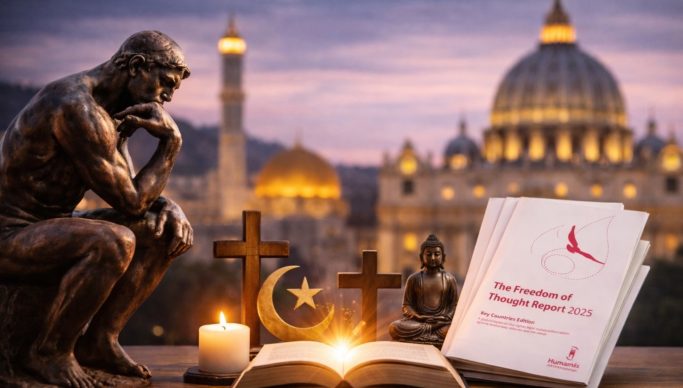
Humanists International’s latest Freedom of Thought Report (Key Countries Edition) warns that laws restricting “blasphemy” and religious criticism remain widespread, with far-reaching consequences for atheists, humanists, and others who challenge dominant religious norms. While the report focuses on discrimination against the non-religious, it argues that the same legal tools often end up harming religious minorities, reformers, and dissenters as well.
The 2024 edition frames the issue as a widening global pressure point where states—sometimes citing “religious harmony” or public order—criminalize forms of expression tied to belief and identity. In the report’s preface, Humanists International President Andrew Copson writes that the “chilling of thought and silencing of expression” through blasphemy laws is among the most pressing challenges to fundamental freedoms today.
How common are blasphemy laws?
According to Humanists International, its research indicates that blasphemy laws exist in at least 89 countries worldwide. In a launch statement accompanying the report, the organization said these laws affect more than half of the world’s population and, regardless of enforcement intensity, tend to produce the same practical outcome: the suppression of open debate, criticism, and dissent. The group has argued publicly that, beyond courtrooms, the very existence of such laws can legitimize harassment and vigilante violence by signaling that religious “offence” is a punishable act.
Humanists International also links its findings to what it describes as a consistent pattern in protection cases. The organization says many people seeking help through its “Humanists at Risk” work cite blasphemy allegations as a key driver of fear, self-censorship, and vulnerability—especially in settings where accusations can trigger threats, ostracism, or violence long before any judicial process begins.
Why this edition focuses on “key countries”
The PDF version is not designed to replicate the entire online report. Humanists International maintains the full country-by-country resource as a live online database, updating a portion of entries each year. The “Key Countries Edition” is a curated selection intended for easier reading and printing, with a limited number of country chapters chosen to illustrate major trends.
In this edition, 10 countries are highlighted—ranging from states with harsh criminal penalties for alleged blasphemy or apostasy to democracies where “religion offence” survives in narrower, sometimes administrative, form. Taken together, the chapters argue that the central question is not only what is written in criminal codes, but how law, identity systems, and social pressure can combine to make belief and nonbelief unsafe.
Afghanistan and Nigeria: where allegations can become life-threatening
In Afghanistan, the report portrays a severe environment in which non-religious identity is often forced underground. It describes conditions where apostasy and blasphemy frameworks—alongside pervasive fear of denunciation—leave little room for open disbelief or criticism of religious authority. The chapter emphasizes that legal structures and social enforcement frequently work together, making concealment a survival strategy for many.
In Nigeria, the report points to blasphemy provisions in the broader legal landscape and the added complexity of states operating Sharia courts. It also highlights the volatile social dimension: in some cases, allegations can trigger threats or mob violence before any legal process has time to unfold. For the report’s authors, Nigeria illustrates how punishment can be both formal (through courts) and informal (through community enforcement), producing widespread self-censorship.
Qatar, Iraq and Eritrea: when the state decides which beliefs are “legible”
In Qatar, the report focuses on the narrow space for openly non-religious identity and advocacy within a legal order where religious dissent can attract serious penalties in law. It also draws attention to constraints on independent civil society, arguing that limited civic space reduces the ability of non-religious communities—and other minorities—to organize safely or challenge restrictive norms.
In Iraq, the report highlights how administrative systems can shape freedom of belief, including the role of registration and identification processes that continue to treat religious affiliation as a state-managed category. And in Eritrea, it describes a recognition regime in which only a limited number of religions are permitted and other beliefs are effectively pushed outside legal protection—conditions that can make nonbelief not only stigmatized but practically unrecognizable in public life.
Europe’s quieter cases: privilege, “religion offence,” and disputes over dialogue
Several European chapters argue that these debates are not confined to authoritarian settings. In Italy, the report notes that blasphemy remains an administrative offence and examines recurring disputes where religious offence claims collide with artistic and media expression. In Portugal, it flags legal provisions criminalizing certain forms of derision tied to religious belief, describing these as a “quasi-blasphemy” risk depending on how they are applied. And in Cyprus, it points to constitutional privileges for specific religious institutions alongside concerns about de facto limits on criticism of religion.
Beyond national laws, questions about freedom of belief also arise in the practical workings of European institutions. Reporting in The European Times (something not covered in this report from the Humanists International) has described allegations that aspects of the European Commission’s handling of the EU’s Article 17 dialogue have been managed in ways some stakeholders view as selective or discouraging—an issue critics say can make the lived reality of Article 18 of the Universal Declaration of Human Rights harder to exercise in practice, in a continent that prides itself of higher standards. Humanist organizations previously raised similar concerns about being sidelined, culminating in a complaint process and an Ombudsman-related finding that, according to contemporaneous accounts, pushed the Commission to adjust how it engaged with non-confessional groups—while some religious and belief communities still argue that informal barriers and imbalances remain.
Why the report says this is not only about atheists
Humanists International stresses that legal restrictions framed as protecting religion often end up functioning as broad speech controls. In its view, rules against “offending religion” can be used against minority faiths, heterodox believers, reform movements, and critics of religious institutions. In that sense, the report presents the non-religious as a visible test case: when a state cannot tolerate open nonbelief, it may also struggle to protect religious diversity and dissent within religion.
As societies become more plural and contested—religiously and politically—the report argues the central challenge is whether governments will protect equal citizenship without transforming “religious offence” into a legal weapon. For readers, the Key Countries Edition offers a snapshot of that challenge in sharply different settings: from severe criminalization and social coercion to subtler remnants of privilege that still shape public life.
Humanists International has made the report freely available online and encourages readers to explore its wider country index for the full global picture. Whether governments respond by repealing blasphemy laws, narrowing vague insult provisions, or strengthening protections for belief minorities, the report’s underlying warning is clear: freedom of thought and conscience is fragile wherever speech about religion becomes a crime.