Central Europe FoRB Forum debuts in Washington
- By WRN Editorial Staff --
- 08 Feb 2026 --
A new civil-society platform focused on freedom of religion or belief (FoRB) in Central Europe was launched this week in Washington, D.C., positioning itself as an evidence-driven bridge between rights commitments on paper and how they play out in national law, public administration and media coverage across Austria, Czechia, Hungary and Slovakia.
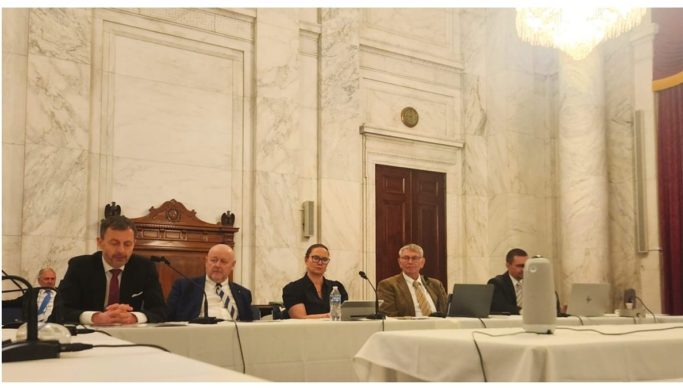
The launch, sponsored by Human Rights Without Frontiers (HRWF), took place on 4 February on the margins of the International Religious Freedom (IRF) Summit, a flagship annual convening of advocates and policymakers in the U.S. capital. According to HRWF, the session followed the IRF Roundtable and was held in the Kennedy Caucus Room of the Russell Senate Office Building, with more than 20 participants in the room and over 50 registered online.
Who was in the room
HRWF lists the first panel’s speakers as former EU Special Envoy on FoRB Ján Figeľ, FOREF Europe executive director Peter Zoehrer, Kristyna Tomanova of InterBelief Relief, and Attila Miklovicz of the University of Pécs. A second panel featured international advisers including Greg Mitchell (IRF Roundtable), former UK MP David Burrowes, and Brandon Taylorian (University of Lancashire), per HRWF’s account.
Among those noted as joining the debate were former Slovak Prime Minister Eduard Heger and Fernanda San Martín Carrasco, director of the International Panel of Parliamentarians for Freedom of Religion or Belief (IPPFoRB), alongside other parliamentarians and civil-society representatives.
Between the lines: Europe’s “FoRB gap” is often domestic
The pitch from organisers is straightforward: FoRB is not only a foreign-policy file. In opening remarks quoted by HRWF, the forum’s leadership framed Central Europe as a case study in how discrimination can be produced not only by overt hostility, but also by the architecture of state recognition and the narratives that follow it.
In practice, that can mean tiered recognition systems that grant “historical” religions broader privileges while leaving newer or smaller communities navigating higher administrative barriers—an issue that touches on core protections recognised in Article 18 of the ICCPR and Article 9 of the European Convention on Human Rights. It can also mean the reputational impact of media labels—particularly the indiscriminate use of “cult”—which HRWF argues can contribute to stigma, job loss and family pressures for ordinary believers.
The EU, for its part, already has an external toolbox, including the EU Guidelines on the promotion and protection of FoRB. But Brussels’ internal credibility is increasingly judged by whether rights concerns inside Member States are treated with the same seriousness as those beyond Europe’s borders.
The Brussels angle: a policy vacuum that keeps returning
FoRB advocates have also pointed to a recurring institutional problem in EU policymaking: continuity. In recent months, HRWF and others have criticised delays in filling the post of EU Special Envoy for the promotion of FoRB outside the Union—an argument echoed in previous reporting by The European Times and contested from different angles by civil-society coalitions calling for any envoy to defend rights for all, without enabling discrimination.
That matters because the Central Europe Forum is explicitly designed to “inform policymakers and parliamentarians across the political spectrum,” in HRWF’s description—suggesting it wants to become a usable input into both national debates and Brussels-level files, from rule-of-law monitoring to external human-rights dialogues.
What’s next
According to HRWF, the forum will meet four times per year, rotating format and using evidence-based briefings—sometimes under Chatham House Rules—aimed at “tangible outcomes rather than consensus for its own sake.” If the initiative succeeds, it could become a test of whether Central Europe’s FoRB disputes can be discussed in a way that is measurable, comparable across countries, and legible to policymakers—without collapsing into culture-war shorthand.
In Washington, the timing was not accidental: anchoring a Europe-focused forum inside a U.S. convening like the IRF Summit is also a signal about where parts of the FoRB advocacy ecosystem are now organising—transatlantic, networked, and increasingly attentive to how domestic legal design shapes religious freedom long before foreign-policy statements are drafted.