European Parliament condemns expulsions of foreign Christians under “national security” claims
- By WRN Editorial Staff --
- 12 Feb 2026 --
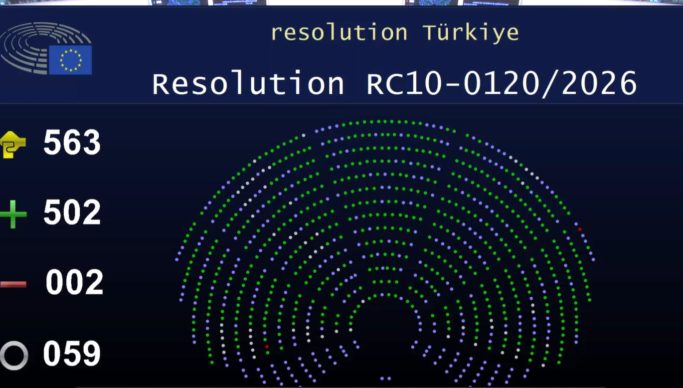
The European Parliament has adopted a resolution condemning some actions of Türkiye’s authorities for what it describes as the targeted expulsion of foreign Christians and foreign journalists under “national security” pretexts, urging Ankara to end the practice and restore due process safeguards. The motion passed with an overwhelming majority after a debate in Strasbourg late on Wednesday.
The text was adopted on Thursday with 502 votes in favour and 2 against, according to an update circulated by the office of Dutch MEP Bert-Jan Ruissen, who has been active on freedom of religion or belief (FoRB) issues in the Parliament. The draft joint motion for resolution (RC-10-2026-0120) was tabled ahead of the vote, while the Parliament’s final adopted text is published in the “Texts adopted” section.
Concerns over expulsions and opaque administrative measures
In a summary accompanying the parliamentary decision, the European Parliament said expulsions and related measures were being pursued “under unsubstantiated national-security pretexts and without due process,” and it urged Türkiye to end what it called administrative and judicial harassment of foreign journalists and foreign Christians. The Parliament’s press service summary also linked the resolution to wider concerns about media freedom and fundamental rights in Türkiye.
The case has drawn particular attention among religious freedom advocates because it centres on administrative “security codes” that can be attached to individuals, affecting residency and re-entry decisions. Several civil society organisations have argued that such measures can be difficult to challenge because the underlying evidence may not be disclosed in full, limiting meaningful judicial review.
Ruissen and the FoRB intergroup: political push from within Parliament
According to a message shared by Ruissen’s office, the resolution was pushed in part through the European Parliament’s cross-party work on freedom of religion or belief, including the Intergroup on FoRB. Intergroups are informal parliamentary groupings that bring together MEPs from different political families around specific themes, and they often serve as platforms for sustained attention to issues that otherwise receive limited plenary time.
The FoRB intergroup was re-established in the current parliamentary cycle and has been publicly associated with Ruissen’s work on religious freedom. Human Rights Without Frontiers has reported that the intergroup is co-chaired by Ruissen and Slovak MEP Miriam Lexmann, with a mandate to raise awareness about religious persecution and freedom of belief issues globally. HRWF’s report on the intergroup situates Ruissen as a leading parliamentary voice in this space.
What the Parliament is asking Türkiye to do
While the precise wording of the final adopted resolution is best consulted directly in the Texts adopted register, the Parliament’s press summary indicates that MEPs are urging Türkiye to halt expulsions and re-entry bans that rely on vague national security grounds and to ensure decisions are individualized, reasoned, and subject to effective judicial oversight. European Parliament press summary
The resolution also addresses the situation of foreign journalists, reflecting concerns that administrative and legal measures can be used to restrict reporting. The Parliament’s summary references the European Commission’s assessments that media freedom and pluralism in Türkiye remain severely constrained, and it urges the Commission to raise these concerns in political dialogue. European Parliament press summary
Broader context: legal challenges and advocacy
Outside Parliament, recent reporting by legal and advocacy groups has highlighted a pattern of residency cancellations and re-entry bans affecting foreign Christians, often tied to internal security designations. For example, ADF International has said the European Court of Human Rights has taken up multiple cases involving Christians barred from re-entering Türkiye after years of residence. The European Centre for Law and Justice has also published a detailed overview of how immigration and security tools can be applied to foreign residents involved in Christian ministry and community life.
These accounts are contested terrain: Turkish authorities have historically defended security-related decisions as matters of national sovereignty and public order. However, critics argue that the lack of transparency and the difficulty of challenging the basis for decisions raise serious rule-of-law questions—particularly when long-term residents or families are affected.
How to watch the debate
The plenary debate that preceded the vote can be viewed on the European Parliament’s webstream archive. The discussion on Türkiye took place on Wednesday night, starting from 21:40 in the plenary session recording. Plenary webstream (11 February)
Why it matters
European Parliament resolutions are not legally binding, but they can shape EU diplomacy, set political expectations for the European Commission, and amplify issues that affect religious communities and civil society actors on the ground. For Christian communities in Türkiye—where local congregations have often relied on foreign clergy, volunteers, and long-term residents—the practical impact of expulsions and re-entry bans can be immediate, disrupting pastoral care, community support, and family life.
The vote also underscores how FoRB concerns have become increasingly visible in parliamentary debates about Türkiye, alongside longstanding disputes over the rule of law, human rights, and media freedom. Whether the resolution leads to concrete changes will depend on how the Commission and EU member states follow up—and on whether Turkish authorities adjust administrative practices that critics say lack transparency and due process.