The Golden Rule Returns to the Spotlight in a Global Interfaith Webinar
- By WRN Editorial Staff --
- 19 Feb 2026 --
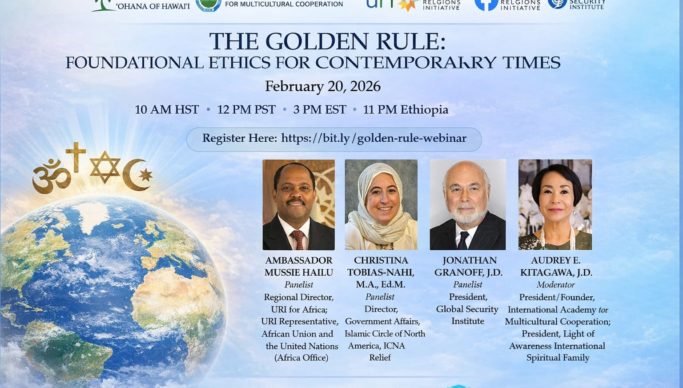
An international online event marking World Interfaith Harmony Week will bring together interfaith and humanitarian leaders on February 20, 2026 for a discussion titled “The Golden Rule: Foundational Ethics for Contemporary Times.” Organizers say the webinar will explore how the long-shared moral principle—treating others as one would wish to be treated—can help address today’s social, political, and religious tensions.
The program is scheduled for 10:00 AM HST, 12:00 PM PST, 3:00 PM EST, and 11:00 PM Ethiopia time, reflecting the event’s cross-regional focus. Registration is available online at https://bit.ly/golden-rule-webinar. The event will also be livestreamed on YouTube and Facebook, according to the event flyer.
A widely shared ethic with renewed urgency
Often described as a “universal” moral teaching, the Golden Rule appears in many religious and philosophical traditions in some form—sometimes as an encouragement to active compassion, other times as a warning against doing harm. In contemporary public life, it is frequently invoked in debates about human dignity, social cohesion, conflict prevention, and the responsibilities of leaders and institutions.
The webinar’s theme suggests a practical question: what does the Golden Rule mean amid rising polarization, wars and displacement, misinformation, and renewed anxieties about identity and belonging? By framing the principle as “foundational ethics,” organizers appear to be positioning it not as abstract spirituality, but as a starting point for civic and interreligious engagement—especially in settings where communities live side by side but do not always share the same assumptions about truth, authority, or morality.
Organizers from interfaith and security circles
The event is presented as a collaborative initiative involving Interfaith ‘Ohana of Hawai‘i, the International Academy for Multicultural Cooperation, the United Religions Initiative (URI), and the Global Security Institute. The mix of interfaith networks and security-focused leadership reflects a growing trend in which moral and religious frameworks are increasingly discussed alongside questions of peacebuilding, social stability, and conflict resolution.
While “interfaith dialogue” can sometimes sound like a niche activity, it often intersects with concrete issues: humanitarian response, community mediation, religious freedom, education, and the place of minority communities in plural societies. Events like this webinar aim to translate shared values into public conversation—without requiring participants to share a single theology.
Panelists span diplomacy, humanitarian work, and global security
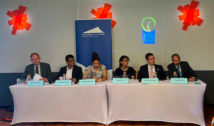
According to the flyer, the discussion will include panelists from diplomacy, humanitarian relief, and global security. The panelists are:
- Ambassador Mussie Hailu, Regional Director, URI for Africa, and URI Representative, African Union and the United Nations (Africa Office).
- Christina Tobias-Nahi, M.A., Ed.M., Director, Government Affairs for the Islamic Circle of North America, ICNA Relief.
- Jonathan Granoff, J.D., President of the Global Security Institute.
The webinar will be moderated by Audrey E. Kitagawa, J.D., as President/Founder of the International Academy for Multicultural Cooperation and President of the Light of Awareness International Spiritual Family.
The range of professional backgrounds suggests the conversation may bridge values-based ethics with policy realities: how moral principles inform decision-making in governance, humanitarian operations, and security thinking. In interfaith settings, that often means moving beyond symbolic statements toward questions of responsibility, trust, and practical cooperation across religious and cultural lines.
Why the topic resonates now
The Golden Rule is sometimes described as “simple,” but applying it in public life can be difficult—especially when communities face fear, inequality, or historic grievances. In many countries, religious identity is increasingly politicized, with faith communities drawn into debates over national identity, migration, education, and public morality. At the same time, civil society groups working in conflict zones or fragile social environments often emphasize that ethical frameworks—religious or philosophical—can play a role in de-escalation and reconciliation.
World Interfaith Harmony Week, which the flyer highlights, is intended to encourage mutual understanding and cooperation among communities of different beliefs. In that context, focusing on the Golden Rule offers a common vocabulary that many traditions recognize, even if they interpret it differently. For some, it is a spiritual mandate; for others, a civic ethic; for others still, a guiding principle for peacebuilding.
The February 20 webinar appears designed as a public-facing conversation rather than an academic seminar, offering a point of entry for viewers who may be seeking constructive ways to think about ethical responsibility in a time of intense global pressures.
How to attend
The webinar, “The Golden Rule: Foundational Ethics for Contemporary Times,” takes place on February 20, 2026. Organizers list the start times as 10:00 AM HST, 12:00 PM PST, 3:00 PM EST, and 11:00 PM Ethiopia time. Registration is available at https://bit.ly/golden-rule-webinar, and the event will be livestreamed on YouTube and Facebook.
As global conversations about religion and public life become more polarized, the event’s central question—whether a shared ethical principle can still guide cooperation across differences—may be one many audiences are ready to revisit.