IARJ Highlights New Research on Why Newsrooms Struggle to Cover Religion
- By WRN Editorial Staff --
- 18 Feb 2026 --
A new resource published by the International Association of Religion Journalists (IARJ) points reporters to a set of global studies arguing that religion coverage is often inconsistent, risk-averse, and increasingly pushed to the margins of mainstream news. Written by IARJ member Uday Basu, the piece frames the research as a practical wake-up call for editors and journalists working in largely secular newsrooms.
The studies Basu highlights were produced by the Faith & Media Initiative in collaboration with market research firm HarrisX. The first, the Global Faith & News Study (released in 2022), surveyed 9,489 people across 18 countries and included more than 30 in-depth interviews with journalists and editors. A second major project, the Global Faith & Entertainment Study (published in 2024), looked beyond journalism to examine how audiences respond to portrayals of religion in entertainment.
“Universal agreement” on religion being sidelined
Basu’s IARJ article summarizes the newsroom interviews with a blunt finding from the 2022 study: “There is universal agreement among journalists that coverage about faith and religion has become more marginalized due to a set of newsroom dynamics.” The reason, he suggests, is not a single editorial decision but a cluster of pressures that make religion feel both difficult and professionally risky to cover—especially under tight deadlines.
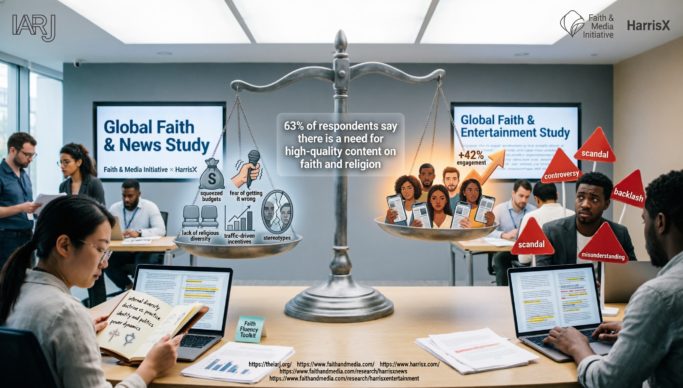
Among the newsroom dynamics listed in the IARJ summary are economics (“squeezed budgets”), a “fear of getting it wrong” in a polarized climate, lack of religious diversity inside editorial teams, incentive structures tied to traffic, and a limited pool of spokespeople that can reinforce stereotypes. Basu adds that many of the journalists interviewed described a general “fear” around religion reporting—driven by the concern that nuance and sensitivity are hard to achieve at speed, and that misunderstanding can quickly trigger backlash.
Audience demand vs. newsroom incentives
The research Basu points to also emphasizes a gap between what journalists think audiences want and what audiences say they want. On the public side, the Global Faith & News Study reports that 63% of respondents say there is a need for high-quality content on faith and religion, and 56% say they are more likely to engage with a publication that provides it. At the same time, the study’s headline “problem” indicators include that 53% believe media actively ignores religion rather than addressing it appropriately, and 61% say the media perpetuates faith-based stereotypes.
Yet newsroom decision-making often pushes religion to the foreground mainly when it can be framed as conflict. Basu writes that the journalists interviewed said editors “almost never encourage stories in this area unless they correspond to a narrative of controversy, dissent or scandal.” The pattern, in other words, becomes self-reinforcing: religion is treated as “hard” to cover well, then covered mainly when it is already contentious—making it even harder to report without inflaming divisions.
The “faith fluency” challenge
One of the most pointed themes in the research is a shortage of specialist knowledge. The 2022 study argues that reduced budgets and shrinking beats leave general assignment reporters handling complex religion stories without time to build expertise. The Faith & Media Initiative’s research page quotes Axios founder Mike Allen praising the concept of “faith fluency”—a shorthand for the vocabulary, context, and lived experience needed to report on belief communities without caricature.
In practice, “faith fluency” can mean understanding internal diversity within traditions, the difference between official doctrine and everyday practice, and how identity, migration, race, and politics interact with belief. It can also mean recognizing that many disputes labeled “religious” are partly about power, law, or social status—and that treating faith as a monolith can distort what is actually happening on the ground.
Why it matters for religion journalism now
The IARJ’s decision to spotlight these studies arrives at a moment when religion is simultaneously ubiquitous in public debate and easy to mishandle in headlines. From conflicts where religious identity is entwined with nationalism, to legal battles over conscience rights and education, to the role of faith groups in humanitarian work, belief continues to shape politics and daily life across regions. But the research Basu shares suggests many newsrooms are covering those stories without consistent tools, staffing, or editorial confidence.
For journalists who do cover religion, the studies raise questions that go beyond beat specialization. If audiences say they want deeper, less stereotyped reporting, what would it take for newsroom structures—budgets, hiring, training, and performance metrics—to reward that work? And if editors fear missteps, how can journalism institutions build routines that reduce error while still allowing for careful storytelling?
Basu’s IARJ article is ultimately an invitation: not only to read the studies, but to treat them as a roadmap for improving coverage. In pointing members to the Global Faith & News Study and the Global Faith & Entertainment Study, he argues that religion journalism can be strengthened when reporters and editors better understand both the professional barriers inside newsrooms and the expectations of the publics they serve.