


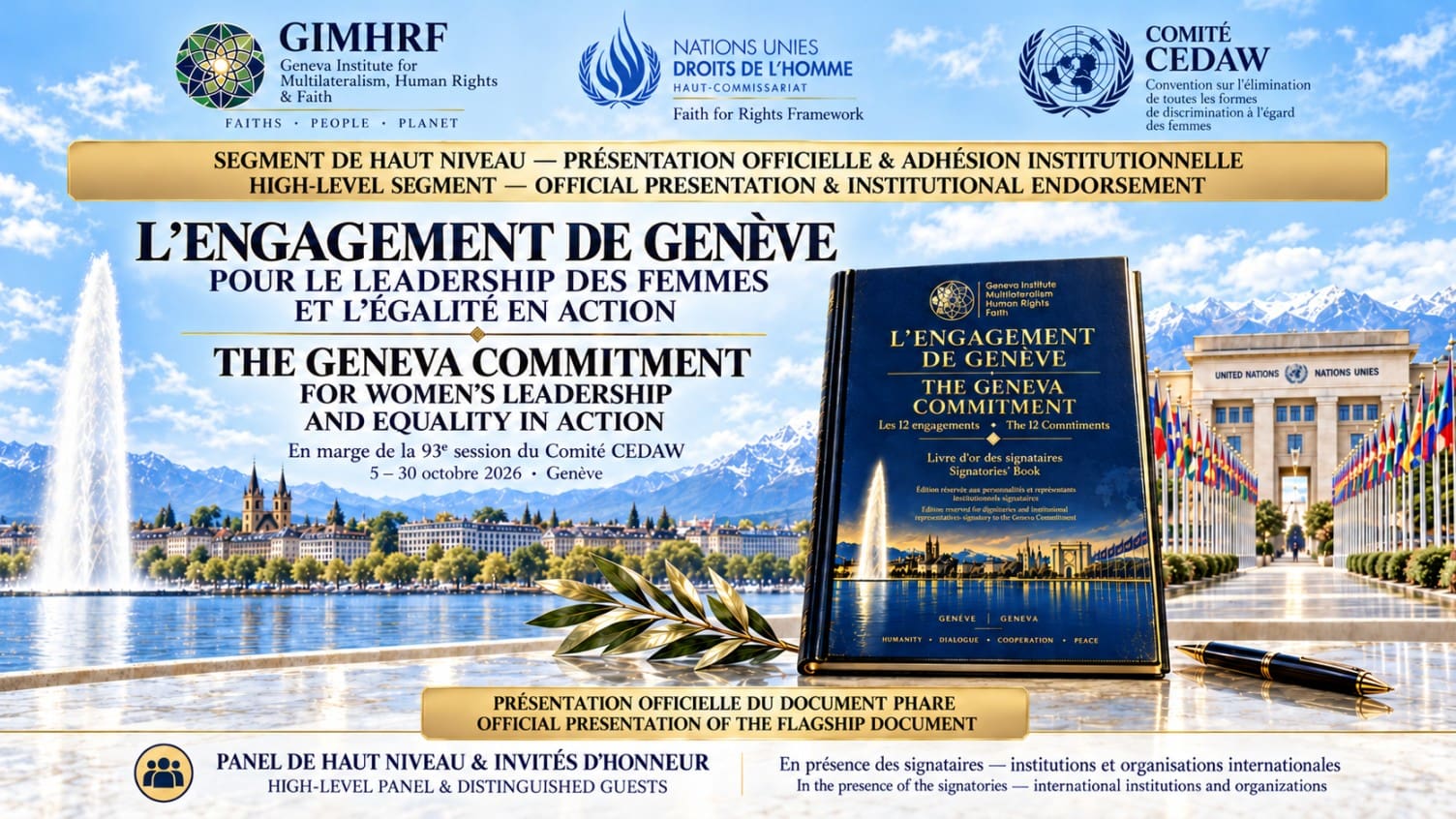
A gathering at the Palais des Nations will connect the Paris Charter with women’s equality, religious engagement and participation in decision-making.
GENEVA — Women’s leadership and the relationship between faith and equal rights will be the focus of an international gathering at the Palais des Nations on October 29, 2026. “Women, Leadership and the Paris Charter” is listed in the programme of the 93rd session of the United Nations Committee on the Elimination of Discrimination against Women, known as CEDAW.
Convened by the Geneva Institute for Multilateralism, Human Rights & Faith (GIMHRF), the event connects the Paris Charter with an initiative called the Geneva Commitment for Women’s Leadership and Equality in Action.
Announced participants include CEDAW Chair Nahla Haidar; Michael Wiener of the Office of the UN High Commissioner for Human Rights (OHCHR), an expert on Faith for Rights; Chems-Eddine Hafiz, rector of the Grand Mosque of Paris, accompanied by a French delegation of women leaders; and GIMHRF Co-Director Élodie Tranchez. The announcement also lists representation from France’s Permanent Mission to the UN in Geneva at ambassadorial level.
The Paris Charter’s place in the discussion
The charter brings a specifically Muslim contribution to the discussion. Developed through a consultation initiated by the Grand Mosque of Paris in 2023, it considers religious life and citizenship in pluralist societies. The mosque describes its approach as combining fidelity to Islamic principles with participation in the secular and cultural settings in which Muslims live.
The consultation brought together two complementary groups: a religious commission involving imams and other religious authorities, and a civil society commission including academics, journalists, legal and health professionals, elected officials and representatives of different beliefs. Their work was published in February 2026 in a volume containing the charter, a glossary and transcripts of the consultations.
For the Geneva gathering, the charter’s relevance lies particularly in its treatment of equality. In a September statement, the Grand Mosque of Paris highlighted its affirmation of equal rights for women and men, its reference to the eighteen Faith for Rights commitments, and its support for women’s full participation in the decision-making bodies of Muslim institutions.
The same statement describes a partnership between the mosque, its Ibn Badis training school and GIMHRF to incorporate Faith for Rights into training for imams and female religious guides, known as mourchidates. This provides a practical connection between the charter and religious education: its principles can inform the preparation of people who advise communities and help shape their everyday religious life.
A shared framework for faith and rights
The involvement of Faith for Rights places the meeting within a wider conversation across religious and belief traditions. Developed with faith-based actors through OHCHR, the framework offers eighteen commitments intended to connect religious and ethical convictions with the protection of human dignity.
Its accompanying #Faith4Rights toolkit translates those commitments into learning and discussion exercises. The approach uses exchange among participants to explore how human rights can be put into practice, drawing on the experience and language of different communities. It offers a way for religious actors, educators and human rights practitioners to examine shared responsibilities while recognising differences of belief.
Commitment V addresses women, girls and gender equality. It pledges non-discrimination and calls on participants, within their respective areas of competence, to revisit religious interpretations that perpetuate inequality or harmful stereotypes. It also affirms protection from violence and harmful practices.
Read alongside the Paris Charter’s provisions on women’s participation, that commitment connects two aspects of equality: how women are treated and how they help shape the institutions around them. The discussion therefore extends to women’s role in interpreting, teaching and applying the principles that affect community life.
From principles to participation
GIMHRF describes the Geneva Commitment as twelve complementary commitments to help put existing standards on women’s rights into practice. It identifies contributions from expertise associated with OHCHR, CEDAW, the University of Ottawa’s Observatory on Human Rights at the United Nations and the Grand Mosque of Paris.
GIMHRF Co-Director Boumédiène Benyahia and OHCHR Human Rights Officer Britta Nicolmann are named as facilitators of the dialogue surrounding the initiative.
A relevant international benchmark is CEDAW’s General Recommendation No. 40, adopted in 2024, on women’s equal and inclusive representation in decision-making systems. It treats parity as a central principle of governance and calls for systematic action across sectors.
In explaining the recommendation, the committee stated that equal and inclusive representation requires 50–50 parity between women and men. Its scope encompasses political and public life, the private sector, economic institutions and digital spaces. The guidance gives the leadership discussion a concrete reference point: equal participation concerns the distribution of decision-making responsibilities throughout society.
These documents help explain the meeting’s combination of participants. CEDAW contributes guidance on equality; Faith for Rights provides tools for engagement across beliefs; and the Paris Charter sets out a religious institution’s commitments on citizenship and women’s participation. Bringing them into the same discussion creates an opportunity to examine how their principles can inform institutional practice.
The October 29 session
The UN timetable schedules the event for Thursday, October 29, from 1:30 p.m. to 4:30 p.m. Geneva time (CET, UTC+1), in the Council Chamber at the Palais des Nations. It takes place during the closing days of CEDAW’s October 5–30 session. Registration is handled through the United Nations’ Indico portal.
The gathering brings the question of women’s leadership into a setting where religious experience and international human rights standards can be considered together. Its practical significance will lie in how the discussion informs women’s opportunities to exercise responsibility in their communities and institutions.