


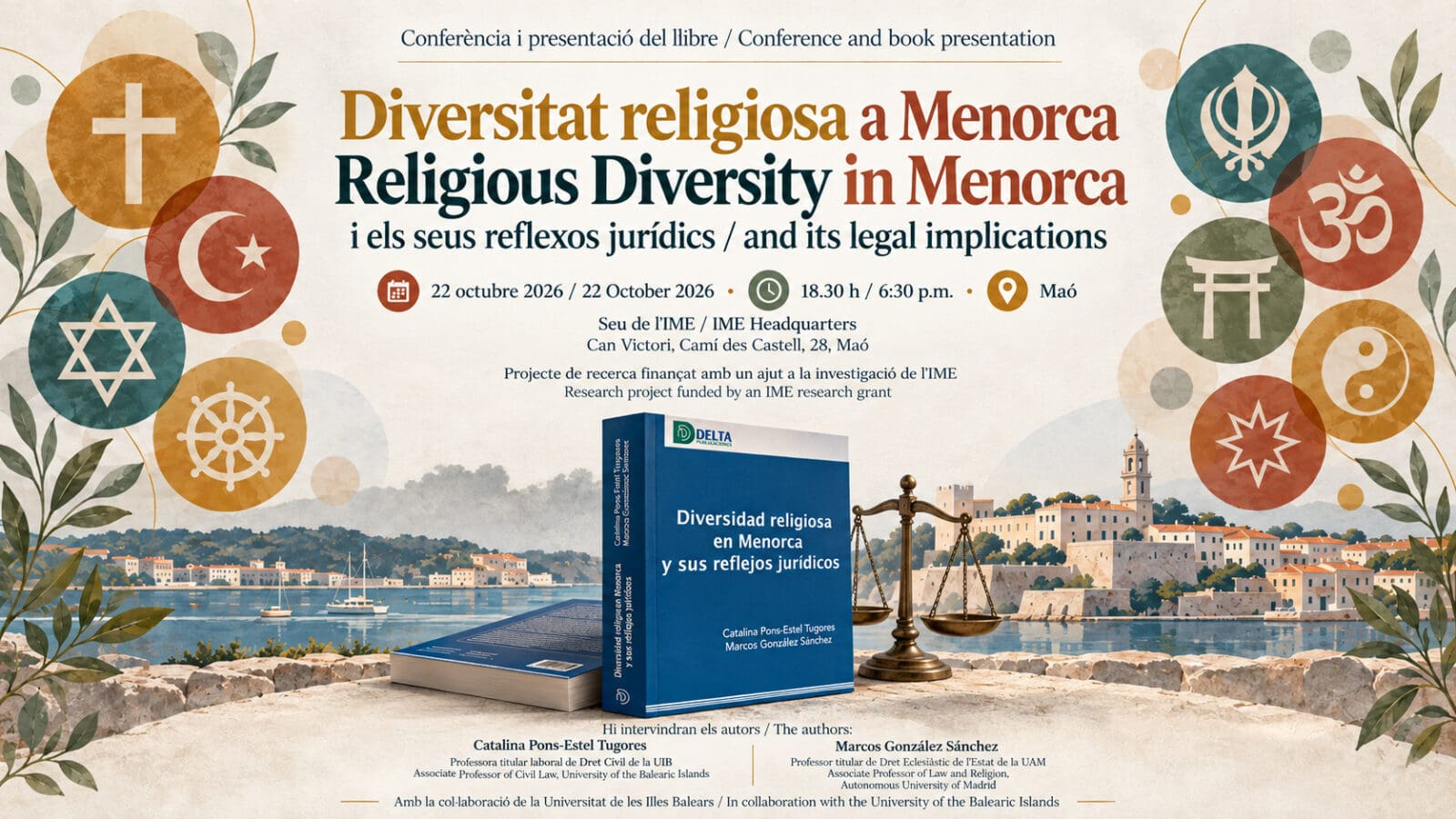
Researchers Catalina Pons-Estel Tugores and Marcos González Sánchez, both awarwed with the Religious Freedom Awards of Fundación MEJORA, will present a study examining the island’s religious communities and the legal challenges of protecting freedom of religion and conscience in contemporary Spain.
MAÓ, Menorca, Spain — October 15, 2026 — How does a society accommodate different religious traditions while ensuring that everyone enjoys the same fundamental rights? This question lies at the heart of a new book examining religious diversity on the Mediterranean island of Menorca, which will be presented on October 22 at the Institut Menorquí d’Estudis (IME) in Maó.
Entitled Diversidad religiosa en Menorca y sus reflejos jurídicos (Religious Diversity in Menorca and Its Legal Implications), the publication explores the island’s religious plurality and the legal questions associated with recognising and accommodating different beliefs in a democratic society. The research places Menorca within a broader discussion taking place across Europe: how freedom of religion or belief operates in everyday life, beyond the principles established in constitutions and international treaties.
From Academic Research to Public Discussion
The book is the result of a research project entitled La diversidad religiosa en Menorca (Religious Diversity in Menorca), supported by a research grant awarded through the IME’s 2023 funding programme. The institute promotes research across disciplines to deepen understanding of Menorca’s social, historical, cultural and environmental realities.
The University of the Balearic Islands’ research portal independently identifies the IME as the project’s funder and lists the two participating scholars.
The investigation is led by Catalina Pons-Estel Tugores, Associate Professor of Civil Law at the University of the Balearic Islands (UIB), alongside Marcos González Sánchez, Associate Professor of State Ecclesiastical Law at the Autonomous University of Madrid.
Both scholars have previously contributed to academic discussions concerning the relationship between law, religion and society. Their joint work includes contributions to the journal Derecho y Religión on subjects such as religious freedom, regional government responsibilities and the legal situation of religious communities.
At the October 22 presentation, the authors are expected to explain the principal findings of their investigation and examine the legal challenges surrounding religious freedom and freedom of conscience in contemporary society.
While the detailed conclusions of the publication have yet to be presented publicly, its subject highlights an important consideration: religious diversity is not simply a matter of identifying different faith communities. It also raises questions about the practical conditions under which individuals and groups can exercise their beliefs freely and equally.
Menorca’s Religious Landscape Extends Beyond Its Catholic Heritage
Menorca, one of Spain’s Balearic Islands, has a long Catholic heritage, visible in its churches, religious festivals and historical institutions. Yet the island’s religious history is considerably more varied than this heritage alone might suggest.
During periods of British rule in the eighteenth century, Menorca experienced encounters between Catholicism and other religious traditions, including Anglican and other Protestant communities. Its position as a Mediterranean trading centre also brought it into contact with Jewish and Eastern Christian populations. The island later became an important location in the history of Spanish Protestantism, including the establishment of a Protestant church in Maó in 1868.
Religious diversity remains part of contemporary Menorcan life. In July 2024, an interreligious gathering in Ciutadella brought together representatives of Catholic, Anglican and Evangelical Christianity, Buddhism and the Bahá’í Faith to reflect on peace and coexistence.
Muslim communities are also established on the island. In March 2025, local newspaper Menorca reported on the absence of Islamic religious instruction in Menorca’s public schools, despite the existence of Muslim families and places of worship. The report noted that schools had not received the necessary requests for such classes and that families were using local mosques for religious education.
This example illustrates a distinction that is central to discussions of religious freedom: a legal right may exist on paper, but its practical implementation depends on institutional arrangements, available resources and the circumstances of individual communities.
Religious Freedom Under Spanish Law
Spain’s legal framework provides a significant foundation for the issues raised by the new publication.
Article 16 of the Spanish Constitution guarantees freedom of ideology, religion and worship for individuals and communities. It also establishes that no religious denomination shall have the character of a state religion, while requiring public authorities to take account of the religious beliefs present in Spanish society and maintain appropriate cooperation with religious communities.
The Organic Law on Religious Freedom of 1980 develops these constitutional protections. Among other guarantees, it recognises the rights of individuals to adopt, change or abandon their religious beliefs; practise worship; receive religious instruction; associate with others for religious purposes; and establish religious communities.
Importantly, these protections extend to the freedom not to profess a religion. Freedom of religion or belief therefore concerns not only relations between different religious traditions but also the rights of people who identify as agnostic, atheist or otherwise nonreligious.
The practical application of these guarantees can involve matters such as access to places of worship, religious education, accommodation of religious practices, recognition of religious organisations and equal treatment before public authorities.
These are examples of the wider legal questions that arise when religious diversity meets public administration. They are not necessarily the specific conclusions of the Menorca study, which the authors will explain during the forthcoming presentation.
Why Local Research Matters
Although religious freedom is frequently discussed in national parliaments, constitutional courts and international institutions, many of the decisions affecting religious communities take place much closer to home.
Municipal authorities may encounter questions concerning the location of places of worship, the use of public facilities or the accommodation of religious celebrations. Educational institutions may need to address different religious and nonreligious convictions, while public services must operate within legal principles of equality and nondiscrimination.
The Observatory of Religious Pluralism in Spain, an initiative of the Fundación Pluralismo y Convivencia, provides resources for understanding religious diversity and improving its management by public institutions.
Research focused on an individual territory can complement such national resources by examining how general legal principles relate to a particular community’s circumstances, history and institutions.
Menorca offers an interesting setting for this type of investigation. Its relatively small geographical scale, distinctive religious history and contemporary plurality make it possible to consider the interaction between local identity, different beliefs and the legal protection of individual freedoms.
The value of such research lies partly in making religious diversity more visible as a subject of public knowledge, rather than treating it exclusively as a matter for religious organisations themselves.
Public Presentation in Maó on October 22
The conference and book presentation will take place on Thursday, October 22, 2026, at 6:30 p.m., at the headquarters of the Institut Menorquí d’Estudis, Camí des Castell, 28, in Maó.
The event is open to the public and will provide an opportunity to hear directly from the researchers about their work, its principal findings and the broader legal implications of religious diversity on the island.
Beyond its academic contribution, the publication brings attention to a question that reaches well beyond Menorca: how can democratic institutions ensure that religious freedom is experienced as a practical reality by individuals and communities, regardless of their beliefs, traditions or numbers?
As societies become increasingly diverse, the answer depends not only on the recognition of fundamental rights but also on understanding how those rights operate in the places where people live. By examining that relationship through the experience of Menorca, the new study promises to contribute to a wider conversation about religious pluralism, equality and coexistence.