


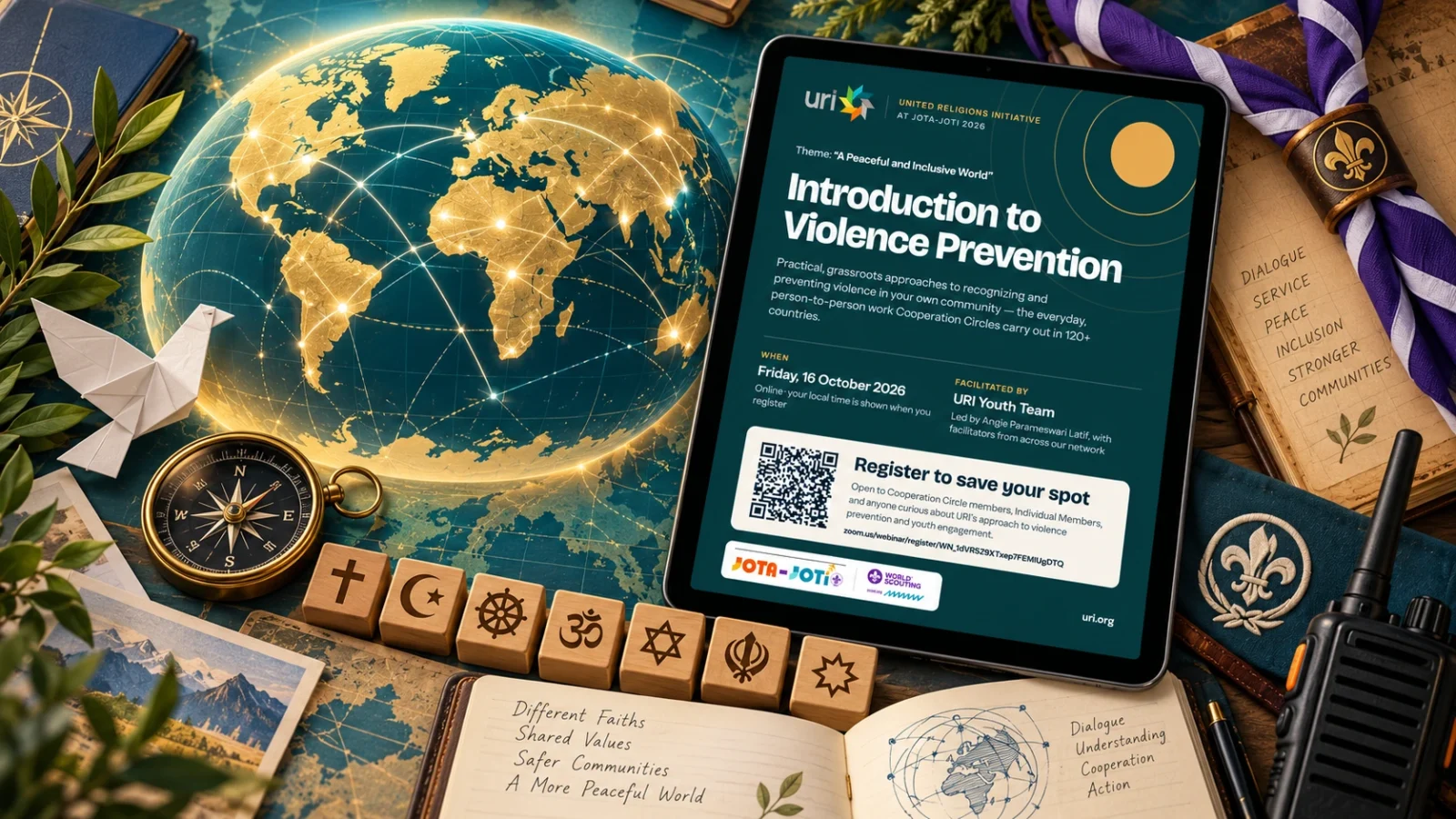
As hundreds of thousands of young people prepare to connect across borders, a new collaboration between the United Religions Initiative and World Scouting aims to turn global friendship into practical skills for preventing violence.
A Scout in one country can make a new friend thousands of miles away in minutes. But what happens when that Scout returns to a community where suspicion, prejudice, or hostility divides people who live just streets apart?
This is the kind of challenge the United Religions Initiative (URI) hopes to address as it joins the World Organization of the Scout Movement (WOSM) for JOTA-JOTI 2026, the world’s largest digital and radio Scouting event.
From October 16 to 18, young people around the world will come together under the theme “A Peaceful and Inclusive World.” Alongside the radio contacts, international conversations, games, and educational activities that have made JOTA-JOTI a global tradition, participants will have an opportunity to explore how violence can be recognized and prevented before it takes hold.
The scale of the event is remarkable. According to World Scouting’s official report, more than 650,000 Scout groups and individuals registered for the 2025 edition, representing 188 countries and territories.
The gathering brings together two complementary forms of connection. JOTA, the Jamboree on the Air, uses amateur radio to connect participants across borders. JOTI, the Jamboree on the Internet, relies on digital platforms to facilitate international encounters, learning, and collaboration.
For URI, the opportunity is to bring another dimension to those connections: learning how to prevent harm within the communities to which participants belong.
Learning to recognize violence before it escalates
On Friday, October 16, URI’s international youth team will lead a workshop titled Introduction to Violence Prevention.
The session will be facilitated by Anggita (Angie) Parameswari Latif, who leads URI’s global youth strategies, together with facilitators from different parts of the organization’s international network.
Originally from Indonesia, Latif has an academic background in sociology and conflict resolution and has worked on issues involving human security, global governance, and peace education. Her current responsibilities at URI include strengthening youth engagement and supporting the organization’s violence prevention network.
The workshop will introduce practical approaches to identifying situations that may lead to violence and responding within local communities.
This reflects a central feature of URI’s peacebuilding philosophy: ordinary people are not merely witnesses to conflicts. They can also help prevent them.
The organization has been developing this approach through its wider training programs. Its 2026 introductory workshop series, for example, explores violence as behavior that can be changed and emphasizes the role of community members who intervene to interrupt destructive patterns.
One of the concepts introduced in that training is the “third side” of a conflict: people who are not necessarily direct participants in a dispute but can help prevent its escalation, encourage dialogue, or create opportunities for reconciliation.
Such ideas are particularly relevant to young people navigating environments where social tensions, exclusion, and misunderstandings can easily become entrenched.
From religious dialogue to everyday cooperation
URI’s contribution also illustrates an important development in interfaith work. For many years, public attention has often focused on meetings between religious leaders, theological exchanges, and declarations of mutual respect.
URI’s model places considerable emphasis on something different: people of diverse beliefs undertaking practical work together.
Its network includes more than 1,300 local groups known as Cooperation Circles, operating across more than 120 countries. These groups bring together members of different religious, spiritual, Indigenous, and nonreligious traditions to undertake shared initiatives.
Their activities range from community dialogue and reconciliation to education, humanitarian work, environmental protection, and efforts to counter violence.
The principle is straightforward. Relationships created through cooperation can help communities respond to differences without turning those differences into hostility.
For young participants in JOTA-JOTI, this offers a perspective that goes beyond learning about other people’s cultures or religions. It encourages them to consider what they can actually do when confronted with divisions in their own surroundings.
It also connects directly with URI’s founding purpose, which includes ending religiously motivated violence and building cultures of peace, justice, and healing.
Two worldwide movements exploring closer cooperation
The collaboration with World Scouting brings together organizations with different histories but overlapping educational and social objectives.
Scouting has long emphasized service, responsibility, international friendship, and learning through practical experience. Its global activities offer opportunities for young people from varied cultural and religious backgrounds to work toward common goals.
Interreligious understanding is already part of that work. Through initiatives such as the Dialogue for Peace program, World Scouting has supported training in intercultural and interreligious dialogue, encouraging young people to develop skills that can improve relationships within their communities.
URI brings its own experience of grassroots peacebuilding, particularly where religious and cultural differences intersect with broader social tensions.
The two organizations have begun developing a relationship intended to continue beyond this year’s event. Their cooperation currently rests on verbal understandings rather than a permanent signed institutional agreement.
JOTA-JOTI 2026 provides an opportunity to put that shared intention into practice by making URI’s experience available to a much wider youth audience.
There is a potentially significant educational connection here. Scouting encourages young people to become responsible members of their communities. URI’s violence prevention work can help equip them with practical ways of exercising that responsibility when relationships become strained.
What happens after the online gathering?
The October 16 workshop will be open not only to Scouts but also to URI Cooperation Circle members, individual members, and anyone interested in youth engagement and violence prevention.
Participants can register for the online session, with the precise starting time displayed in their local time zone during registration.
The broader JOTA-JOTI 2026 program runs throughout the weekend, inviting participants to connect across national boundaries and explore ways of contributing to a more peaceful and inclusive world.
For URI and World Scouting, the significance of this collaboration extends beyond the number of participants reached during a single online event.
International encounters can challenge stereotypes and create friendships. Practical peacebuilding skills can help sustain those encounters when young people return to schools, neighborhoods, religious communities, and everyday life.
The most meaningful result of this partnership may therefore emerge long after the radio conversations have ended and the computers have been switched off: when a young person recognizes a developing conflict, chooses to intervene constructively, and helps others find a way forward together.