


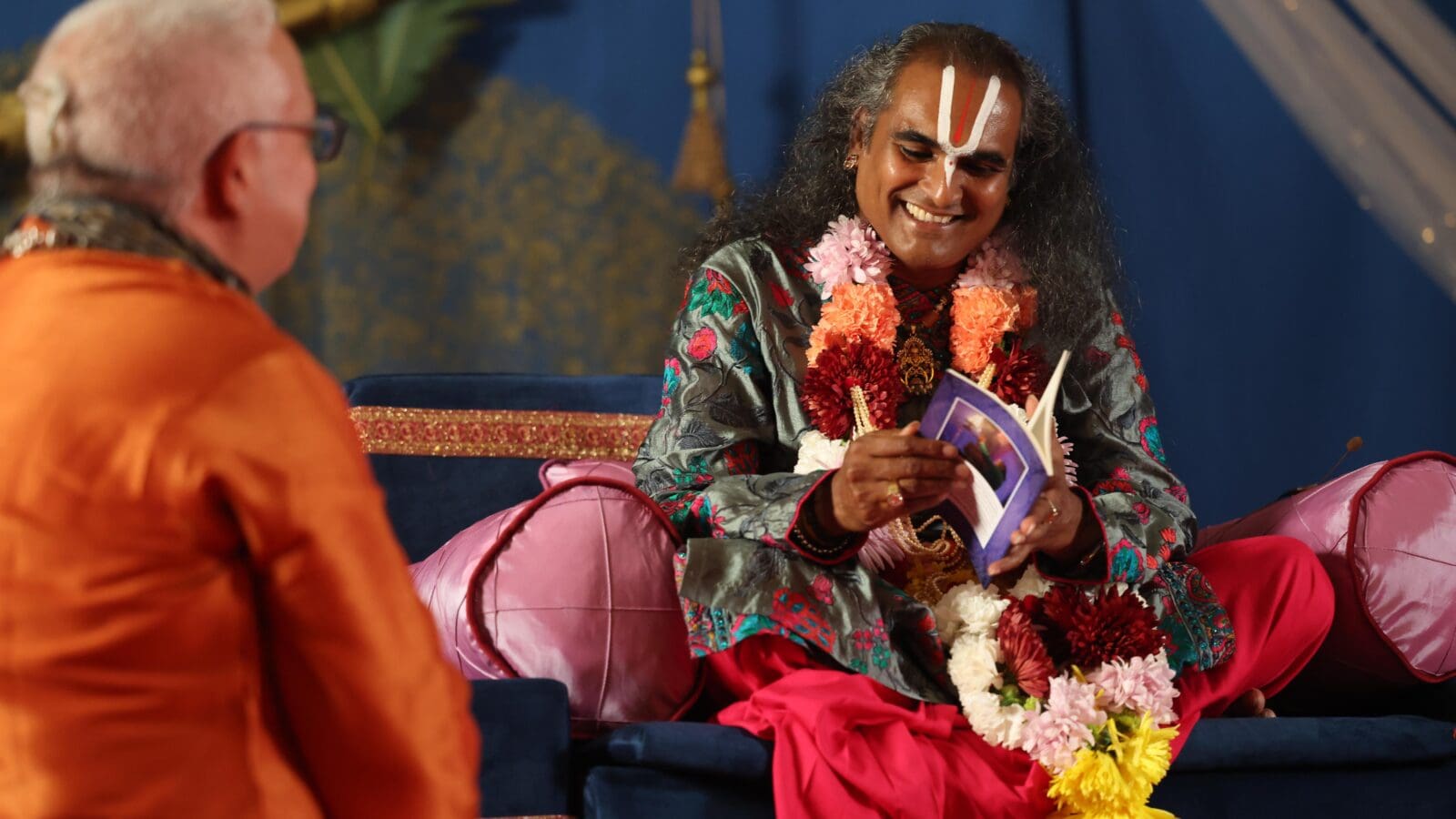
The President of the Hindu Federation of Spain welcomed the spiritual master and offered him an original Sanskrit hymn at a gathering attended by more than seven hundred people.
On Saturday, 21 November 2026, the island of Lanzarote, Spain, hosted a major Hindu spiritual gathering on the occasion of the darshan of Paramahamsa Swami Vishwananda, one of the most prominent contemporary spiritual masters of Hinduism and founder of the international Bhakti Marga movement.
More than seven hundred people filled the hall of the Hotel Beatriz Costa, including devotees from mainland Spain and various European countries, as well as many local residents of Lanzarote and people interested in exploring Hindu spirituality.
Among the invited guests was Pandit Krishna Kripa Dasa (Juan Carlos Ramchandani), a Hindu priest, author and lecturer from Ceuta, Spain, who attended in his capacity as President of the Hindu Federation of Spain (FHE) and President of the Advisory Board of Sanatana Dharma Europe.
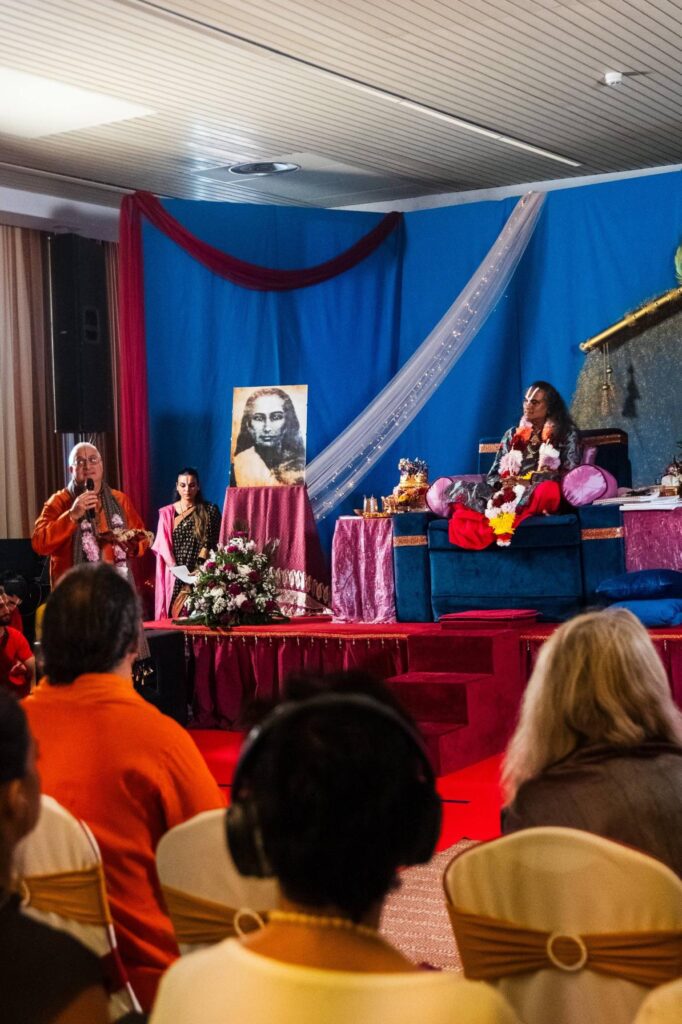
Ramchandani formally welcomed Paramahamsa Swami Vishwananda on behalf of both institutions, highlighting the importance of his spiritual work and his efforts to spread the teachings of Sanatana Dharma, the traditional name for Hinduism.
Ramchand Murlidhar, President of the Prem Prakash Association of Lanzarote, also addressed the audience and welcomed the spiritual master.
The gathering was accompanied by kirtan, the devotional chanting of the names of God, performed by the excellent musicians and singers of Bhakti Marga, who helped create an atmosphere of joy, contemplation and devotion.
Darshan: To See and Be Seen
The Sanskrit word darśana, commonly known as darshan, literally means vision or the act of seeing. In the Hindu religious context, it refers to an encounter with the divine presence, whether through a sacred image, a deity in a temple or a spiritual master.
Bhakti Marga describes this experience with an expression that is both simple and profound: “to see and be seen.” It is not merely about seeing the spiritual master, but also about opening oneself to his gaze, his blessings and the possibility of experiencing the presence and love of God.
From the perspective of the bhakti tradition, the path of devotion, darshan is an opportunity to strengthen one’s personal relationship with the Divine. It does not require extensive philosophical knowledge or complex spiritual practices, but rather an attitude of receptivity, humility and openness of heart.
For the disciples of Paramahamsa Swami Vishwananda, whom they affectionately call Guruji, meeting their spiritual master represents a particularly meaningful moment in their spiritual lives.
Of Indian origin and born on the island of Mauritius, Paramahamsa Swami Vishwananda is the founder of Bhakti Marga, a Sanskrit expression meaning “the path of devotion.” His movement has disciples, temples, ashrams — spiritual communities — and centres of spiritual practice across five continents.
His teachings focus on unconditional love for God, cultivated through prayer, chanting the Divine Names, meditation, selfless service and the study of sacred scriptures.
One of the most significant aspects of his message is bringing spirituality into everyday life, reminding us that love for God should not be confined to temples or moments of prayer, but should also be expressed through the way we live and relate to others.
A Spiritual Friendship and a Literary Offering

The relationship between Paramahamsa Swami Vishwananda and Pandit Krishna Kripa Dasa is founded on friendship, mutual respect and admiration for the work they both carry out in the service of Sanatana Dharma.
As a result of this relationship of trust, Paramahamsa Swami Vishwananda entrusted the Pandit with the training of male and female priests of Bhakti Marga in the practice of samskaras, the Hindu rites of passage that sanctify the different stages of human existence, from before birth until the end of life.
From this friendship and in recognition of the spiritual master’s work came a special publication entitled Śrī Paramahaṃsa Svāmī Viśvānanda Aṣṭādaśa Stavaḥ.
It is a hymn of praise (stava) originally composed in Sanskrit by Krishna Kripa Dasa, consisting of eighteen ślokas, or verses, glorifying the spiritual qualities of the master, his dissemination of the path of bhakti — love and devotion to God — his promotion of the chanting of the Divine Names and his respect for the diversity of religious and philosophical traditions within Sanatana Dharma.
During his address, the Pandit explained the significance of the work and recited two of its verses in Sanskrit before personally offering the publication to Paramahamsa Swami Vishwananda.
The book includes the original Sanskrit text in IAST academic transliteration, together with its English translation. Initially conceived as a personal offering to the spiritual master, it has attracted considerable interest among his disciples, and a Spanish edition is now being planned.
During a private meeting, Guruji expressed his appreciation for the publication and personally thanked the author for his offering. During their conversation, the spiritual master also enquired about the current situation in the city of Ceuta, demonstrating how a deep commitment to spiritual life can coexist with an awareness of and sensitivity towards events in the contemporary world.
Ramchandani also received a flower garland and several gifts from Bhakti Marga Spain as a gesture of affection and recognition.
Pandit Krishna Kripa Dasa wished to express his special gratitude to the entire team and volunteers of Bhakti Marga Spain for the respect and affection shown to him, their exceptional hospitality and their attention to protocol throughout the gathering. He also highlighted their dedication and spirit of selfless service, which were essential to the smooth running of the event.
Unity in the Diversity of Sanatana Dharma
The gathering also provided an opportunity to strengthen bonds of friendship and cooperation, with future collaborations agreed upon in the areas of education, preservation and dissemination of Hindu teachings.
The presence of the Hindu priest from Ceuta in Lanzarote reaffirmed his commitment to unity in the diversity of Sanatana Dharma, one of the fundamental principles inspiring his institutional and spiritual work.
In a world often marked by divisions, gatherings such as this demonstrate that the diversity of philosophical schools, spiritual lineages and forms of worship need not be a cause of separation, but rather a source of mutual enrichment.
The gathering in Lanzarote was, ultimately, a celebration of devotion, friendship and spiritual fellowship, as well as an invitation to continue building bridges between the different traditions of Hinduism.
For the true strength of Sanatana Dharma lies not in the uniformity of its expressions, but in its ability to embrace many spiritual paths that converge towards a common goal: the love of God.
Photos by Bhakti Marga Spain