


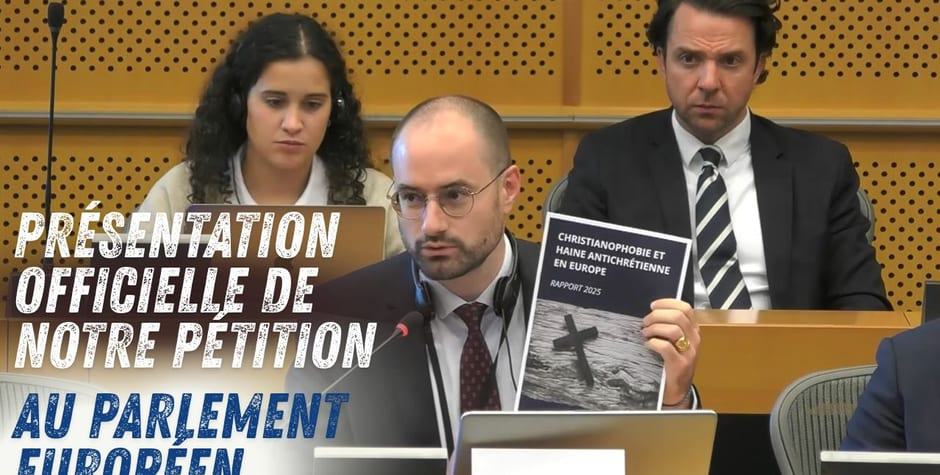
Thibault van den Bossche urged European lawmakers to address anti-Christian hate crimes on the same footing as hostility directed at other religious communities.
BRUSSELS — When Thibault van den Bossche appeared before the European Parliament’s Committee on Petitions on October 12, his argument was built around a relatively simple question: if European institutions have developed specific mechanisms to respond to hatred targeting some religious communities, should Christians facing violence and discrimination receive comparable institutional attention?
Van den Bossche, Advocacy Officer for Religious Freedom at the European Centre for Law and Justice, was presenting petition No. 0443/2026, concerning the alleged rise of anti-Christian sentiment and what the petition describes as a need for equal protection across the European Union.
By the end of the hearing, the European Parliament’s Committee on Petitions had decided to keep the petition open, allowing further consideration and requests for information from the European Commission. The ECLJ is also seeking a debate in Parliament’s plenary and, eventually, a resolution addressing the issue.
For van den Bossche, the hearing represented an opportunity to move a subject often discussed through statistics and individual attacks into a formal European institutional setting.
Making anti-Christian attacks visible
A central part of van den Bossche’s presentation concerned what the ECLJ sees as the limited visibility of anti-Christian hate crimes in Europe.
The organization pointed lawmakers to figures from the Observatory on Intolerance and Discrimination against Christians in Europe, known as OIDAC Europe. Its latest report identified 2,211 anti-Christian hate crimes during 2024, including 274 personal attacks involving violence or threats and 94 cases of arson against churches or other Christian sites.
Those figures do not show a simple across-the-board increase. OIDAC recorded 2,444 incidents the previous year, although the organization says differences and gaps in national reporting complicate direct comparisons. More significantly, according to its figures, personal attacks increased from 232 to 274, while arson attacks rose sharply.
Van den Bossche’s argument before Parliament was therefore not simply that such incidents occur, but that Europe may still be failing to see their full extent.
The ECLJ identifies several possible reasons. Some acts against churches are recorded primarily as vandalism or property crime without a religious-bias designation. Some victims do not report abuse, whether because they expect little result from a complaint or because they minimize what happened. The organization also argues that Christianity’s historically dominant position in many European societies can make institutions less accustomed to recognizing Christians as potential victims of religion-based hostility.
That last argument represents the ECLJ’s interpretation rather than an established conclusion of the European institutions. Questions surrounding incomplete reporting, however, affect the measurement of hate crimes against several religious and belief communities and remain a broader challenge for European human-rights policy.
A call for equal institutional treatment
Van den Bossche’s most concrete demand is the creation of an EU coordinator responsible for combating anti-Christian hatred and discrimination.
The proposal follows mechanisms already established by the European Commission to address antisemitism and anti-Muslim hatred. For the ECLJ, creating an equivalent position addressing anti-Christian hatred is principally a question of equal institutional treatment rather than of granting Christians a privileged status.
The proposal has already appeared in the European Parliament itself. In its annual resolution on human rights and democracy adopted on January 21, 2026, Parliament expressly regretted the absence of an EU coordinator responsible for combating what the resolution termed “Christianophobia,” while noting the existence of an EU coordinator addressing anti-Muslim hatred.
That distinction matters. Van den Bossche was therefore not asking lawmakers to consider an entirely new idea. Rather, his petition sought to turn a concern already acknowledged in an adopted parliamentary text into a more concrete European policy discussion.
The European Commission has so far taken a broader approach. It has emphasized that existing European mechanisms addressing hate speech, hate crime and discrimination on religious grounds are applicable to Christians as well as to other religious communities.
According to the ECLJ’s account of the October 12 hearing, the Commission representative acknowledged that violence against Christians was unacceptable but indicated that the executive did not currently intend to establish additional mechanisms.
Political differences emerge at the hearing
Van den Bossche’s intervention also exposed differing political views over whether existing European structures are sufficient.
According to the ECLJ, members participating in the discussion from the European People’s Party, Patriots for Europe, European Conservatives and Reformists, and Europe of Sovereign Nations supported keeping the petition open. The organization also criticized the absence of representatives from several other parliamentary groups during the hearing.
Several participating MEPs argued that failure to establish a mechanism comparable to those addressing antisemitic and anti-Muslim hatred creates unequal treatment between religious communities.
The debate can easily become politically polarized, but the underlying freedom of religion or belief question is broader. Protection against religious hatred is not a finite resource: recognizing anti-Christian violence does not require diminishing measures against antisemitism, anti-Muslim hatred or attacks against smaller religious and belief minorities.
The relevant question is whether comparable conduct is recognized and addressed according to comparable standards, regardless of the identity of the victim.
From individual attacks to a European question
Van den Bossche also referred to particularly serious cases while presenting the issue, including the September 2025 killing in Lyon of Ashur Sarnaya, an Iraqi Christian refugee who had previously fled violence by ISIS.
Cases of lethal violence inevitably attract attention because of their severity, but the petition reaches further. It encompasses vandalism of churches, threats and harassment against individuals, discrimination and the broader question of whether religiously motivated hostility is consistently identified in official statistics.
The issue is also being discussed beyond the European Union institutions. On June 24, members of the Parliamentary Assembly of the Council of Europe submitted a cross-party motion for a resolution on “Hate crimes, intolerance and discrimination against Christians in Europe”.
The motion calls for improved collection of data, stronger protection of places of worship, action against online hatred and greater cooperation among governments, law-enforcement authorities, religious communities and civil society. It remains a motion rather than an adopted PACE resolution, but its cross-party sponsorship shows that the subject is being raised in more than one European institution.
What van den Bossche achieved in Brussels
The immediate result of the October 12 hearing is procedural, but important: petition 0443/2026 has not been closed.
That means the questions raised by van den Bossche remain before the Committee on Petitions. Further information can be requested from the European Commission, and additional parliamentary initiatives may follow. The ECLJ says it wants the matter ultimately brought before the Parliament as a whole.
Whether the European Union will eventually appoint a dedicated coordinator remains unresolved. The Commission has not committed to doing so, and the political groups represented in Parliament do not necessarily share the ECLJ’s analysis or preferred solution.
But van den Bossche’s appearance before the committee has placed the issue more firmly within an institutional debate already developing in Brussels and Strasbourg: how should Europe respond when members of a historically majority religion experience violence or hostility because of their faith?
For freedom of religion or belief advocates, the implications extend beyond Christianity. A system of religious freedom ultimately depends not on whether a community is historically dominant or numerically small, but on whether people receive effective protection when they are targeted because of their religion or belief. Van den Bossche’s petition asks European institutions to examine whether that principle is being applied consistently — and, for now, the European Parliament has agreed to keep examining the question.