


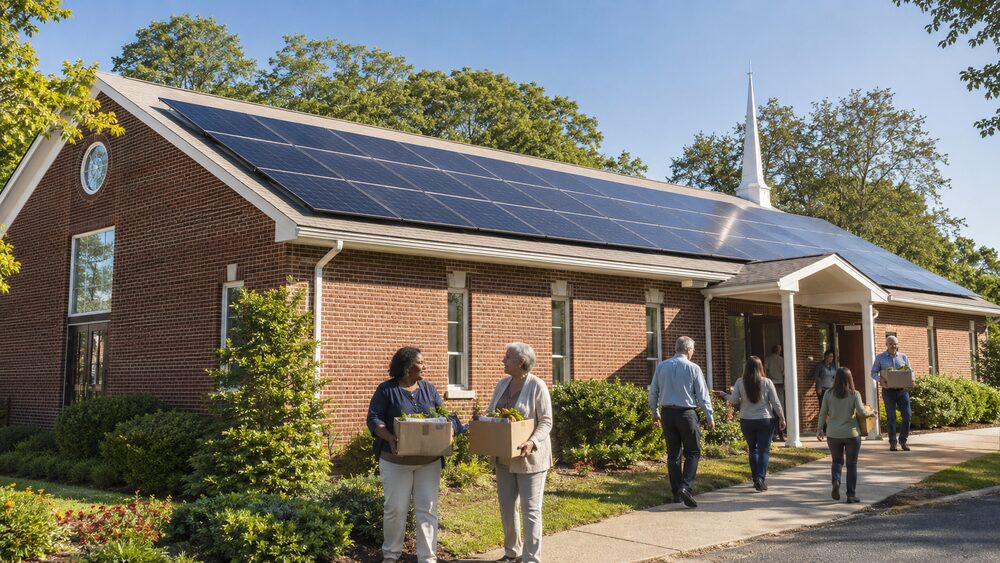
A growing group of United Methodist congregations in Georgia is discovering that environmental stewardship can also strengthen the practical foundations of local ministry.
Churches in and around Atlanta are installing solar panels with guidance from Georgia Interfaith Power and Light, a nonprofit that helps religious communities evaluate energy use, identify qualified installers and navigate financing options.
The participating congregations highlighted in a new United Methodist News report include Dunwoody United Methodist Church, Chamblee First United Methodist Church, North Decatur United Methodist Church and Neighborhood Church. Oconee Street United Methodist Church in Athens is also preparing for an installation.
The projects connect a theological commitment to care for creation with two everyday concerns shared by many congregations: controlling utility expenses and directing more resources toward service.
Savings that can support ministry
Chamblee First United Methodist Church completed its installation in April and reported approximately $40,000 in savings. Dunwoody United Methodist Church, whose system was completed in 2025, reported saving $15,000 during its first year of solar operations.
Those figures were supplied by the congregations and will need to be assessed over a longer period to show the projects’ full financial performance. Even so, the early results illustrate why solar power is attracting attention from churches responsible for maintaining large, frequently used buildings.
Depending on the financing arrangement, a congregation may be able to begin without paying the entire cost upfront. Some churches lease their panels and purchase the electricity produced by the system at a rate intended to be lower than their previous utility costs. The arrangement can also place equipment maintenance with the solar provider.
Georgia Interfaith Power and Light conducts low-cost energy assessments and serves as a liaison between congregations and vetted installers. Its broader work includes waste reduction, environmental justice and community resilience, allowing churches to consider solar power as one part of a more comprehensive stewardship plan.
For the Rev. Miki Chastain of Oconee Street United Methodist Church, energy use is connected to the congregation’s work alongside vulnerable neighbors. She told UM News that a church seeking credibility on questions of justice must also examine how it consumes natural resources and affects the air.
From lower bills to disaster resilience
Solar energy’s value to churches may extend beyond routine savings. When paired with battery storage, it can help a congregation maintain essential operations during a power failure or natural disaster. That can matter when a church building functions as a cooling center, food-distribution site, communications hub or temporary shelter.
The United Methodist Board of Global Ministries and the United Methodist Committee on Relief are now developing that potential nationally through a Solar and Battery Pilot Program.
Up to 20 United Methodist churches serving vulnerable communities will be selected for a two-month training cohort. Participants will receive guidance on procuring and installing solar panels, battery storage or both. Selected congregations may then apply for grants of up to $100,000, with $1 million available across the program. Participation in the training does not guarantee a grant.
Applications are scheduled to remain open through Nov. 2, 2026, with training planned from Jan. 11 through March 12, 2027.
The Georgia projects demonstrate how environmental commitments can move from statements and study groups into visible community infrastructure. Solar panels on a sanctuary roof are both functional equipment and a public sign that religious stewardship includes attention to energy, climate and the responsible use of shared resources.
For congregations, the most constructive result may be the combination of benefits: fewer emissions, more predictable expenses and facilities that are better prepared to serve their neighbors during emergencies. In that sense, creation care is becoming less of a separate church initiative and more of a practical way to sustain ministry.