


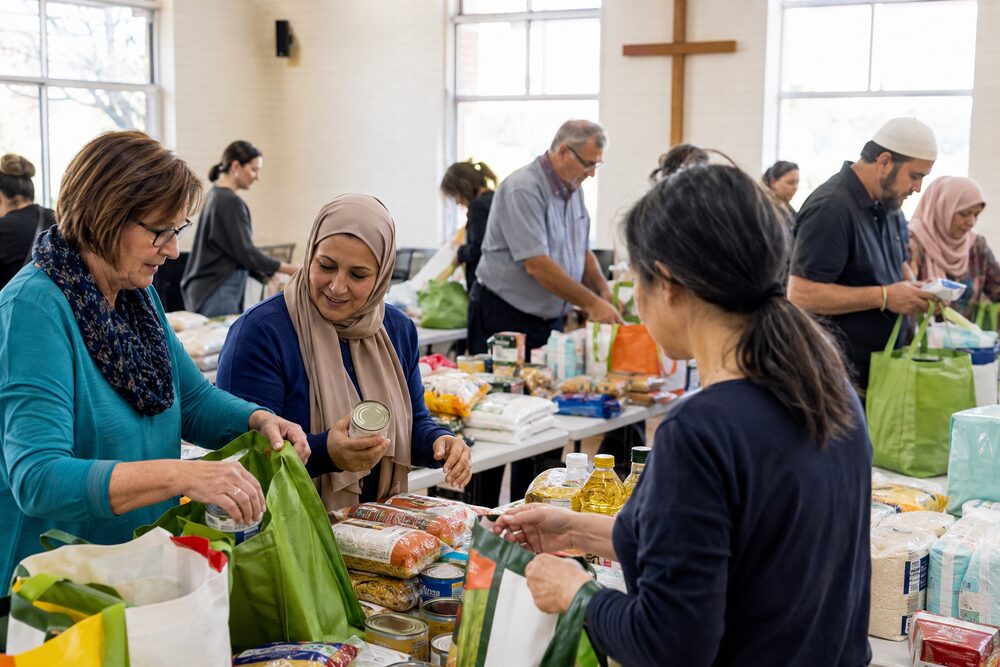
A month-long food drive in Western Sydney has offered a practical example of what interfaith cooperation can accomplish when conversation is paired with service.
The Columban Centre for Christian-Muslim Relations worked with St Andrew the Apostle Parish in Marayong to collect groceries and household essentials for Mahboba’s Promise, an organization supporting vulnerable women and children in Afghanistan and refugees rebuilding their lives in Australia.
By the end of the collection, parishioners had assembled two carloads of supplies. According to the organizers, the donated items went directly to Afghan children living in Western Sydney, providing immediate assistance while also offering a visible sign of welcome.
Relationships Made the Project Possible
The initiative developed through a network of local relationships. Merilyn Hancock, a St Andrew’s parishioner and member of the Interfaith Commission of the Diocese of Parramatta, connected the Columban Centre with the parish Social Justice Committee.
Committee chair Socorro Amos and parish priests Father Kevin Redmond and Father Floyd Gatana then invited the congregation to contribute. The St Vincent de Paul Society also supported the collection.
The drive culminated on July 26, when Mahboba’s Promise founder Mahboba Rawi and three Afghan teenagers visited the parish. After Mass, parishioners and guests shared refreshments and spoke informally about the young people’s experiences of resettlement.
Rawi also described her organization’s work in education, housing and care for children. The encounter allowed parishioners to see the human impact of their donations while giving the Afghan guests an opportunity to meet members of the neighborhood supporting them.
An account published by Catholic Outlook on August 31 highlighted the project as an example of Christian and Muslim communities finding common ground through concern for people facing displacement.
Beyond Symbolic Dialogue
Interfaith initiatives are sometimes judged by the size of their conferences or the prominence of their speakers. The Marayong project suggests another measure: whether a relationship produces something useful for people experiencing hardship.
Here, the collection was deliberately modest and local. Parishioners gathered food and essentials, community organizations connected donors with recipients, and an informal meeting created space for people of different religious and cultural backgrounds to speak with one another.
That combination matters. Material aid can respond to an urgent need, while personal encounters can reduce the distance that often develops between established communities and newly arrived families. Neither element requires participants to minimize their religious identities. Instead, Catholic teachings on service and Muslim commitments to charity and hospitality become points of cooperation.
The project also offers a model that other congregations could adapt. A church, mosque, synagogue, temple or secular neighborhood association does not need to launch a large new institution to contribute. It can begin by identifying a trusted local partner, asking what is genuinely needed and organizing a focused response.
A Welcome Expressed Through Action
For refugees, belonging is shaped not only by government programs but also by everyday contact with neighbors. A donated bag of groceries cannot resolve every challenge of resettlement, but it can communicate that a family has not been forgotten.
The Western Sydney food drive demonstrates how religious communities can strengthen social cohesion without reducing interfaith work to ceremony. Its central achievement was straightforward: people formed relationships, listened to one another and delivered practical support.
At a time when religious difference is often framed as a source of tension, that is a constructive story worth repeating. Cooperation becomes credible when it can be seen in stocked tables, shared refreshments and new neighbors welcomed with dignity.