


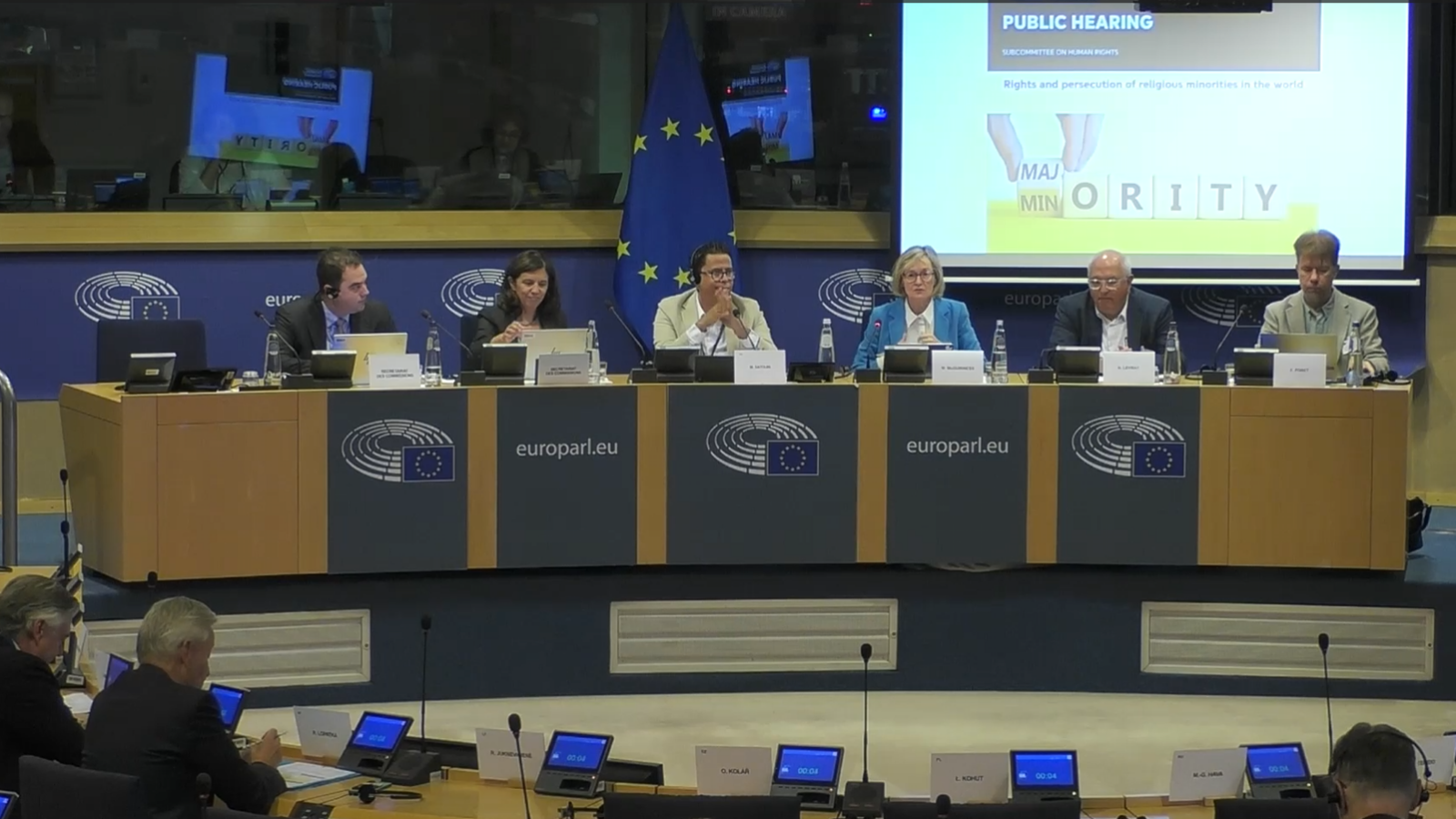
MEPs, the EU’s new religious freedom envoy and UN experts confronted persecution, Christian vulnerability, double standards and the question of whether Europe is prepared to turn principles into political action.
A European Parliament hearing on September 3 brought an unusually direct question to the centre of EU foreign policy: if freedom of religion or belief is a universal human right, what is Europe prepared to do when governments, armed groups or social systems deny it?
The public hearing of the Parliament’s Subcommittee on Human Rights, DROI, brought together Mairead McGuinness, the recently appointed EU Special Envoy for the promotion of freedom of religion or belief outside the European Union; Nicolas Levrat, UN Special Rapporteur on minority issues; and François Foret, a specialist in religion and European politics at the Université libre de Bruxelles.
Over more than two hours, the discussion ranged from Nigeria, Pakistan, India, Turkey and Belarus to anti-conversion laws, blasphemy accusations, forced marriage, discrimination against Muslims in Europe, the responsibilities of states, religious literacy, artificial intelligence and the potential use of EU trade and diplomatic relations as leverage.
But beneath those subjects ran a deeper debate. Several members insisted that the scale of persecution of Christians has been insufficiently recognised in European policy. Others warned against building a hierarchy of victims and argued that the credibility of religious freedom depends precisely on defending Christians, Muslims, Jews, Sikhs, Ahmadis, atheists and other believers and non-believers according to the same universal principle.
By the end of the hearing, a broad consensus appeared to exist on the seriousness of the global problem. What remained much less settled was how the European Union should translate that consensus into measurable action.
McGuinness warns that human-rights progress is reversible
Opening the hearing, DROI Chair Mounir Satouri described freedom of thought, conscience and religion as a universal right protecting the freedom to believe, not to believe, change belief and manifest belief without coercion or fear.
McGuinness then set a stark backdrop for the debate. Referring to a recent statement by EU High Representative Kaja Kallas, she recalled the estimate that almost two-thirds of the world’s population live in countries where serious abuses and violations of freedom of religion or belief occur.
“Millions of people suffer daily from intolerance, discrimination, hatred, hostility and violence because of their actual or perceived religion or belief, or lack thereof,” she said, quoting the EU statement. “And many pay with their lives.”
For McGuinness, the worsening international environment is linked to a broader erosion of institutions, political polarisation, extremism and nationalism. In places where state authority is weak, she warned, militias, armed groups and criminal organisations can use religion as an instrument for domination or as a justification for violence.
That makes engagement with local actors particularly important. Governments alone, she argued, may either lack the capacity to protect minorities or form part of the problem themselves. Religious communities, non-confessional groups, civil society organisations and others living with persecution therefore have to become part of the EU’s information and diplomatic network.
Her mandate, she stressed repeatedly, is not confined to traditional religions. Freedom of religion or belief protects “the right to believe or not to believe,” including non-theistic and atheistic convictions.
McGuinness also offered one of the hearing’s most striking personal reflections. When younger, she said, she assumed that progress in human rights was effectively inevitable.
“I regret to say that I was wrong in my youth to believe that that would happen,” she told the committee.
The implication was clear: rights achieved in one generation can be weakened in another, making political vigilance and institutional action necessary rather than optional.
Christian persecution moves to the centre of the debate
A substantial part of the parliamentary exchange focused on Christians.
Antonio López-Istúriz White argued that Europe should not remain silent when Christians are persecuted because of their religion, pointing particularly to violence in Nigeria, the Sahel and Mozambique and to the vulnerability of Christian women.
Marco Tarquinio agreed that Christians face severe persecution across many parts of the world, but explicitly cautioned against restricting the debate to one faith. As a Christian himself, he said, he regarded it as important to recognise Christians’ vulnerability without ignoring the persecution of other religious minorities.
Bernard Guetta went further in challenging what he described as a longstanding “timidity” in the Parliament over religious liberty. Christians should not receive more protection merely because Christianity has historically shaped Europe, he argued, but neither should they receive less protection for that reason.
Tomasz Froelich and other MEPs raised Nigeria repeatedly, arguing that the specifically anti-Christian element in attacks should not disappear behind broader explanations involving land, resources, insurgency or communal conflict.
Bert-Jan Ruissen asked McGuinness to set concrete priorities for her first months, particularly in countries such as Nigeria, India and Pakistan where Christians face serious difficulties.
The resulting exchange exposed an important distinction between political concern and statistical certainty.
Several MEPs stated that Christians are the world’s most persecuted religious group. Guetta specifically pressed McGuinness to confirm whether that claim was correct.
She did not give the categorical answer some members appeared to seek.
McGuinness acknowledged the scale of persecution affecting Christians and noted Christianity’s very large global population, meaning that numerically it “may well be” the case. But she cautioned against allowing numerical comparisons to determine whose rights deserve protection.
Foret was even more cautious. Rankings of religious persecution, he noted, depend heavily on definitions, criteria and methodology. Some are produced within specific national or political environments, particularly in the United States, and classifications can produce surprising results depending on how restrictions are measured.
The hearing therefore stopped short of establishing an agreed ranking of persecuted religions. Instead, it demonstrated how politically significant that question has become.
India raises the question Europe cannot easily escape
Rima Hassan brought another tension into the discussion: what happens when the European Union deepens economic relationships with states accused of discrimination against religious minorities?
She pointed to India and referred to discrimination and persecution affecting Muslims, Christians and Sikhs while asking how the EU reconciles its human-rights commitments with expanding economic, trade and technological cooperation.
Other MEPs asked similar questions more broadly. Should access to EU money depend on respect for religious freedom? Should violations affect trade agreements? Should European diplomatic delegations systematically make freedom of religion or belief a higher priority?
McGuinness rejected the idea that the answer should normally be disengagement.
Relationships with governments accused of violations, she suggested, can provide precisely the diplomatic channel through which pressure can be exercised. Trade and political partnerships should not prevent discussion of human rights; they can create leverage for it.
“Engagement is what we need and deeper engagement,” she said.
That approach places considerable responsibility on the EU. If engagement is justified partly because it allows Europe to raise human-rights concerns, then the effectiveness of that engagement ultimately has to be judged by whether those concerns are actually raised and whether consequences follow persistent violations.
Nigeria, Pakistan, Turkey and Belarus enter the discussion
Several country situations received sustained attention.
Nigeria dominated much of the discussion of Christian persecution. MEPs referred to killings, violence against women and girls, armed extremist organisations and questions about whether Nigerian authorities are responding adequately.
McGuinness disclosed that she had already had contact with faith communities concerning Nigeria, while describing her preferred method as one of “quiet diplomacy.”
Pakistan emerged principally in connection with blasphemy accusations, forced conversion and forced marriage.
Levrat offered an especially significant observation from his own engagement with Pakistan. Discussing the operation of anti-blasphemy provisions and their impact particularly on Ahmadis, he said the issue was intertwined with what he described as widespread institutional corruption.
His broader point was that apparent religious persecution cannot always be understood solely through theology or religious hostility. Dysfunctional institutions, corruption, economic interests and unequal access to justice may interact with religious discrimination and make it considerably more dangerous.
Ruissen raised Turkey, telling the hearing that the European Court of Human Rights had communicated cases involving foreign Christians who had allegedly been banned or deported in connection with their religious activity. He asked whether McGuinness would take the matter directly to Ankara.
McGuinness said she would need to examine the individual circumstances before answering substantively.
Belarus was raised by Małgorzata Gosiewska, who described administrative means of restricting religious communities, including problems affecting clergy and religious organisations. She invited McGuinness to engage more closely with the Parliament’s Belarus delegation and specialists on the situation.
McGuinness indicated that she was open to such engagement.
The UN Special Rapporteur maps the mechanisms of discrimination
If the first panel concentrated on political priorities, Nicolas Levrat’s intervention offered a structural explanation of how religious discrimination operates.
His starting point was simple: minorities are often treated differently precisely because they belong to a group that differs from the majority.
But the mechanisms can range dramatically in severity.
Levrat told MEPs that roughly 50 countries have a state religion. In his analysis, the privileged relationship between a state and a particular religion can create discriminatory effects for those outside it, even where there is no violent persecution.
These may include bureaucratic restrictions, difficulties obtaining permission for places of worship or unequal access to public institutions.
At the extreme, however, discrimination can develop into physical persecution and even attempts to destroy entire communities.
A second major problem is conversion.
Levrat contrasted the explicit wording of Article 18 of the Universal Declaration of Human Rights concerning the freedom to change religion with the wording of the International Covenant on Civil and Political Rights, which speaks of the freedom to “have or to adopt” a religion or belief.
He argued that the less explicit formulation can matter in societies where conversion is restricted. He cited 46 countries as currently having laws banning or restricting conversion.
Such provisions, he argued, are often asymmetrical in practice. Conversion from a minority religion into the majority religion may be accepted while movement in the opposite direction can lead to legal, administrative or social consequences.
Marriage can intensify those pressures, particularly for women.
Levrat’s third category concerned the state’s responsibility to protect people from violence. In many situations, members of minority communities are attacked not directly by government forces but by private individuals, mobs or armed groups. The human-rights question then becomes whether authorities are willing and able to protect them.
Failure to do so may itself reflect discrimination.
Blasphemy laws remain a major global concern
Levrat also highlighted blasphemy legislation.
According to figures he presented to the committee, 105 countries retain some form of anti-blasphemy legislation. In eight, he said, violations can lead to the death penalty, while in around 30 countries imprisonment is possible.
The issue raises a fundamental distinction between protecting individuals and protecting religious doctrines from criticism.
Human-rights law protects people against violence and discrimination because of their religion or belief. But whether governments should protect religions themselves against allegedly offensive opinions is a very different question.
That distinction can become blurred when blasphemy accusations are used against minorities, converts, dissenters or people involved in personal or commercial disputes.
Levrat nevertheless cautioned against reopening foundational international human-rights treaties simply to improve their wording. In the present geopolitical climate, renegotiation could result not in stronger protection but in weaker commitments.
Foret: Europe needs more religious literacy
François Foret approached the issue from a different perspective.
Drawing on decades of research into religion and European politics, he offered four broad warnings: Europe should not be “too European” when looking at the rest of the world; policymakers should fight today’s battles rather than yesterday’s; they should identify carefully who holds power and who is vulnerable; and they should expect resistance and backlash when defending freedom of religion or belief.
Europe, Foret observed, is one of the world’s more secularised regions. As a consequence, European officials may lack what he called “religious literacy”: the ability to understand the role religion continues to play in the everyday identity, social organisation and politics of other societies.
That does not mean abandoning European principles. It means avoiding the assumption that the European historical path can simply be reproduced elsewhere.
Religious freedom also increasingly extends beyond the classical dispute between church and state.
Foret urged policymakers to look at discrimination in workplaces, businesses, media and digital environments. He even raised the way artificial intelligence learns and reproduces information about religions as an emerging field requiring attention.
Religion may also intersect with ethnicity, gender, sexual orientation, generation, economic position, land disputes and political identity. In such situations, he argued, reducing a conflict to religion alone can obscure rather than illuminate what is happening.
Religious minorities can nevertheless serve as a social “barometer”: pressure on them often reveals much wider failures in the rule of law and the protection of fundamental rights.
Europe’s credibility abroad leads back to Europe itself
Although McGuinness repeatedly reminded MEPs that her formal mandate concerns countries outside the European Union, the question of Europe’s own record repeatedly returned.
Hana Jalloul Muro argued that religious freedom discussions must include Islamophobia and antisemitism as well as Christian persecution and the rights of people with no religion.
Hassan referred to findings concerning discrimination against Muslims within the EU and asked how Europe could credibly promote freedom of religion abroad without fully addressing problems at home.
Malika Sorel similarly challenged the strict division between external and internal religious freedom, pointing to rising tensions involving religions inside Europe.
Levrat acknowledged the problem of perceived double standards. He said the EU frequently appears more focused on minority rights beyond its borders than within them, even if institutional competences partly explain the difference.
He also revealed that he had obtained EU agreement for a monitoring visit concerning religion and minorities.
Foret added another dimension: one feature distinguishing Europe is precisely that its failures can be discussed publicly. Criticism of the EU’s internal record, he suggested, should not be confused with arguing that Europe is among the worst regions of the world for religious freedom.
McGuinness herself did not dismiss the issue. Although it falls outside her mandate, she acknowledged that the concerns expressed inside the room were significant and that perceptions of double standards have consequences for the Union’s credibility.
MEPs demand to know what happens after a resolution
One of the hearing’s most concrete exchanges came when Ruissen asked what had happened after Parliament adopted resolutions on the persecution of Christians.
He referred to parliamentary action involving Turkey, Pakistan and Nigeria and asked a direct question: after Parliament asks the EU institutions to act, what is the follow-up?
Did officials contact governments? Did they apply pressure? What concrete measures resulted?
McGuinness said that she had taken the Parliament’s resolutions into account and had conducted outreach relating to issues raised by MEPs. She encouraged Parliament to continue adopting such resolutions, saying governments do notice them even when they do not immediately change policy.
But the exchange also exposed a gap that the hearing never completely closed.
The EU possesses guidelines, diplomatic delegations, human-rights dialogues, trade relations, development programmes, special representatives, sanctions mechanisms and now a renewed Special Envoy mandate. Yet MEPs repeatedly asked how those instruments translate into identifiable consequences in individual cases.
McGuinness herself acknowledged the challenge, saying that one of the questions she asks is whether existing action is actually effective.
Quiet diplomacy versus visible accountability
That may become one of the defining questions of McGuinness’s mandate.
She clearly signalled a preference for pragmatic engagement rather than public confrontation in every case. She spoke of listening, travelling, cooperating with other special envoys and UN mechanisms and working closely with communities on the ground.
“I will engage, I will listen, I will travel,” she said.
There are obvious advantages to diplomacy that occurs away from cameras. Governments may be willing to discuss sensitive cases privately when public pressure would cause them to harden their position.
But parliamentary scrutiny introduces a competing requirement: accountability. If diplomatic efforts are largely invisible, legislators and civil society will inevitably ask how success or failure is to be measured.
The September 3 hearing did not resolve that tension. It did, however, put it squarely on the record.
A new front: social media, misinformation and AI
Toward the end of the hearing, McGuinness noted another issue that had received relatively little attention during the discussion: social media.
Digital platforms can rapidly distribute information, misinformation and disinformation about religious communities. Recommendation systems can reinforce existing views by repeatedly supplying users with content resembling what they already consume.
Foret’s reference to artificial intelligence widened that warning further. In an era in which algorithms increasingly mediate how societies learn about unfamiliar beliefs, religious literacy is no longer only a matter for schools, diplomats or journalists. It is becoming a question of how technology categorises communities, reproduces stereotypes and makes decisions.
That could become one of the least developed but most consequential aspects of future FoRB policy.
The hearing ends with a choice between universalism and rivalry
Satouri closed the hearing by returning to the philosophical divide that had run through much of the morning.
Religious persecution can be addressed through universal rights, he argued, or through a competition in which communities defend primarily those with whom they identify.
The first approach treats attacks on Christians, Muslims, Jews and other minorities as manifestations of the same fundamental problem: the denial of human dignity and freedom.
The second risks turning religious freedom into another arena of geopolitical and cultural rivalry.
For Satouri, Europe’s credibility depends on choosing the universalist approach. A policy based on pitting communities against one another, he warned, could ultimately contribute to a “war of civilisations” in which everyone loses.
That did not negate the repeated warnings about Christians. On the contrary, the hearing demonstrated that the persecution of Christians has become an increasingly prominent concern inside the European Parliament. What the universalist approach demands is that their suffering be addressed seriously without requiring that the suffering of another community first be minimised.
McGuinness reached a similar conclusion from a different direction. If the EU retreats from defending freedom of religion or belief, she warned, then the word “backsliding” would have to be written in bold and underlined.
The hearing therefore ended with far more than a catalogue of persecution.
It placed a test before the European Union: whether its diplomatic network, trade relationships, human-rights mechanisms and renewed Special Envoy mandate can turn a principle almost everyone professes to support into protection that is felt by individuals whose names rarely reach Brussels.
For those individuals—Christians attacked in their communities, Muslims facing discrimination, Ahmadis accused under religious laws, converts threatened because they changed belief, believers unable to worship freely and non-believers unable to express their convictions—the success of European policy will not ultimately be measured by the number of resolutions, guidelines or hearings produced.
It will be measured by whether those instruments change what happens to them.