


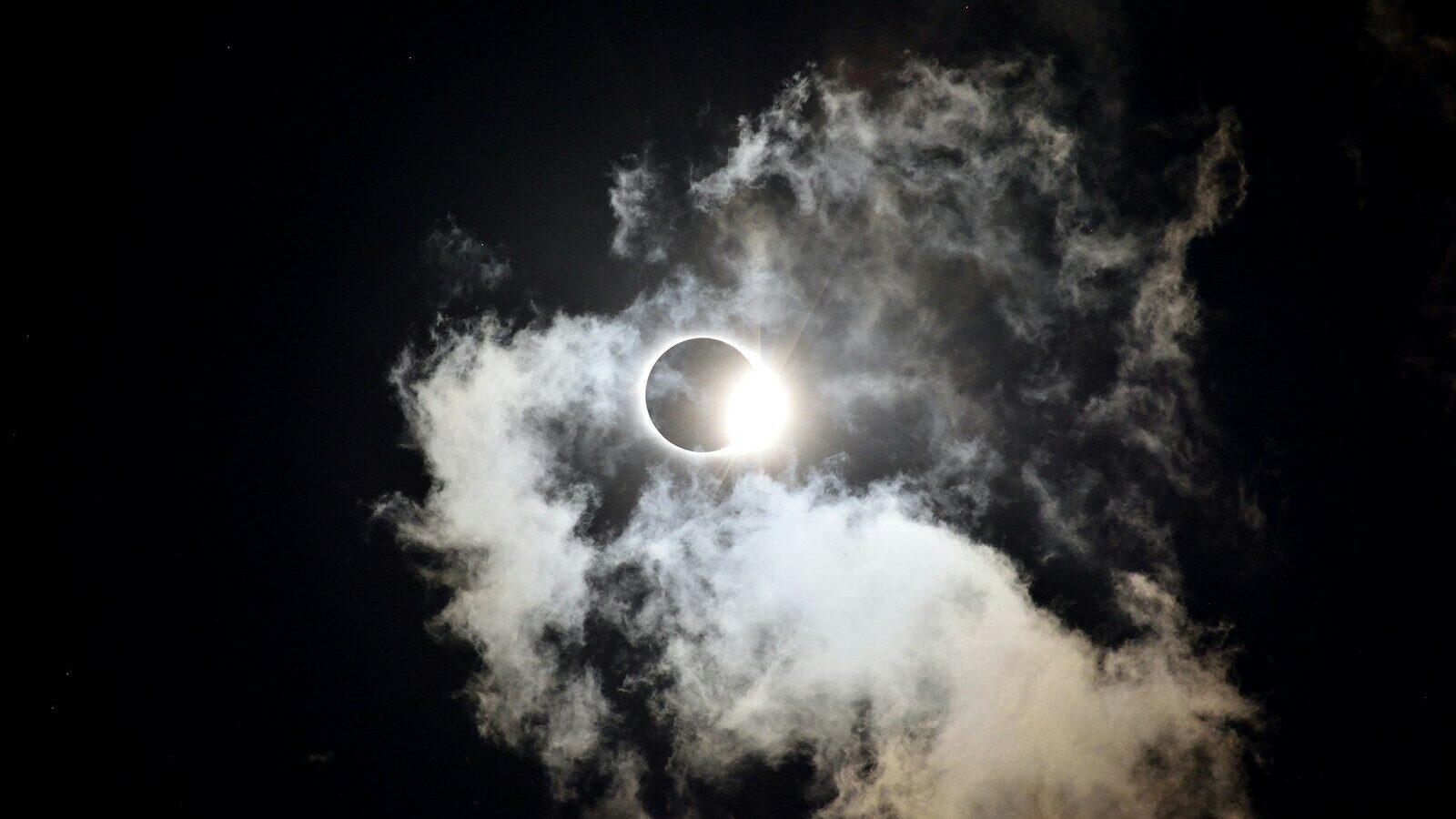
On August 12, 2026, the Moon’s shadow will cross part of the Northern Hemisphere, briefly turning daylight into darkness. According to NASA’s eclipse forecast, totality will be visible from Greenland, Iceland, northern Russia, Spain and a small corner of Portugal. Much of Europe, northwestern Africa and northern North America will experience a partial eclipse.
Astronomy explains what will happen: the Moon will pass between Earth and the Sun. Religion, mythology and culture ask additional questions. What does such a dramatic interruption of daylight mean? How should people respond? Is it a warning, a sacred pause, a call to prayer or an invitation to wonder?
Human communities have offered remarkably different answers. Some tried to defend the Sun from a celestial attacker. Others treated eclipses as messages for rulers. Several living religious traditions turn the experience toward prayer, ethical reflection or spiritual practice. These responses should not be flattened into a single category of “eclipse superstition.” They belong to distinct histories and continue to carry meaning for many people.
Ancient China: When the Sun Was “Eaten”
Some of humanity’s earliest surviving eclipse records come from China. Around 1200 BCE, scribes at Anyang recorded eclipses on oracle bones using language translated as “the Sun has been eaten.” Modern scientists have used those records to study changes in Earth’s rotation, as described in NASA’s history of eclipse observation.
Chinese traditions later spoke of a celestial dragon attacking or consuming the Sun. Drums and other loud sounds were used in rituals intended to assist the threatened heavenly body. Behind the memorable dragon story was a serious understanding of cosmic and political order. An irregularity in the sky could be interpreted as a warning to the emperor, whose responsibility was to preserve harmony between heaven and society.
The records also demonstrate that observation, ritual and political responsibility were not separate categories in the ancient world. The people recording a heavenly omen were simultaneously building a body of astronomical knowledge.
Mesopotamia: An Omen That Threatened the King
In ancient Mesopotamia, eclipses belonged to a sophisticated system of celestial divination. Priests and scholars studied the sky as a field of signs through which the gods might communicate danger or opportunity.
A solar eclipse could be considered an especially grave threat to the ruler. According to the Metropolitan Museum of Art’s account of the substitute-king ritual, the real king might temporarily withdraw while another man was installed in his place. The substitute was expected to absorb the dangerous fate indicated by the eclipse. In some recorded cases, the substitute and his queen were later killed.
The practice reveals both the intellectual achievements and the severe inequalities of Mesopotamian court religion. Astronomers could predict eclipses with considerable accuracy, yet the event was still understood as a divine message with political consequences. Knowledge of the mechanism did not remove its religious significance.
Hindu Traditions: Rahu, Ketu and the Power of Sacred Time
One of the best-known Hindu eclipse narratives concerns Rahu. In later forms of the story, Rahu secretly tastes the nectar of immortality. The Sun and Moon expose him, and Vishnu severs his head. Because Rahu has already become immortal, his head continues pursuing and swallowing the Sun or Moon. The light soon reappears because Rahu cannot hold it within a severed body. Ketu becomes associated with the remaining body or tail.
The history of these figures is complex. A scholarly study of the development of Rahu and Ketu in Indian astronomy and mythology traces them through Vedic and later Sanskrit sources. Rahu and Ketu also became associated with the ascending and descending lunar nodes: the points at which the Moon’s path crosses the apparent path of the Sun and where eclipses can occur.
Hindu communities are highly diverse, but traditional observances may include fasting, mantra recitation, charitable giving and bathing at the end of an eclipse. Some temples close during the event and reopen after ritual purification. Other Hindus participate in scientific viewing events or do not follow special restrictions. Myth, mathematical astronomy and contemporary practice can coexist without every practitioner interpreting them in the same way.
Islam: A Sign of God and a Call to Prayer
Islamic tradition contains one of history’s clearest rejections of linking an eclipse to the death of a powerful or holy person. A solar eclipse occurred around the time Ibrahim, the young son of the Prophet Muhammad, died. When people associated the two events, Muhammad taught that the Sun and Moon do not eclipse because of anyone’s birth or death.
Instead, Muslims were instructed to respond with prayer, remembrance of God, supplication and charity. The special congregational prayer offered during a solar eclipse is known as salat al-kusuf.
As the University of Chicago’s Center for Middle Eastern Studies explains, an eclipse can be understood as ordinary because it belongs to the divine order of creation, yet extraordinary because it draws renewed attention to divine power. The response is therefore neither worship of the Sun nor panic, but humility and prayer.
Judaism: Omen, Moral Reflection and Debate
The Babylonian Talmud, in Sukkah 29a, compares an eclipse to a king removing a lamp from a banquet and describes a darkened Sun as an unfavorable sign for the nations. The same passage ultimately teaches that those who faithfully do God’s will need not fear celestial signs.
Jewish interpreters have long discussed how this teaching relates to the predictable movement of the Sun, Moon and Earth. One Orthodox Jewish discussion of the passage argues that a natural and calculable event can still prompt spiritual reflection without denying its physical cause.
There is no single contemporary Jewish reaction to an eclipse. Some approach it primarily as an astronomical wonder; others regard the older texts as an invitation to examine human conduct. The interpretive conversation itself is characteristically important: knowledge, moral responsibility and inherited teaching are placed in dialogue.
Christianity: From Apocalyptic Imagery to Faith and Science
Darkened skies appear in several biblical passages, including prophetic and apocalyptic texts. The Gospels also describe darkness during the crucifixion of Jesus. Across Christian history, some readers have consequently treated eclipses as signs of judgment or approaching upheaval.
Many contemporary Christians, however, caution against attaching end-times predictions to a calculable astronomical event. They understand an eclipse as part of the created order and as an occasion for awe, gratitude and scientific discovery.
That approach was visible during the 2024 North American eclipse, when Catholic clergy, astronomers and families gathered for a faith-and-science retreat described by the Vatican Observatory. Lectures on astronomy and cosmology accompanied prayer and communal observation. For participants, scientific understanding did not diminish wonder; it gave them another way to contemplate creation.
Tibetan Buddhism: A Time for Intensified Practice
In some Tibetan Buddhist lineages, an eclipse is considered an especially powerful period for spiritual practice because the karmic effects of actions are believed to be multiplied. Practitioners may recite sutras and mantras, meditate, make offerings or dedicate virtuous actions to the welfare of others.
The Foundation for the Preservation of the Mahayana Tradition advises its students to undertake merit-making activities during the actual local eclipse. This teaching should be understood as a practice associated with particular Tibetan Buddhist teachers and communities, rather than a belief held identically by every Buddhist tradition.
Diné Teachings: A Sacred Pause That Should Be Respected
For many Diné people, commonly known as Navajo, an eclipse is a sacred period of renewal. Traditional protocols may call for remaining indoors, refraining from looking at the eclipse, avoiding food and unnecessary activity, and spending the period in prayer and reflection.
The National Museum of the American Indian’s collection of Indigenous eclipse teachings shows why it is misleading to speak of a single “Native American belief.” Diné, Cherokee, Shawnee, Shoshone-Bannock and other peoples have their own narratives and protocols.
Respect sometimes means making room for people who do not wish to participate in a public viewing. A school or workplace can celebrate astronomy while also allowing Indigenous students and employees to follow a sacred practice without pressure or ridicule.
What These Traditions Share
Across cultures, a recurring story imagines something consuming the Sun: a dragon, serpent, wolf, jaguar or other celestial being. The Smithsonian Center for Folklife and Cultural Heritage has documented this widespread “swallowing the Sun” motif.
Yet the similarities should not erase the differences. An ancient Chinese state ritual, a Hindu narrative about Rahu, an Islamic eclipse prayer and a Diné sacred protocol are not interchangeable versions of the same belief. Each belongs to a particular community, history and understanding of humanity’s relationship with the cosmos.
What they do share is recognition that an eclipse interrupts ordinary attention. For a few minutes, familiar daylight becomes strange. Temperatures fall, shadows sharpen and the horizon changes color. People look upward—or, in traditions that prohibit viewing, deliberately turn inward.
Science now predicts these events with extraordinary precision. That knowledge can protect eyesight and explain the alignment of celestial bodies. It does not prevent an eclipse from inspiring prayer, ethical reflection, storytelling or wonder.
The most constructive response may therefore be one of informed humility: observe safely, listen respectfully and allow different communities to decide what the darkened Sun means within their own traditions.
Viewing the Eclipse Safely
During every partial phase, viewers must use certified solar-viewing glasses or another proper solar filter. Ordinary sunglasses are not sufficient. Direct viewing without protection is safe only during the brief period of complete totality and only for observers located inside the path of totality. People following religious traditions that discourage viewing should not be pressured to watch.