

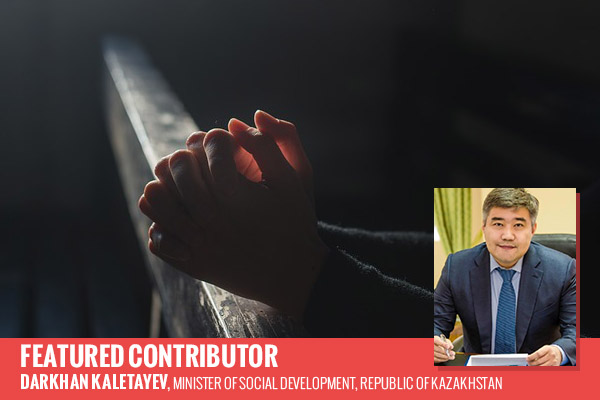
After the 2016 terrorist attacks, the Ministry of Social Development was established to safeguard secularism and monitor and counteract subversive religious practices.
Kazakhstan is a young and diverse nation. In the 26 years since our independence, we have worked hard to build an inclusive society that promotes interfaith dialogue and religious harmony.
Safeguarding the Secular State in an Era of Religious Extremism[/tweetthis]
President Nazarbayev has been a longstanding advocate of secular state development. There is no state religion in Kazakhstan, and under the Constitution, the state cannot give preference to any religious association. All citizens, no matter their ethnicity, language or creed are guaranteed the same principles of equality before the law. Kazakhstan’s multicultural society is made up of 18 million people, representing more than 100 ethnic groups, 18 religious denominations and 3,715 religious associations. Such diversity is to be celebrated in a modern, global nation.
The Kazakh government is deeply concerned by the rise of extremist violence in the region since 2005. After the 2016 terrorist attacks, the Ministry of Social Development was established to safeguard secularism and monitor and counteract subversive religious practices.
Countries across the world continue to face the complex challenges associated with the rise of radical religious thought and religious extremism. Indeed, many societies bear the scars of such religiously-inspired violence. A collective response is needed.
Religiously-inspired extremism does not respect international values or norms. Nor does it confine itself to a single religious group or geographical region. National governments, educators, civil society organisations and religious groups must work together to develop robust policies that help prevent such extremism developing and which can tackle it head on wherever it is found.
Kazakhstan’s programme of secular state development has gone a long way to helping promote and maintain regional stability. We have taken concrete steps to create our own model of interaction between the state and religious groups. We believe that the state should act as a guarantor to the peaceful coexistence of all ethnic and religious groups, helping to promote interfaith harmony.
Continued, open dialogue remains essential. Our government is committed to ongoing engagement with religious organisations across Kazakhstan to promote transparency and inclusivity. To help achieve this in a structured way, the Government launched a new state policy on religion for 2017-2020. Its primary goal is to ensure that Kazakh citizens are safe and protected. It is important that people understand the dangers posed by radical religious movements and can clearly differentiate between radical and traditional religious groups.
Kazakhstan’s policy on religion sets out several measures to help achieve this. By way of example, it has introduced financial checks to ensure that all religious associations are financially transparent. This greatly limits the ability of extremist organizations to fund illicit activities under the guise of charitable or religious works.
The new policy also plays an important role in safeguarding children, requiring a parent or guardian to be present at religious events for children under the age of 16. The government also prohibits religious instruction in public schools.
Kazakhstan’s state policy on religion is built on solid foundations. It was developed following longstanding consultations with our citizens, civil society institutions and secular and religious groups. It provides new and innovative approaches to the issues of security and stability in public spaces. Furthermore, it includes concrete measures to strengthen the collective defense of society to safeguard against the spread of radical religious ideology and extremism. We are achieving this by strengthening the secular foundations of the state, while also protecting the interests of citizens who identify with different faiths.
At the same time, issues of religion at a geopolitical level cannot be overlooked. The intensification of global extremism and terrorism in recent years requires the improvement of religious legislation internationally as well as domestically. Providing an international forum which promotes interfaith discussion and dialog is one such example of how this can be achieved.
Kazakhstan is proud to host the triennial Congress of Leaders of World and Traditional Religions in the capital Astana. The Congress promotes constructive dialogue and understanding between religious leaders of all faiths and denominations. It presents an opportunity for religious organisations to develop concrete practices to integrate themselves in secular societies, and tackle global issues such as religious extremism. Astana will be hosting the sixth Congress in October 2018.
Promoting religious tolerance and countering long held misconceptions is essential to the long-term promotion of peace and stability. Kazakhstan continues to play an active role in the Organisation of Islamic Cooperation, and has made significant efforts to help promote better understanding between predominantly Muslim nations and the rest of the world. Our government will continue to act as a strong advocate for the development of inclusive policies that respect individual freedoms, ensure the safety and security of our citizens, and promote collective international dialogue.