


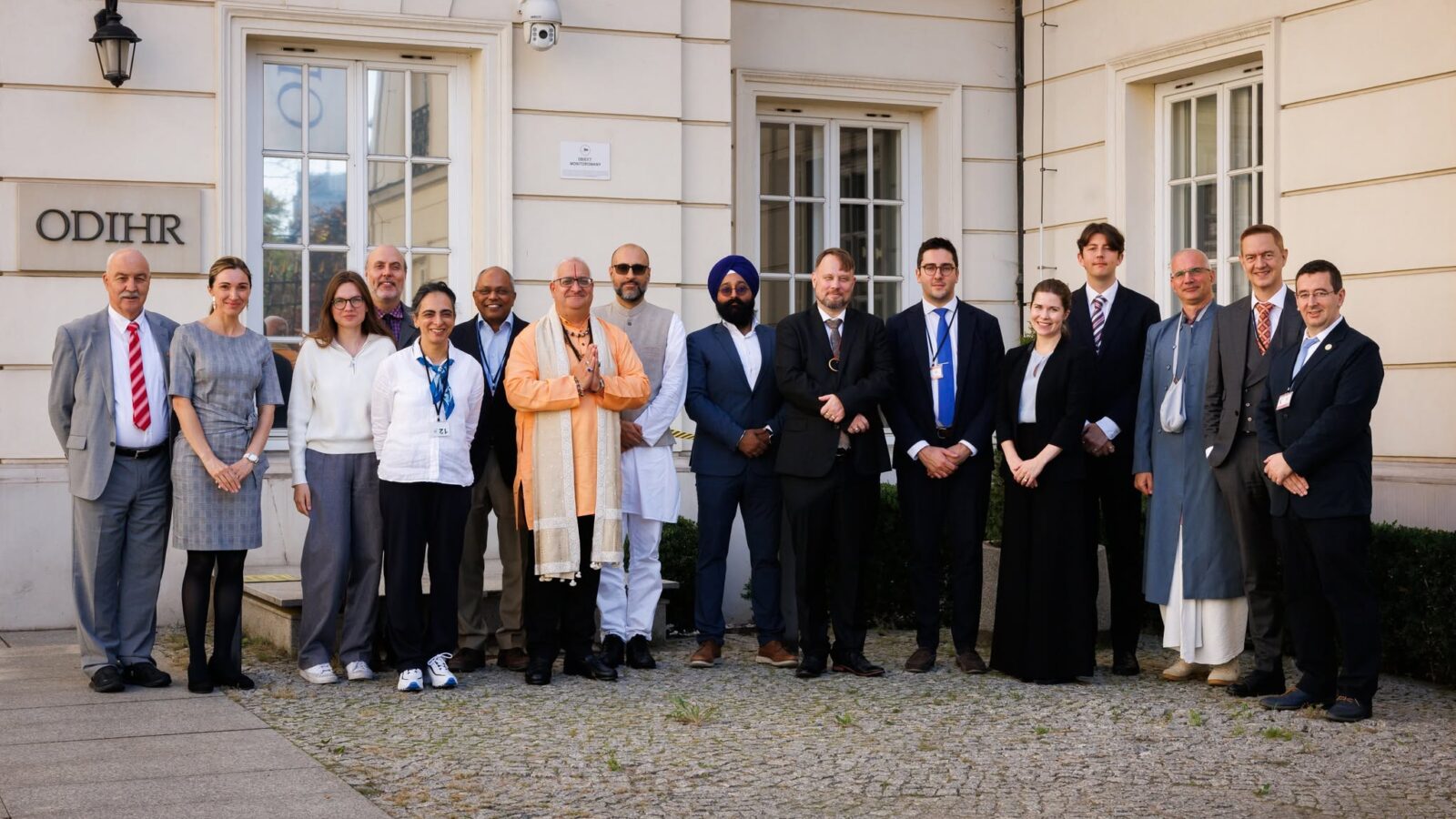
In September 2025, I had the opportunity to participate in a consultation at the Warsaw headquarters of the OSCE Office for Democratic Institutions and Human Rights (ODIHR) that was unusual in both its scope and the diversity of the people around the table.
The meeting was devoted to the “Challenges, Opportunities and Needs of Religious or Belief Communities beyond Christians, Jews and Muslims.” Representatives of Bahá’í, Hindu, Humanist, Krishna, Sikh, Scientologist, Zoroastrian, ethnic, indigenous and pagan traditions came together to discuss their experiences across the OSCE region — not only the discrimination and intolerance they encounter, but also opportunities for dialogue and the contributions their communities can make to society.
ODIHR has now published its “Summary report: Consultation Meeting on the Challenges, Opportunities and Needs of Religious or Belief Communities beyond Christians, Jews and Muslims | OSCE Office for Democratic Institutions and Human Rights“.
Having participated in the meeting, I am pleased to see the breadth of our discussions reflected in the final document, and grateful to ODIHR both for creating the opportunity for this conversation and for ensuring that it did not end when we left the room in Warsaw.
The consultation took place under Chatham House rules, so individual contributions have been anonymized. Its recommendations summarize proposals and priorities raised by participants and do not necessarily represent the views or position of ODIHR. That distinction also allows the report to preserve something important about the meeting: there were different perspectives and disagreements, as one would expect among such diverse religious and belief traditions, but many more agreements and mutual understanding.
Religious freedom beyond the most familiar communities
The premise behind the consultation was relatively simple, but important. Much of ODIHR’s previous work addressing religious intolerance has focused on Christians, Jews and Muslims. There are compelling reasons for that work, and discrimination and hate crimes against members of those communities remain serious concerns across the OSCE region.
But freedom of religion or belief is universal. It also protects religions that are numerically small, traditions that are relatively unfamiliar to public institutions, communities that have only recently become visible in a particular country, ancient religions with small European populations, decentralized traditions, and people holding non-religious beliefs.
What became apparent during the consultation — and comes through clearly in the report — is that many difficulties do not begin with an explicit rejection of that principle. They arise in the gap between formal equality and the way institutions operate in practice.
Participants described legal and administrative frameworks that may have developed around the structures of historically established Christian or Abrahamic traditions. When a very different religious tradition encounters those systems, rules that appear neutral can sometimes produce unequal consequences.
Registration provides a good example. Different OSCE participating States have very different systems for granting legal personality to religious or belief communities. Some distinguish between registered and unregistered groups; others provide several levels of recognition. But these categories can determine much more than the name written on an official certificate. Participants described consequences for legally recognized religious rites, participation in consultation platforms, chaplaincy services, subsidies, tax benefits and access to public broadcasting.
The problem becomes still more evident when a decentralized or pluralistic tradition is expected to organize itself according to a model developed around a centralized majority religion. The report specifically notes this difficulty for some Dharmic traditions. Participants consequently called for legal personality to be available fairly and without discrimination, independently of a community’s size, structure or beliefs.
Discrimination does not always announce itself
The same gap between principle and practice appeared in discussions about public and professional life.
Participants spoke about profiling and disproportionate security checks at airports and borders, sometimes involving people mistakenly perceived as Muslim because of visible characteristics. This is an important reminder that religious prejudice does not necessarily respect the actual identity of its victim: intolerance directed toward one community can spill over onto another simply because an observer assumes that they are the same.
There were also examples of discrimination in professional settings. Among them, the report records cases in which members of a religious community were required to sign declarations renouncing their faith in order to apply for public tenders — the type of practice sometimes described as a “faith-breaker” or religious disassociation declaration. Whatever terminology is used, conditioning access to an economic opportunity on distancing oneself from a particular religion raises obvious questions of freedom of religion or belief and equal treatment.
Education raised another set of concerns. Participants described minority religions being trivialized or represented through derogatory terminology in academic studies, as well as inaccurate or inadequate treatment in school curricula and textbooks. Restrictions on visible religious identifiers and differential treatment of children because of their religious identity were also discussed.
This matters because education does not merely transmit information. For many children, a school textbook may provide their first encounter with a religion other than their own. If that encounter begins with a stereotype, the effects can extend well beyond the classroom. The report therefore places considerable emphasis on religious literacy, accurate representation of different traditions and better training for teachers and public officials.
Persuasion, media narratives and artificial intelligence
One of the more nuanced discussions in Warsaw concerned the right to communicate religious convictions and attempt to persuade others. The report deliberately uses the expression “non-coercive persuasion” rather than “proselytism,” noting that the latter is undefined and often carries negative connotations.
There were different views. Some participants were concerned about the effect that attempts at conversion can have on families or interreligious harmony. Others emphasized that peacefully trying to persuade another person is closely connected to freedom of religion or belief, particularly for smaller communities seeking to sustain and grow themselves.
The area of broad agreement was more interesting than the disagreement: the real boundary is coercion. Freedom of religion or belief protects the ability to communicate convictions, just as it protects the other person’s freedom to reject them. Violence, intimidation, threats and unlawful pressure are another matter entirely.
Media representation generated equally strong discussion because, for less-known communities, the media may be the principal way the wider population encounters them. Participants described hostile or dismissive reporting and the use of labels such as “cult/sect” or characterizations as “new” movements that they said can delegitimize communities and reinforce stigma.
That stigma does not necessarily remain in the newspaper or television programme where it originated. Repeated narratives can shape the assumptions of employers, teachers, officials and other institutions. At the same time, smaller communities often lack the resources and professional capacity to respond effectively when inaccurate information circulates about them.
The discussion became particularly contemporary when it turned to artificial intelligence. Participants warned that AI systems can reproduce existing biases against religious or belief minorities. That concern deserves attention precisely because AI can appear neutral. An automated system trained on an information environment containing decades of stereotypes and inaccurate descriptions may simply reproduce them in a new form and at a much greater scale.
For less-known communities, this creates a particular vulnerability: if the available material about a religion is disproportionately hostile or inaccurate, an AI system may learn the stereotype more readily than the reality.
Hate crime, security and the problem of invisibility
The consultation also dealt with more direct forms of hostility. Participants referred to vandalism and attacks against places of worship and community spaces, bomb threats, harassment and assaults in public places. Communities displaying visible religious identifiers were described as particularly vulnerable.
Here again, mistaken identity complicates the picture. A person can be attacked because a perpetrator incorrectly believes that he or she belongs to another religious group. That raises a practical question for hate-crime recording: should the incident be recorded according to the victim’s actual religion or the prejudice that motivated the attacker?
The report argues for systems capable of capturing the perpetrator’s bias motivation while also finding appropriate ways to understand the identity of affected victims and communities, within applicable data-protection rules.
Participants also highlighted widespread underreporting. Victims may distrust authorities, be uncertain whether an incident qualifies as a hate crime, fear bringing unwanted attention to their community or simply become accustomed to a level of discrimination that should never have become normal.
This is where statistics and trust become inseparable. If communities do not report incidents because they believe nothing will happen, authorities receive incomplete data. If the data show few incidents, the authorities may conclude that there is little problem to address. Rebuilding confidence therefore requires more than better forms and databases; it requires sustained relationships between institutions and communities.
Who gets a place at the table?
That need for relationships brought the discussion back to dialogue itself.
Several participants observed that government consultation mechanisms can remain limited to a relatively small circle of historically established religious communities. There may be an “interfaith” table, but that does not necessarily mean the full diversity of religious and belief life has a seat at it.
Even the common expectation that every religion should nominate a single representative can create difficulties. Some traditions are decentralized and simply do not have one authority who can speak for everyone. Participants therefore called for more flexible forms of consultation and for greater inclusion of women, young people and indigenous voices.
Importantly, the voices in the report also challenge the tendency to engage unfamiliar religious communities principally through a security lens. Communities are not only potential victims of discrimination or subjects of regulation. They contribute to humanitarian work, education, environmental protection and social cohesion. Participants encouraged governments to recognize those contributions and develop practical forms of co-operation.
This is perhaps one of the most constructive elements of the report. Protecting religious diversity is not simply about preventing bad things from happening to minorities. It is also about creating the conditions in which different communities can participate fully in society.
From Warsaw to the next stage
The recommendations emerging from the consultation follow naturally from these discussions. Participants called for fairer registration systems, non-discriminatory access to legal personality and public benefits, more inclusive government dialogue, better training for public officials and teachers, improved curricula, stronger hate-crime responses and greater religious literacy in the media.
International organizations were encouraged to make sure that numerically smaller, less-established and less-known communities are actually represented when religious freedom is discussed. Religious and belief communities themselves were encouraged to build relationships across traditions, involve young people, strengthen their communication skills and report hate incidents. Media organizations were urged to improve the religious literacy of journalists and editors.
Having been part of the Warsaw consultation, I think one of its most valuable aspects was precisely that nobody needed to pretend that the communities around the table were the same. They were not. Their histories, beliefs, structures and understandings of religion differed sometimes enormously.
Yet across those differences, some surprisingly familiar patterns emerged: difficulties obtaining equal recognition, exclusion from institutional dialogue, stereotypes reproduced in education or media, discrimination in professional life and the feeling that incidents affecting smaller communities sometimes receive less attention.
I am therefore pleased that ODIHR has published this report and grateful that it organized the consultation in the first place. Giving these communities an opportunity to speak directly, listen to one another and place their experiences before an international human-rights institution was valuable; preserving that discussion in a public report makes it considerably more useful.
The document should not be read as a competition over which religion or belief experiences the greatest discrimination. Its more important contribution is to ask whether the principles we already claim to uphold are being applied consistently.
Freedom of religion or belief is easiest to affirm in the abstract. Its universality is tested when institutions encounter a community that is small, unfamiliar, organized differently, misunderstood or even unpopular.
That test takes place not only in constitutions and international declarations, but in registration offices, schools and universities, workplaces and public tenders, police stations, newsrooms, government consultation tables and increasingly in the digital and artificial-intelligence systems through which people learn about one another.
ODIHR’s report gives governments, international organizations, civil society and religious and belief communities a useful basis for continuing that conversation. For creating the space in which it could begin, and for now putting its substance on the public record, ODIHR deserves our appreciation.