

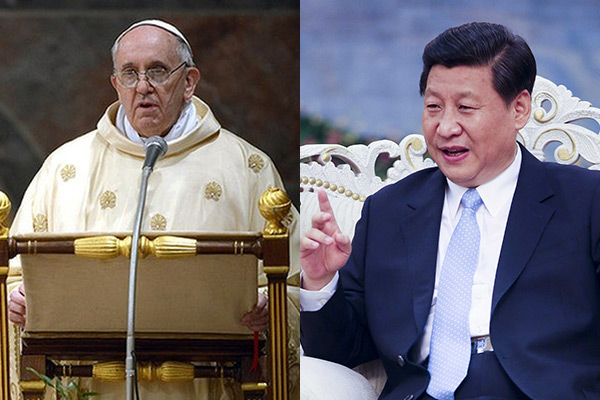
Pope Francis and the Chinese Communist Party rulers of China who are close to Chinese president Xi Jinping, both criticize the abandonment of moral traditions for the uncontrolled quest of wealth. The unity in this comment sounds strange as it is no secret that Roman Catholic Church has an icy relationship with China. The question lies in the fact that it makes the two parties seem secretively closer together.
According to Reuter’s sources, President Xi “is troubled by what he sees as the country’s moral decline and obsession with money.” He also hopes the traditional cultures of China’s three largest faiths “will help fill a void that has allowed corruption to flourish.” The three largest faiths in China are Confucianism, Buddhism and Taoism.
In the same manner, Pope Francis made a great impact on the news last week through his statement “an economic system which has at its center an idol called money,” and called for “financial reform along ethical lines that would produce in its turn an economic reform to benefit everyone. Money has to serve, not to rule.”
Based on Reuter’s sources, the eagerness of Xi to allow religion to take a greater role in China is a recent change. He’s often warned about corruption that jeopardizes his party’s rule, but this emphasis on religion leaves his motives unclear.
China’s population is now 1.35 billion. Of this figure, China’s government estimates there are 50 million Buddhists and Taoists, 23 million Protestants, 21 million Muslims, and 5.5 million Catholics. However, independent statisticians estimate the number to be exceedingly higher, at 100 to 300 million followers of Buddhism, Taoism, and folk religions. The constitution of China safeguards “normal religious activity,” which boils down to allowing people to practice the religion of their choice as long as it’s through a state-run organization. Many of these organizations are somewhat censored and not recognized by the official religion, such as the case with the “Chinese Patriotic Catholic Association,” which strangely does not recognize the pope as the head of the Catholic Church, who in turn, does not recognize the Chinese Patriotic Catholic Association as an official Catholic organization. Further, religious Chinese are not welcome to join the Communist Party.
The aforementioned standpoint proves that the top goal of party officials is maintaining social stability. “The influence of religions will expand, albeit subtly. Traditional cultures will not be comprehensively popularized, but attacks on them will be avoided”, says a statement from one of Reuter’s sources.
Pope Francis said, “Ideologies which uphold the absolute autonomy of markets and financial speculation, and thus deny the right of control to States, which are themselves charged with providing for the common good. Where there is no work, there is no dignity,” he added. China would most likely agree with the Pope that the state should control the economy.
But this agreement only goes so far, as Pope Francis also stated: “We can never serve God and money at the same time. It is not possible: either one or the other. This is not Communism. It is the true Gospel!” This statement may have ruffled the Communist Party’s feathers.
Comments are closed.