


One of Christianity’s most striking celebrations brings ancient tradition, family gatherings and prayers for peace together across Ethiopia.
ADDIS ABABA, Ethiopia — Towering bonfires, white-robed worshippers, rhythmic chanting and the glow of thousands of candles have once again transformed public spaces across Ethiopia as Christians celebrate Meskel, the annual feast commemorating the Finding of the True Cross.
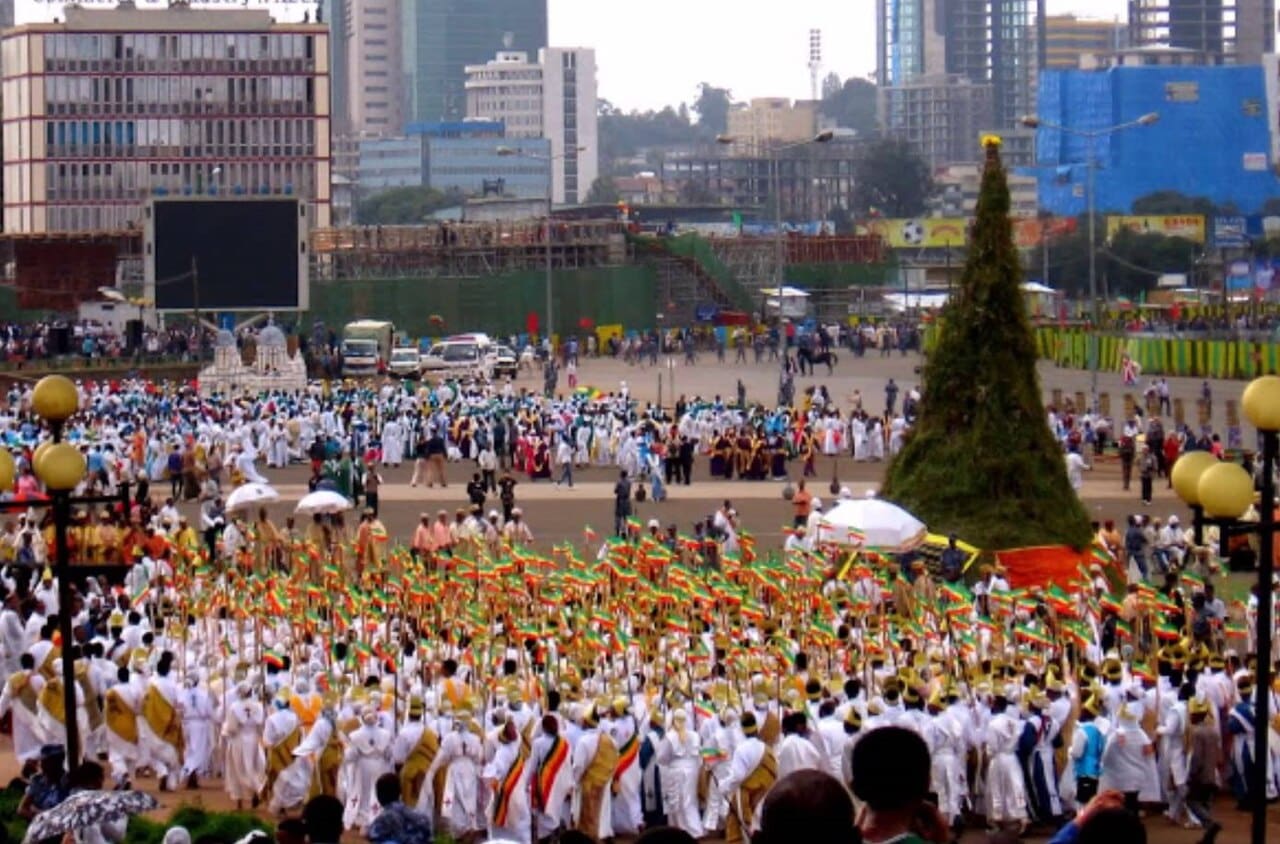
At Addis Ababa’s Meskel Square, thousands gathered for the central Demera ceremony, while celebrations took place in communities across the country. The festival, one of the most distinctive observances of the Ethiopian Orthodox Tewahedo Church, combines solemn Christian worship with traditions that have been transmitted through generations and become part of Ethiopia’s wider cultural identity.
This year, however, prayers for peace have carried particular weight. Renewed fighting in northern Ethiopia has brought fresh anxiety to families and communities, while worshippers used the feast to emphasize reconciliation, unity and the possibility of overcoming division.
A feast built around the Cross
Meskel — a word meaning “Cross” — commemorates the Christian tradition that Saint Helena, the mother of the Roman Emperor Constantine, discovered the cross on which Jesus Christ had been crucified in the fourth century.
According to the tradition preserved in Ethiopia, Helena was guided in her search by the smoke of a fire. That story is represented each year by the Demera, a large ceremonial bonfire constructed from wood and traditionally decorated with yellow Meskel flowers.
The bonfire is much more than spectacle. Priests and deacons gather in ceremonial dress, crosses are carried in procession, hymns and prayers are chanted, and the lighting of the fire becomes the focal point of a communal act of remembrance.
In Addis Ababa, the celebration surrounding the Demera takes place in a public space that itself bears the name Meskel Square. Similar ceremonies are held throughout Ethiopia, from large urban gatherings to celebrations organised by local churches and communities.
A Christian tradition recognised as world heritage
Meskel’s importance reaches beyond the life of the Ethiopian Orthodox Church. In 2013, UNESCO inscribed the “Commemoration feast of the finding of the True Holy Cross of Christ” on its Representative List of the Intangible Cultural Heritage of Humanity.
UNESCO’s recognition highlighted not only the religious character of the festival but also its role in bringing families and communities together and encouraging reconciliation, social cohesion and peaceful coexistence.
That distinction is important. Intangible cultural heritage is not simply about preserving an old ceremony as if it belonged in a museum. It refers to practices that remain alive because communities continue to understand them, perform them and transmit their meaning to younger generations.
Meskel is a striking example. Its rituals are ancient, yet the feast remains highly visible in contemporary Ethiopian life. Children grow up watching the Demera being prepared; families travel to celebrate together; members of the Ethiopian diaspora return home; and clergy, choirs and lay believers continue to reproduce prayers, music, clothing and ceremonial practices inherited from previous generations.
Faith in the public square
The scale of Meskel also illustrates something increasingly unusual in many parts of the world: religion occupying the physical centre of civic life without ceasing to be recognisably religious.
The processions, crosses, vestments and prayers are not cultural additions placed around an otherwise secular festival. They are expressions of the feast’s Christian meaning. At the same time, Meskel has developed a wider cultural significance for many Ethiopians and has become one of the country’s most internationally recognisable celebrations.
That combination of particular religious identity and broader cultural participation is one reason the festival attracts visitors from outside the Ethiopian Orthodox community and from abroad.
It also reflects the distinctive place of the Ethiopian Orthodox Tewahedo Church in Christian history. Ethiopia possesses one of the world’s oldest continuous Christian traditions, with a religious culture shaped for centuries in relative independence from the dominant Christian centres of Europe.
The Ethiopian Church belongs to the Oriental Orthodox family, alongside churches including the Coptic Orthodox Church, the Armenian Apostolic Church, the Syriac Orthodox Church and others. Its liturgy, calendar, music, fasting traditions and sacred art developed their own unmistakable character.
Praying for peace
Religious leaders placed peace and reconciliation prominently within this year’s celebration.
Patriarch Abune Mathias, head of the Ethiopian Orthodox Tewahedo Church, told worshippers that “the primary message of the Cross is to establish peace and unity, forgiveness and reconciliation.”
The message gave contemporary expression to themes long associated with Meskel. The festival remembers the discovery of something believed to have been hidden and lost, but its religious symbolism ultimately points toward the Christian understanding of the Cross as a sign of sacrifice, redemption and reconciliation.
Those ideas have particular resonance when celebrations take place while families are divided by insecurity or conflict. Reports from Ethiopia this weekend described worshippers praying not only for themselves and their families, but also for peace across the country.
That does not turn Meskel into a political event. Rather, it shows how religious festivals can create a vocabulary through which communities respond spiritually to circumstances beyond the walls of their churches.
More than a bonfire
To an outside observer, the enormous flames of the Demera may be the most unforgettable image of Meskel. Yet the spectacle makes sense only when understood within the faith that created it.
The fire represents memory. The cross at the centre of the celebration represents a sacred story. The gathering of families represents continuity. And the prayers for peace show how inherited ritual can still speak to the concerns of people living now.
That may explain why Meskel continues to thrive after centuries of celebration. It is simultaneously an act of worship, a family tradition, a public gathering and a piece of living heritage.
As the flames rise again over Ethiopia this September, they illuminate more than a festival. They reveal how an ancient religious tradition can remain profoundly contemporary when a community continues to find meaning in it — and continues to pass that meaning on.