


Jewish communities worldwide are spending a week in temporary huts, turning vulnerability, hospitality and gratitude into religious practice.
Across Jewish communities this weekend, dining rooms have temporarily moved outdoors. Tables are being set beneath roofs of branches, meals are being shared inside improvised huts, and families are gathering in structures intentionally designed not to feel entirely permanent.
It is Sukkot, one of Judaism’s major festivals and perhaps one of its most visually distinctive. Beginning at sunset on September 25 and continuing through October 2 in 2026, the week-long observance asks Jews to leave the security of their ordinary homes and spend time in a sukkah: a temporary dwelling covered with natural material and open enough to maintain a connection with the world outside.
This Sunday, September 27, Jews in the diaspora are observing the second full festival day, while communities in Israel have already entered the intermediate days of the holiday. Around the world, however, the central symbols remain recognizable: the sukkah, festive meals, prayers and the vegetation known collectively as the Four Species.
Behind those practices is an unusual religious idea. Sukkot does not commemorate permanence. It makes fragility itself part of the celebration.
Living, briefly, somewhere less secure
The word Sukkot is the plural of sukkah, generally translated as booth or hut. The festival recalls the biblical account of the Israelites living in temporary dwellings during their journey through the wilderness after leaving Egypt.
It is also an agricultural festival associated with the gathering of the harvest, placing it among Judaism’s three traditional pilgrimage festivals together with Passover and Shavuot. The combination of harvest celebration and historical remembrance has shaped Sukkot for centuries.
For the duration of the holiday, many observant Jews eat their meals in the sukkah, and some also study, socialize or sleep there. According to traditional requirements, its roof, known as schach, is made from natural material that has grown from the ground, such as branches, reeds or bamboo.
A sukkah is meant to function as a temporary home, but its character is deliberately different from that of a permanent building. Wind can be felt through it. Temperature changes matter. Rain cannot always be ignored. The sky may be visible through the vegetation overhead.
For one week, the boundary between home and outside becomes thinner.
The Four Species
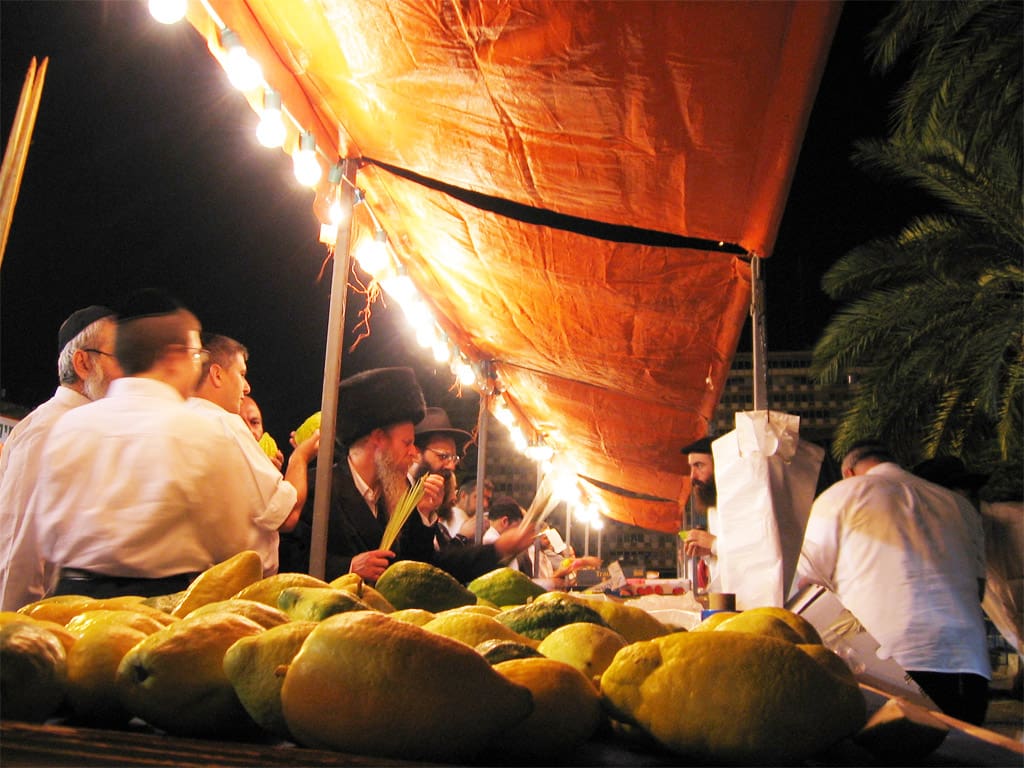
Another distinctive Sukkot practice involves the arba minim, or Four Species: the lulav, a palm branch; hadas, myrtle; aravah, willow; and etrog, a citron.
They are brought together and used during the festival in a ritual in which they are moved in different directions. The practice is among the most immediately recognizable observances of Sukkot.
Like the sukkah itself, the ritual connects religious worship with the physical world. Plants, fragrance, fruit, branches and harvest are not merely decorative surroundings to the festival. They become part of its religious language.
That makes Sukkot particularly tangible. Judaism’s sacred texts and prayers remain central, but the festival is also experienced through objects that can be held, spaces that can be entered and meals that can be shared.
A commandment to rejoice
There is another apparent contradiction at the heart of Sukkot. A festival centered on an unstable shelter is also traditionally understood as a season of joy.
The holiday comes only five days after Yom Kippur, the Day of Atonement, with its fasting, introspection and emphasis on repentance. The religious calendar then changes mood dramatically.
Instead of fasting, families eat together. Instead of remaining primarily inside places of worship, much of religious life moves into a decorated outdoor shelter. Guests are welcomed, songs are sung and communities gather for festive meals.
As My Jewish Learning explains in its overview of Sukkot, the festival combines biblical remembrance with the older imagery of harvest and thanksgiving. That mixture helps explain why joy, gratitude and the natural world are so closely connected throughout the observance.
The transition has also given generations of Jewish thinkers material for reflection. Security, the festival can suggest, does not necessarily come from walls alone. Joy does not require perfect circumstances. Gratitude can exist even while people acknowledge that much of what they rely upon is temporary.
Those interpretations vary between Jewish traditions and individual believers, but the physical experience of the sukkah gives them an unusually concrete starting point.
Hospitality as part of the festival
Sukkot is also strongly associated with hospitality.
Families commonly invite friends, relatives and community members into their sukkot. Some communities organize public meals, children’s activities and gatherings intended for people who might not have the space or ability to construct a sukkah of their own.
Jewish tradition also developed the idea of the ushpizin, symbolic guests from biblical history who are spiritually welcomed into the sukkah during the festival.
The combination of temporary shelter and hospitality produces one of Sukkot’s most striking social dimensions: the structure may be fragile, but it is meant to be shared.
In modern cities that can produce remarkable scenes. Sukkot structures appear on balconies, rooftops, terraces, synagogue grounds, gardens and courtyards. In some places, communal sukkot provide an alternative for residents of apartment buildings where constructing one privately would be difficult.
An ancient agricultural and pilgrimage festival therefore continues to adapt to the architecture of contemporary life.
Ancient practice in a modern world
That adaptability helps explain the continuing visibility of Sukkot.
Its essential ritual does not require recreating the ancient world in every detail. A sukkah can stand beside a modern apartment tower or in the courtyard of a twenty-first-century synagogue and still communicate the festival’s central themes.
There is something particularly contemporary about those themes.
Modern societies invest enormous resources in permanence: stronger buildings, financial security, digital archives, insurance, infrastructure and systems designed to reduce uncertainty. Sukkot introduces a different religious exercise. For a limited period, worshippers voluntarily inhabit something less permanent and are asked not merely to endure the experience but to celebrate within it.
That does not mean romanticizing insecurity. A voluntary week in a religious shelter is plainly different from homelessness, displacement or poverty. Rather, the sukkah functions as religious symbolism made physical, reminding the person sitting beneath its branches that even the strongest human structures cannot eliminate vulnerability altogether.
The festival’s dates and practices continue to be observed across different Jewish traditions. The Reform Judaism holiday calendar, for example, likewise lists Sukkot from September 25 to October 2 this year, followed by Sh’mini Atzeret and Simchat Torah.
A roof through which the world can enter
For Jewish communities observing Sukkot in 2026, the rituals are centuries old. Yet the questions raised by them remain immediate: What makes a place a home? How much security do human beings truly control? What deserves gratitude? And what happens when temporary space is opened to somebody else?
Sukkot does not provide those answers primarily through abstract theology.
It asks people to build something.
Then it asks them to enter it, bring food, welcome others and rejoice.
For seven days, an intentionally temporary shelter becomes a religious home. Its very impermanence is part of its meaning.
And perhaps that is why the sukkah remains such an enduring image of the festival: a structure fragile enough to remind its occupants that life cannot be completely secured, but open enough for family, community, nature and faith to enter.