


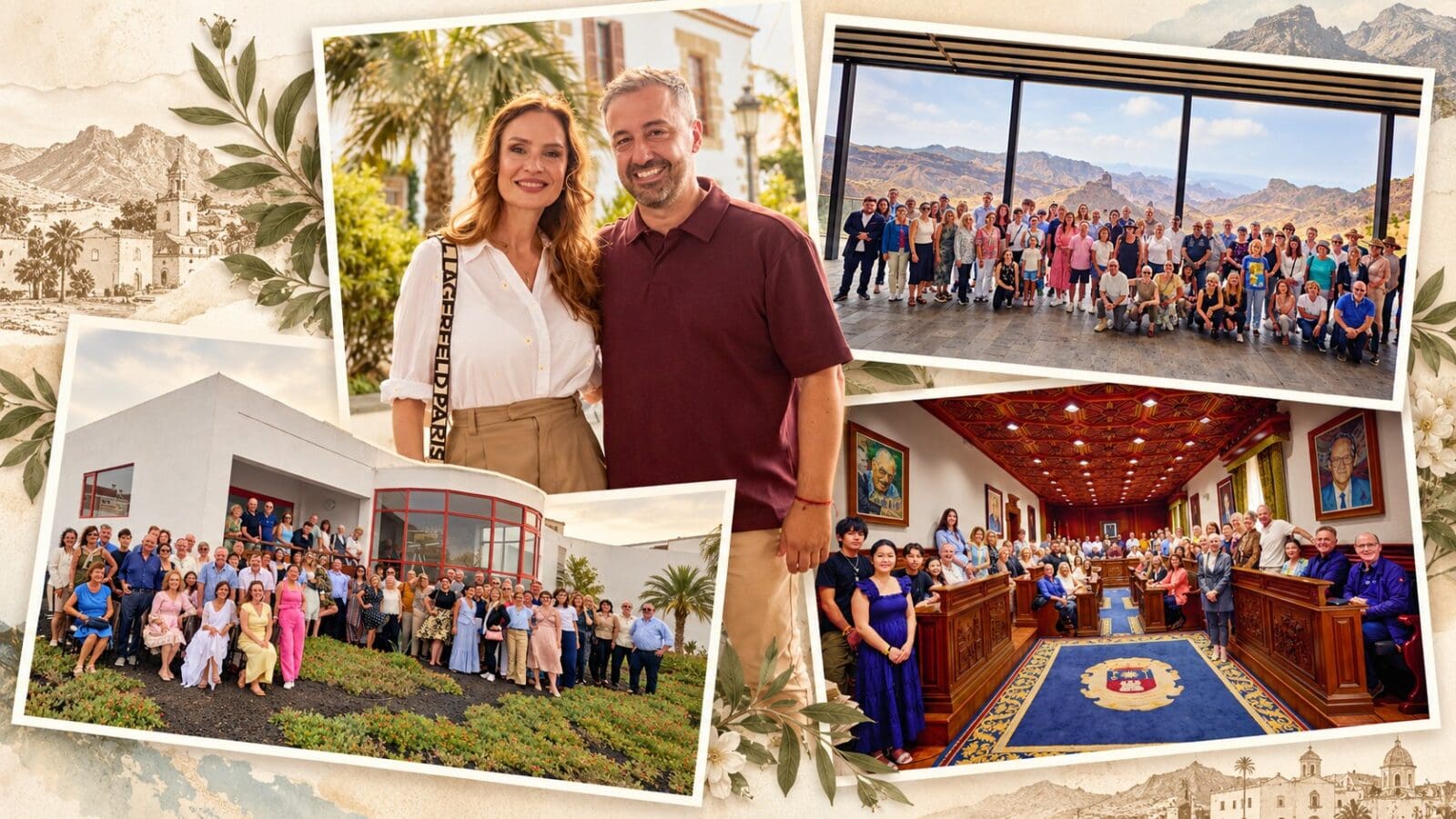
Nearly 100 international visitors followed places linked to L. Ron Hubbard, combining Scientology history with the wider heritage of Gran Canaria.
TELDE, GRAN CANARIA — More than half a century after L. Ron Hubbard worked from a villa overlooking the Atlantic Ocean in Telde, Gran Canaria, nearly 100 international visitors returned to the island to explore the places associated with that period of his life and with an important chapter in the history of Scientology.
The September journey brought participants from 12 countries to locations ranging from the dunes of Maspalomas to the historic centre of Telde and, ultimately, Estrella Villa, the restored house where Hubbard recorded his famous Ron’s Journal 1967.
For the visitors, the trip offered something that religious texts, photographs and recordings cannot fully reproduce: the experience of standing in the landscape where events remembered by a religious community actually took place.
A voice — and a wind — from 1967
One detail links the Gran Canaria of 1967 remarkably directly with the island today: the Atlantic wind.
At the beginning of Ron’s Journal 1967, Ron Hubbard drew listeners’ attention to a sound audible on the recording, explaining that it was not tape noise but “the wind” coming up over the cliff.
That recording was made at Estrella Villa in the coastal area of La Estrella, Telde. The house is now one of the international L. Ron Hubbard Landmark Sites, properties preserved because of their association with different relevant periods in the life and work of the founder of the Scientology religion.
According to the official Landmark Site, Mr Hubbard established a base in La Estrella after arriving in Las Palmas in February 1967. From there he conducted religious research, communicated with maritime operations in the port and issued some of the early directives connected with the development of the Sea Organization (the religious fraternity order of Scientology).
The site also identifies the villa as the place where Ron Hubbard recorded Ron’s Journal 1967, a message distributed to Scientologists internationally and closely associated within the religion with developments in its advanced spiritual teachings and its maritime period.
The Gran Canaria connection has attracted wider local attention as well. Canarian writer Michel Jorge Millares examined the history of the property earlier this year, describing the restored villa and the renewed international interest surrounding it as an unusual intersection between Gran Canaria’s local history and the global history of Scientology.
Beyond Villa Estrella
The September visit was not confined to the house. Participants travelled through places connected with L Ron Hubbard’s earlier movements around the island, including the Maspalomas area, where he photographed the lighthouse, and viewpoints across Gran Canaria’s mountainous interior.
The group included visitors from the United States, Italy, the United Kingdom, Mexico, Taiwan, Hungary, Germany, the Netherlands, South Africa, Denmark and Spain. Their itinerary combined Hubbard-related sites with encounters with Canarian history and contemporary island life.
That combination became particularly visible in Telde. In the historic district of San Juan, the visitors were received by Mayor Juan Antonio Peña and Juan Martel (Culture Counselor) before being introduced to a city whose history extends back 675 years. The Telde City Council later described the visit as an opportunity for the international group to discover the municipality’s culture, traditions, institutions and architectural heritage.
Canarian folklore groups Anzar and Ágora performed isas and malagueñas, but the visitors did not remain spectators for long. Members of the group were invited to join the dancing.
For Timea, who travelled from Hungary with two friends, that moment changed the character of the visit. “Through the Isas and Malagueñas performed by Anzar and Agora, we became not only spectators but participants,” she said. “As we danced together, I no longer felt like a tourist, but rather a part of this remarkable city and its vibrant spirit.”
The group later visited Telde’s City Hall and the León y Castillo House-Museum, adding the political, architectural and cultural history of the Canary Islands to a journey that had begun with a much more specific religious-historical interest.
Inside Estrella Villa
The culmination of the journey came at Estrella Villa itself. Because of the size of the group, visitors entered in smaller numbers. Inside, they encountered restored rooms and objects associated with Hubbard’s 1967 stay. The Landmark Site displays the very reel-to-reel recorder identified as the machine used for Ron’s Journal 1967, as well as a desk and a religious artefact known as E-Meter associated with his work and, his restored 1967 Ford Country Squire.
For visitors familiar with this period of Scientology history primarily through recordings and written accounts, the physical environment gave those materials a different dimension. “Hearing the wind come over the cliff and connecting it to RJ 67 was very special,” visitor Kim said. “I love that we have this bit of history to experience today, so many years later.”
Another participant, Felix, described seeing locations associated within Scientology history with the formation of the Sea Organization and Ron Hubbard’s advanced religious research as an emotional experience. Tom B., another visitor, said being inside the preserved property gave him a more personal connection to events he had previously known largely as history.
When religious memory becomes cultural tourism
The Gran Canaria journey also illustrates a phenomenon extending well beyond Scientology: religious history can generate travel to places that might otherwise remain little known outside their immediate communities.
Pilgrimage is one of the world’s oldest forms of travel. Historic churches, temples, monasteries, shrines and the homes of religious founders continue to draw millions of visitors. Newer religious traditions are increasingly developing their own geography of memory as buildings connected with founders and formative events are identified and preserved.
Estrella Villa belongs to that newer landscape. Its significance to Scientologists arises from events little more than half a century old, yet the mechanisms of memory are familiar: preserving a place, retaining objects connected with its history and allowing later generations to experience physically what they have previously encountered through teaching, testimony or recorded material.
At the same time, the September visit showed how such journeys can extend beyond the boundaries of the religion that prompted them. Visitors who arrived because of their interest in Mr Hubbard also encountered Canarian music, architecture, museums, local government and centuries of Telde history. Timea said the city ultimately became far more than another point on an itinerary. “Telde is far more than simply a destination,” she said. “It is a city where history, music, architecture, tradition and genuine hospitality come together.”
And at Estrella Villa, one particularly simple element connected the present journey with 1967. The house has been restored, its historical objects preserved and the surrounding island transformed by decades of development. But outside, above the Atlantic, the same wind L Ron Hubbard drew attention to on his recording can still be heard coming over the cliff.
For the visitors who travelled thousands of kilometres to hear it there, that continuity turned a piece of recorded religious history into a physical and spiritual experience.