


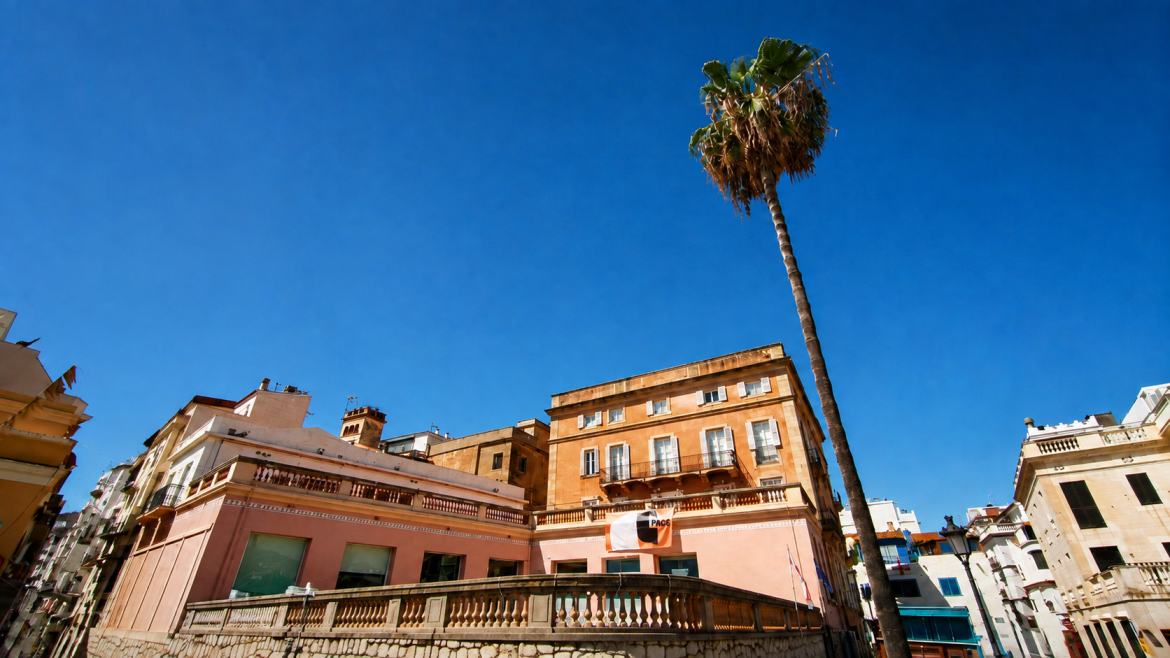
A journey prompted by L. Ron Hubbard’s 1953 stay reveals centuries of sacred art, maritime devotion and living religious tradition on the Catalan coast.
On August 23, 2026, I travelled to Sitges with a very particular destination in mind: the former Hotel Miramar.
More than seven decades earlier, L. Ron Hubbard, founder of Scientology, had stayed there during a journey through Europe. I wanted to see the place for myself—to walk through the building where he had stayed and to look out towards the Mediterranean from that privileged part of Sitges.
What began as a visit prompted by one little-known episode in modern religious history soon became something much broader. Within a remarkably small area, I found medieval and Baroque Christian art, paintings by El Greco, the remains of a Gothic hospital chapel, a parish church rising dramatically above the sea, and a town preparing to celebrate one of its patron saints.
I had come to Sitges following a trace from 1953. Instead, I found myself walking through centuries of belief.
L. Ron Hubbard in Sitges in 1953
L Ron Hubbard’s presence in Sitges is not simply a local anecdote. It is documented through his correspondence from 1953. A 2024 academic study published by Editorial Dykinson identifies the underlying source as L. Ron Hubbard’s Associate Newsletter No. 5 and records his journey through Spain and into Catalonia, where he stayed at the Hotel Miramar in Sitges.
The letter records Mr Hubbard writing from his room at the Miramar on June 18, 1953, after an intense journey across Europe: “After a fast and violent passage across most of the countries of Europe, we are catching our breath in Spain.”
The journey had taken him through Belgium, Germany, Luxembourg, Austria and France before entering Spain. In the informational letter to Scientologists worldwide, Mr Hubbard explained that he “came down to Spain for a rest and to organize the material for the doctorate degrees. Living is better here than in many other places and it is certainly beautiful enough to encourage anybody”.
His observations were not limited to his own work. From Sitges he also commented on the place in which he found himself. He opened one particularly striking observation with the words “This is Old Catalonia and although Spanish is the general language, Catalonian, the native tongue, predominates and slurs the imported Spanish”.
It is a small but unusually vivid historical snapshot: Mr Hubbard was not merely passing through Spain. He was noticing the language, culture and identity of Catalonia while staying in a hotel overlooking the Mediterranean.
More than seventy years later, that precise historical connection was what brought me to Sitges on August 23, 2026.
The Miramar of L Ron Hubbard’s time occupied the former Casa Aleix Vidal-Quadras, a nineteenth-century building in an exceptional position above the Mediterranean. Architectural heritage documentation from the Diputació de Barcelona records its later history as the Hotel Miramar, which remained in operation until the 1970s.
Today, it is the Miramar – Centre Cultural, used by Sitges for exhibitions and cultural activities.
Of course, more than seven decades and successive renovations separate the building I entered from the hotel Hubbard knew. I did not go there expecting to find a preserved hotel room or an untouched corridor from 1953. I went because the building itself was there, because Hubbard had been there—and because I wanted to experience its setting for myself.
Looking out towards the Mediterranean
Once there, one element of the old Miramar required no historical reconstruction at all: the sea.
From this unique part of Sitges, the Mediterranean is a commanding presence. Standing there and looking towards the water gave my visit an additional significance because Mr Hubbard’s relationship with the sea extended throughout his life.
In the official biographical collection devoted to his maritime life, Master Mariner: At the Helm Across Seven Seas, Ron expressed that attachment in the simplest possible terms: “I loved the sea. I loved steamers and sailboats and surf and sailors. And I yearned and strained to the sea, always the sea, for it is a lovely, vicious lonely thing. In its limitless variety I had a sort of HOME”.
Those words came back to me as I stood at Miramar.
I cannot know exactly what L Ron Hubbard saw from the hotel in 1953, how long he stood looking towards the Mediterranean, or what thoughts the view inspired in him. Historical travel should not become imagined biography. But I could see the same sea, from the same extraordinary location, and understand why the setting felt so fitting for someone whose life had been so deeply connected with it.
There was also something compelling about the sequence of events. Mr Hubbard had travelled rapidly across Europe before stopping here to rest, organize his work and write to the Scientologists. Sitges became, however briefly, a place of pause.
That was the place I had come looking for.
And yet, almost as soon as I continued walking, the reason for my journey began to expand far beyond Hubbard.
(For those wishing to continue following L. Ron Hubbard’s footsteps in Spain, the recently restored Villa Estrella-in Telde, the Canary Islands– offers another remarkable opportunity to experience a place closely connected with his life and legacy.)
From Miramar to Maricel
One of the pleasures of Sitges is how quickly one historical layer gives way to another. From the former Hotel Miramar, I continued through the old town and entered the world surrounding the Museu de Maricel.
Here the religious dimension of the journey changes completely.
Maricel houses art spanning many centuries, with particularly important works from the Romanesque, Gothic, Renaissance and Baroque periods. The Dr. Jesús Pérez-Rosales Collection, acquired for Sitges in the twentieth century, brought together paintings, sculpture, furniture and decorative and liturgical objects representing a remarkable sweep of European artistic history.
For a visitor interested in religion, the medieval rooms are not merely an art-historical exercise. Images of Christ, the Virgin, saints and scenes that once formed part of altarpieces reveal something about how generations before us encountered their faith visually.
Before widespread literacy, sacred art could teach, inspire, warn and console. A painted saint or a carved Virgin was not created primarily as an object destined for a museum display case. Such works belonged to a world of churches, chapels, prayer, patronage and communal memory.
Part of the Maricel complex also incorporates the former Gothic chapel associated with the old Hospital of Sant Joan. The religious history is therefore present not only in the collection but in the architecture through which the visitor moves.
In my personal experience, many statementes or teaching from L Ron Hubbard, even the “simplest” ones, time and again bring me greater experiences and knowledge. And so, my original reason for coming to Sitges, visiting this hotel where he stayed for a few days and where he discovered part of Spain and its variety of languages, suddenly expanded to a much longer story.
El Greco in the “Temple of Modernisme”
That story becomes still more intriguing beside Maricel at the Museu del Cau Ferrat, the former home and studio of the Catalan artist and writer Santiago Rusiñol.
Cau Ferrat became known as the “Temple of Modernisme.” The description is deliberately evocative. Rusiñol and those around him regarded artistic creation with an intensity that sometimes borrowed the language and ceremonial forms traditionally associated with religion.
Two of the museum’s most important works make that relationship particularly visible. In 1894, Rusiñol acquired two paintings by El Greco: The Tears of Saint Peter and Penitent Magdalene with the Cross.
These are profoundly Christian images of repentance, suffering and spiritual transformation. Yet their arrival in Sitges also became part of the history of Catalan Modernisme. The paintings were ceremonially welcomed during the Third Modernist Festival and brought to Cau Ferrat in an event that elevated art itself to an almost ritual status.
The result is one of the most fascinating intersections in Sitges between traditional religious imagery and modern cultural identity.
The church above the sea
Outside the museums, religion is impossible to separate from the physical image of Sitges.
The Parish Church of Sant Bartomeu i Santa Tecla rises above the waterfront at La Punta. Its silhouette, framed by the Mediterranean, is perhaps the most recognizable image of the town.
Tourists photograph it constantly. Yet it remains more than a picturesque monument.
The church is dedicated to Sitges’ two patron saints, Saint Bartholomew (Sant Bartomeu) and Saint Thecla (Santa Tecla), and contains centuries of religious and artistic heritage. Its Baroque altarpieces, sacred images and historic organ belong to a continuing place of worship rather than to a religious past that has disappeared.
And my visit happened on an extraordinary date.
August 23: Sitges on the eve of Saint Bartholomew
I was walking through Sitges on August 23, the eve of the feast of Saint Bartholomew on August 24 and one of the central days of the town’s Festa Major.
The timing added another dimension to everything around me. Precisely at 2pm, a number of unexpected firework rockets started to fire, and the celebration was just starting.
Sitges was not simply displaying its religious heritage for visitors. It was living it.
The 2026 Festa Major programme brought together church bells, ceremonial salutes, music, traditional dances, civic ritual and the celebrations surrounding Sant Bartomeu. These traditions are difficult to divide neatly into “religious” and “secular” categories because centuries of local identity have woven the two together.
That is precisely what makes religious tourism interesting in places such as Sitges. Religion is not confined to a sanctuary. It has helped shape the calendar, public spaces, art, music and collective memory of the town.
Devotion made of flowers, boats and bells
Other Sitges traditions tell the same story.
Every August 5, the Sanctuary of Our Lady of Vinyet becomes the focus of one of the town’s strongest Marian traditions. Religious services, veneration of the Virgin and popular celebrations continue around a sanctuary whose history is deeply embedded in local identity.
During Corpus Christi, streets are transformed by elaborate carpets made from flowers before the Eucharistic procession moves through the town. What visitors see as extraordinary ephemeral art is inseparable from the Catholic feast for which those carpets were created.
The Mediterranean itself becomes part of religious practice during the feast of Our Lady of Mount Carmel, traditionally associated with sailors and fishermen. A maritime procession carries the celebration onto the water, while remembrance of those lost at sea connects faith with the generations whose lives depended upon the Mediterranean.
Beyond the centre, old hermitages such as the Ermita de la Trinitat add yet another layer: smaller places of worship in the landscape, connected historically with devotion, gathering and pilgrimage.
Religious Sitges hiding in plain sight
Internationally, Sitges is famous for many other reasons. Its beaches, Modernista heritage, cinema and nightlife have created a distinctive modern identity.
But these characteristics do not erase its religious heritage. They coexist with it.
That coexistence may actually be one of the most interesting things about Sitges. A contemporary, cosmopolitan Mediterranean town continues to celebrate saints whose devotions are centuries old. Residents and visitors walk streets where Catholic processions still take place. Modern art occupies buildings containing fragments of older sacred spaces. Religious paintings by El Greco became icons of a movement determined to revolutionize Catalan culture.
And, unexpectedly, the same town also contains a small but documented chapter in the history of Scientology.
All of this can be encountered largely on foot.
That was what impressed me most on August 23.
I had travelled to Sitges because L. Ron Hubbard had stayed at the Hotel Miramar in 1953. I wanted to walk through the building, to experience its location and to stand close to that magnificent Mediterranean view.
But after leaving Miramar and continuing through Maricel and the surrounding streets, my journey changed.
I had followed one episode of twentieth-century religious history to the Catalan coast and, almost without planning it, discovered medieval Christianity, Marian devotion, El Greco’s spirituality, Modernisme’s fascination with the sacred, maritime faith and the living celebration of a patron saint.
Sometimes religious tourism begins with a pilgrimage destination carefully marked on a map.
And sometimes it begins by following one person (in this case the most published author according to the World Guinness of Records) to an old hotel by the sea—and then simply continuing to walk.