

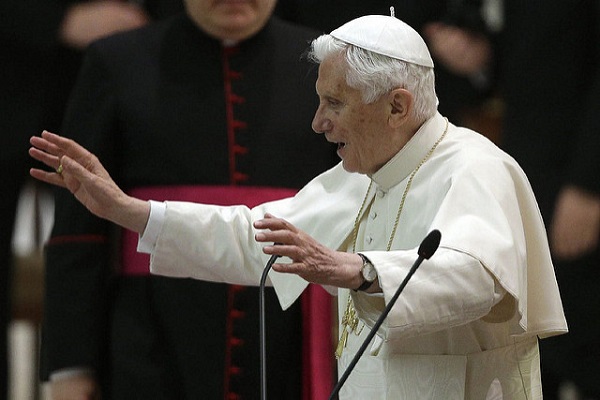
Pope Benedict XVI wrote an article concerning how the Old Testament should be read
Multiple Christian theologians have accused Pope Emeritus Benedict XVI of fostering anti-Semitism.[/tweetit] The accusations came up after the former head of the Catholic Church published Grace and Vocation Without Remorse, in the magazine Communio. The German language magazine was founded in 1972 by Joseph Ratzinger with Henri de Lubac and Hans Urs von Balthasar. Communio prides itself as an important theological journal.
Pope Benedict XVI Accused of Anti-Semitism[/tweetthis]
The July-August issue article in Communio magazine dated October 26, 2017, was originally composed to mirror Nostra Aetate 50th anniversary. The event comprised the 1965 declaration by the Second Vatican Council on the relation of the church with the non-Christian relations. The article's primary purpose was to serve as an internal document linked with Vatican's Commission for Religious Relations with the Jews, under the auspices of Pontifical Council for Promoting Christian Unity.
The article kicked up a storm, with both Catholic and Jewish leaders having the opinion that the former pope's essay concerning Jewish-Catholic relations clearly points to the fact that he holds anti-Semitic views despite his much-publicized visits to synagogues. Benedict XVI, during his papacy, made it a point to promote Christian-Jewish cordial relations. This does not mean that the former pope is vilified by all theologists: a few of them have defended the essay which rocked the German, Swiss, and Austrian media in the last few weeks.
The crux of the theological uproar was the denial by the former pope that the Catholic Church adopted "supersessionism." It comprises the theological belief that the God's covenant via Christ substituted a certain covenant which God sealed with the Jews. Benedict also insisted that the lens of Christianity remains the sole valid one when it comes to reading and analyzing the Old Testament or Hebrew Bible. Critics like Rabbi Walter Homolka Germany's Potsdam University seized on this text, claiming that whoever describes Judaism's role in a similar manner is actively constructing a new foundation for anti-Semitism on a Christian basis. The identical opinion was echoed by Reverend Christian Rutishauser, who said the pope's suggestion of how Jews should learn from Christians on how to read specific portions of Hebrew's Bible is extremely problematic. Reverend Rutishauser heads a Swiss Jesuit order and is considered an expert on Jewish-Christian relations.
Apparently believing Christianity is true is anti-Semitic https://t.co/ywvwxjpG6x
— Kevin Greenlee?? (@Ethawyn) August 5, 2018
Supporters of the Communio publication included Jan-Heiner Tuck, the editor of Communio's German edition, who said that the article by Benedict was remarkable for multiple reasons. One of them was illustrated in detail by Cardinal Kurt Koch, who originally convinced the pope to publish the article in Communio. He said the theological reflections mentioned in the article should be included in subsequent dialogues between church and Israel.
Pope Emeritus Benedict XVI led the Catholic Church from 2005 to 2013.