

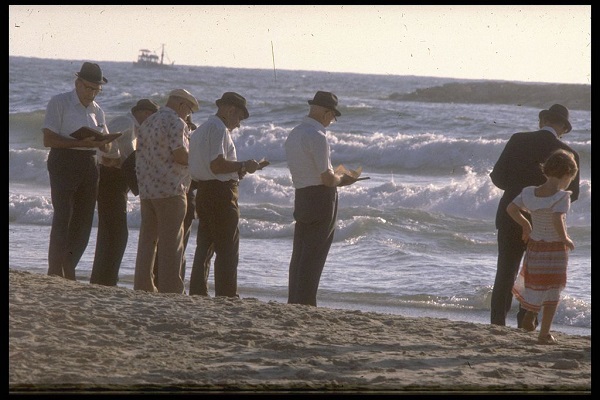
![Yaakov Saar [CC BY-SA 3.0], via Wikimedia Commons](http://www.worldreligionnews.com/wp-content/uploads/2015/09/Flickr_-_Government_Press_Office_GPO_-_The_Taslich_Prayer_1.jpg)
_-_The_Taslich_Prayer_(1).jpg)
The atonement ritual, Tashlikh, is performed during Rosh Hashanah as a symbolic casting off of sins.
Members of the Jewish faith have an interesting way to cast away or get rid of their sins. They call the ritual Tashlikh. Based on Jewish customs, it is performed on the first day of Rosh Hashanah, unless the first day falls on a Shabbat, then it would be done on the second day. Rosh Hashanah is the Jewish celebration of New Year.
The ritual is performed in an afternoon at any body of water. Those who perform the ritual recite prayers of repentance and asking for forgiveness. While praying, individuals throw away pieces of bread that symbolize their sins. They also shake their clothes which they believe will loosen out the evil and sins clinging to their bodies.
Photo: Rosh Hashanah greeting card depicting tashlikh – circa 1920 http://t.co/RXWvrz1zlx
— Eretz Yisrael (@_EretzYisrael) September 9, 2015
The ritual can be done individually, in group, or by the whole family. Young children can participate in the tradition as well. When choosing a specific body of water, the sea is on top of the list. The next best alternatives include the river, lake, spring and if access to these is not possible, a fountain or faucet will do. It is also ideal that the body of water contains or is home to fishes because fishes symbolize human’s precarious existence.
The history of Tashlikh
The practice was said to originate from the 13th century. Before it became an accepted practice in the Jewish religion, the ritual was challenged by opposition from rabbis in its early years. Early Jewish leaders considered the practice as a superstitious belief and it undermined the concept of repentance back then.
But as time goes by, the religion legitimized the practice by associating religious stories and symbolisms in it. Several variations of the ritual have also sprouted throughout history. Babylonian Jews for examples used sin-filled containers instead of bread. Kurdistani Jews on the other hand cleanses their sins by plunging and swimming around the water.
Religious significance of Tashlikh
Prayer is an essential part of the ritual. And when it comes to symbolism, water is at the limelight. Water symbolizes purity and nature’s only element that cleanses. Jews symbolically clean themselves of sins using water.
Another significant purpose of the Tashlikh tradition is for the individual to ponder upon the sins and mistakes he or she has committed in the past year. It is also an activity of looking forward or hoping for a better future acknowledging that God will eventually grant forgiveness and favors in the coming years.