


A historic Buddhist temple in South Korea is turning recovery from a devastating wildfire into a community effort encompassing cultural preservation, ecological care and generous hospitality.
Gounsa Temple in Uiseong County hosted its fourth Goun Cultural Festival and Temple Food Festival on October 17 and 18. Returning after a two-year interval, the gathering invited residents and visitors to participate in the recovery of a sacred landscape badly damaged by the March 2025 wildfires.
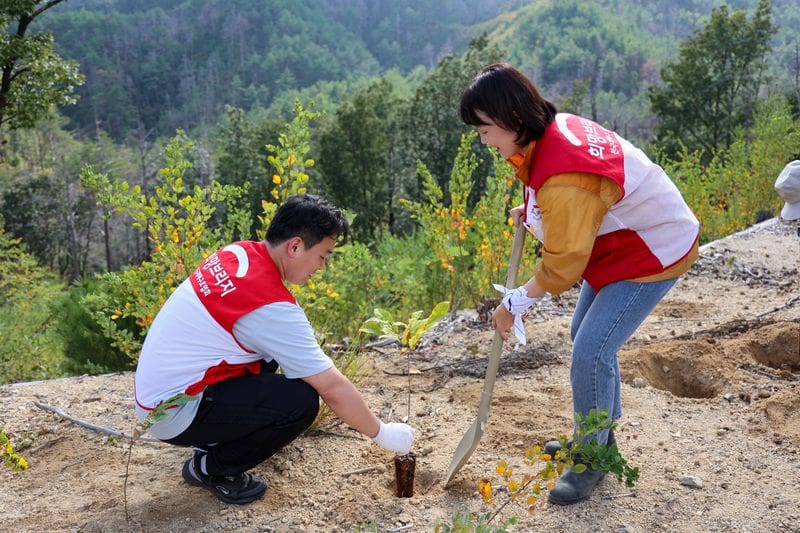
The festival’s theme, “Back to the Forest of a Thousand Years,” connected the future of the temple with the restoration of its surrounding woodland. As The Asia Business Daily reported, participants planted 100 trees, shared thousands of servings of temple food and joined cultural and environmental activities across the grounds.
Restoring more than buildings
Gounsa traces its foundation to 681, during Korea’s Silla period. Although its surviving structures were built in later centuries, the complex remained an important center of Korean Buddhist heritage before fire swept through it in 2025.
The Associated Press documented the destruction shortly after the disaster. About 20 of the temple’s roughly 30 buildings and structures were completely burned, including Gaunru Pavilion and Yeonsujeon Hall, two buildings that held protected “treasure” status for their historical and artistic importance.
Monks and members of the Buddhist community were able to move other sacred objects to safety, including an ancient stone Buddha statue. Saving those objects preserved part of the temple’s tangible heritage, but rebuilding Gounsa also requires attention to the forest, wildlife and human community that surround it.
The revived festival reflected that broader understanding of restoration. Visitors were invited to plant 90 of the 100 new trees after guests planted the first 10. A barefoot walk along the temple’s forest trail encouraged participants to experience the recovering landscape directly.
Hospitality as a form of renewal
Twenty branch temples affiliated with Gounsa prepared approximately 4,500 free portions of traditional temple food. The festival also included cooking demonstrations, meditation, tea gatherings with monks, environmental programs, music and a community flea market.
That combination made the gathering more than a fundraising or commemorative event. Temple food, commonly prepared around principles of simplicity, restraint and respect for ingredients, became a practical expression of welcome. Cultural performances and participatory activities helped reconnect the damaged site with the wider community.
Venerable Deungun, Gounsa’s abbot and head of the Jogye Order’s 16th district, described the festival as an opportunity to heal both the natural environment and people’s hearts. His message recognized the depth of the loss without allowing destruction to become the final chapter of the temple’s story.
Nature shows early signs of recovery
Recent ecological monitoring has added another source of cautious hope. A September report on the Gounsa forest found that 243 hectares, or 97.6 percent of the temple’s 249-hectare woodland, had been affected by the fire. Researchers nevertheless recorded recovering vegetation and a wide range of insects, birds and mammals in areas where burned trees were allowed to remain and decompose naturally.
The monitoring identified 198 insect groups and 57 bird species, including the endangered fairy pitta. Otters, leopard cats, yellow-throated martens and other mammals were also detected. Researchers said dead trees were providing food and shelter as the ecosystem began rebuilding itself.
The festival’s public tree planting and the separately monitored natural-regeneration areas represent different parts of a complex recovery. Together, they underscore the need for restoration decisions to be guided by ecology as well as symbolism and community participation.
A living heritage
Gounsa’s recovery will take years. Historic structures cannot be reconstructed quickly, and a mature forest cannot be replaced in a single planting season. The temple’s recent festival did, however, demonstrate that heritage is not limited to surviving architecture.
It also lives in meals offered freely, knowledge shared between generations, careful observation of returning wildlife and the willingness of a community to gather again after loss.
By joining Buddhist hospitality with cultural and environmental renewal, Gounsa is showing how a sacred place can honor its past while cultivating hope for what grows next.
Suggested categories: Buddhism, Environmental Stewardship, Cultural Preservation
Suggested tags: Gounsa Temple, Jogye Order, South Korea, Buddhist temple food, wildfire recovery, forest restoration, Korean Buddhism