


Pew Research Center develops a scale to measure views on immigration and religious minorities.
Electoral prospects in Western European countries have been influenced by anti-immigration and nationalist sentiments.[/tweetit] This came to prominence after the influx of refugees from majorly Muslim countries. It is to be said that views across Europe are not uniform. They vary from one European nation to another. The Pew Research Center, to better understand the phenomena, created a scale. This scale was built to measure the intensity of nationalist, anti-immigrant, and anti-religious minority sentiment. The scale was colloquially named NIM.
How Views About Immigrants and Religious Minorities Vary Across Western Europe[/tweetthis]
The NIM is essentially a survey of 22 questions. The queries are taken from a broad range of issues like European views on Muslims, immigrants and Jews. Questions were also set on immigration policies. The scale scores were based on the premise that the numbers will go up if the respondents generate right-wing answers like favoring the reduction of immigration, and unwillingness to live near a Jew or Muslim. The numerical data goes up if the respondents feel Islam is not compatible with European ethos. Other causes of NIM going up includes the sentiment that being born in a specific country makes them more a citizen of that country. Higher scores in short means the respondents have expressed anti-religious minority, nationalist, and anti-immigrant sentiments at the time of the survey. Score values began at 0, and the maximum is 10.
Only a few adults in all surveyed European nations scored above five on the NIM scale. The data show significant variation across the countries. Sweden achieved the lowest score. Only eight percent of those surveyed made a score exceeding five. Conversely, Italy occupies the top position at the other end of the scale. A staggering 38 percent expressed far-right sentiment above five. Most countries showed that any percentage of the surveyed population expressing ultra-right sentiment varied from 15 percent to 25 percent. About 19 percent of respondents in France and Norway scored five or higher.
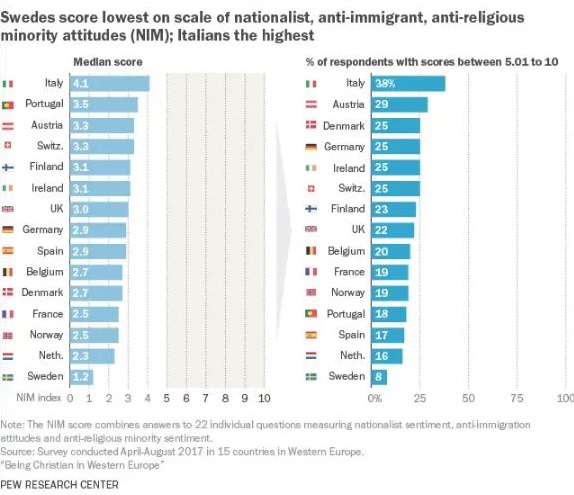
The NIM scale opens a window to understand whether factors like religious affiliation, age, or political ideology are linked with such attitudes. “Political right” voters score higher on anti-religious minority, nationalist, and anti-immigrant views. Those on the “political left” score lower on the scale. Those who identify themselves as Christian score higher than the religiously unaffiliated respondents.
Personal familiarity with immigrants and Muslims are linked with lower scores.