

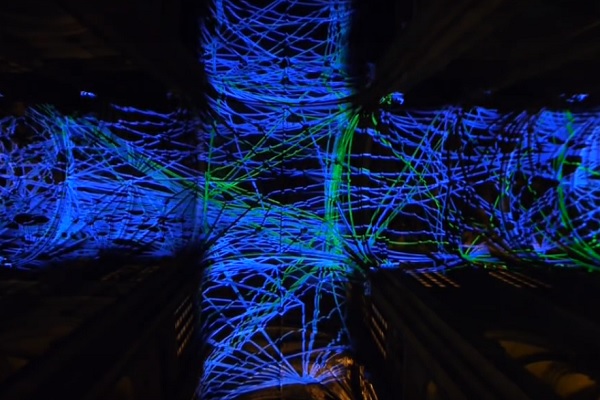
Nuit Blanche art event ‘Voûtes Célestes’ at Paris’s Saint-Eustache Church
Those in Paris attending the annual Nuit Blanche looking for something pretty far-out, should visit the historic Saint-Eustache Church. Let yourself go and watch the vaulted ceiling be transformed into an otherworldly sight of swirling electric colors amplified by French organist Baptiste-Florian Marle-Ouvrard.
Heavenly Lights: Virtual Reality Art in a Gothic Cathedral in Paris[/tweetthis]
The virtual reality installation, Voûtes Célestes or “Celestial Vaults,” is the work of artist Miguel Chevalier. He describes his 35 streams of colored of light that glow and dance within the church as a network of “sinuous webs,” an ever-changing and flowing highlight of the building’s architecture.
As one the premiere Gothic cathedrals, Chevalier designed the constellation-like digital projections to highlight the church’s towering ceilings and prestige. Visitors are encouraged not only to walk around but lie down on the ground to take in the visual display.
A Virtual Reality Sky Opens Up the Ceiling of a Gothic Church in Paris Nuit Blanche 2016 Saint-Eustache https://t.co/T94Krogy0b
— Marco (@xmarcor) October 20, 2016
Saint-Eustache Church
2 Impasse Saint-Eustache
75001 Paris, France
www.saint-eustache.org