


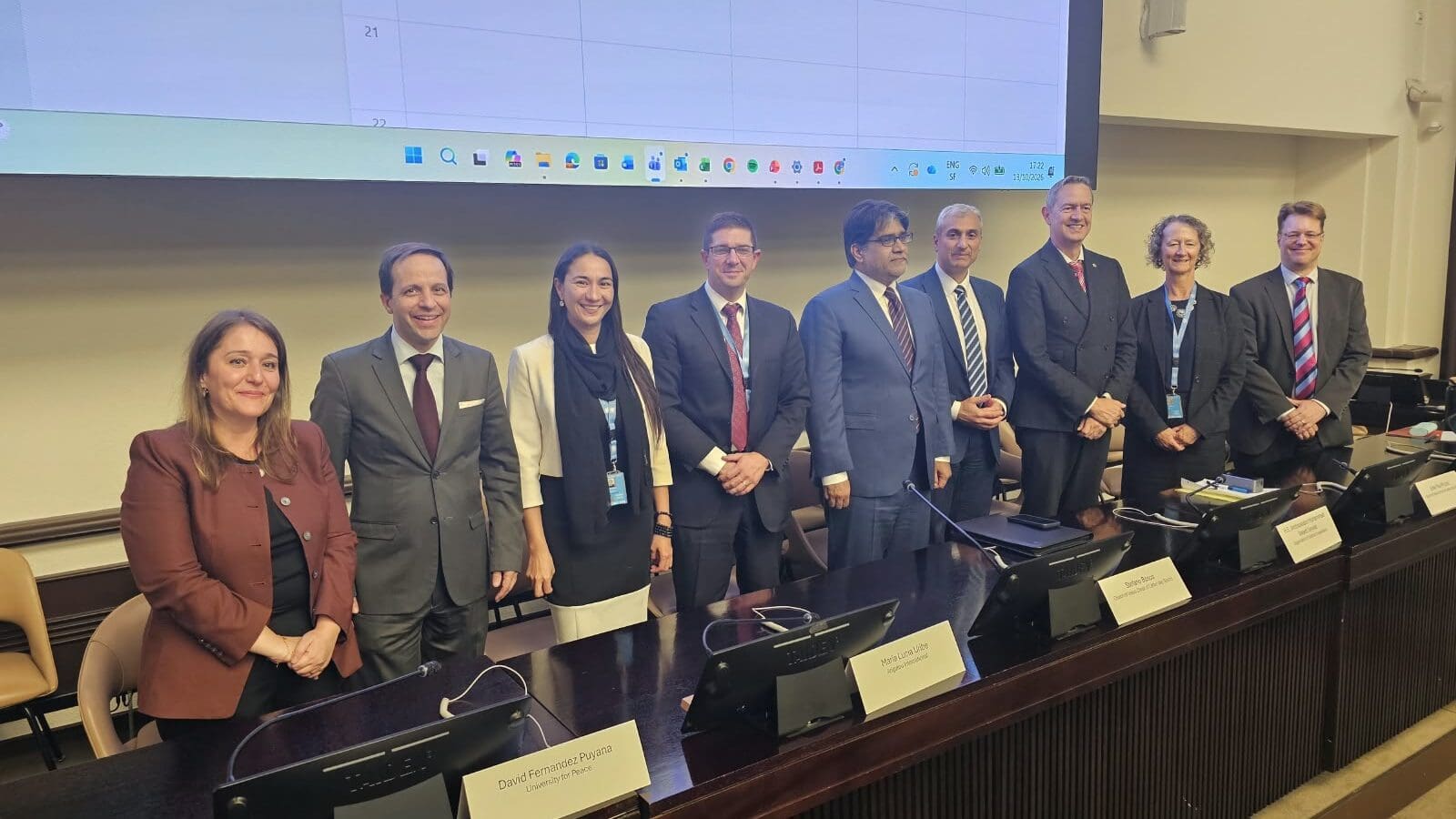
At the Palais des Nations in Geneva, religious leaders, diplomats, human-rights practitioners and international organizations examined what happens when faith is translated into service, cooperation and responsibility for others.
GENEVA — What does faith look like when it moves beyond belief and becomes action? That question shaped a multifaith gathering held on October 13 at the Palais des Nations in Geneva, where representatives of religious communities, international organizations, academia and civil society met under the title Faith in Action: Religion as a Force for Peace, Human Dignity and Rights. The event was principally convened by Stefano Bosco, Director of the International Affairs Office in Geneva of the Church of Jesus Christ of Latter-day Saints and Secretary of the UN Geneva NGO Committee on Freedom of Religion or Belief (FoRB), together with a group of organizations working across religion, peacebuilding and human rights.
Rather than remaining at the level of theological principle, the discussion that was co-organized by Church of Jesus Christ of Latter-day Saints with Faith for Rights, Religions for Peace, University for Peace and United Religions Initiative, quickly moved toward concrete examples: children learning across religious differences in Indonesia, Christian and Muslim leaders developing violence-prevention networks in Nigeria, faith communities supporting refugees and families in crisis, Sikhs using the trust generated by places of worship to assist health research and women facing abuse, and Bahá’í communities rebuilding relationships across social and ethnic divisions.
What emerged over the course of the afternoon was a remarkably practical vision of religion as a source of social responsibility. The traditions represented around the table were different, as were their theological languages, institutional structures and geographical experiences, yet again and again the conversation returned to the same point: faith acquires a particular public significance when conviction becomes service. Participants spoke about protecting children, responding to humanitarian emergencies, rebuilding trust after conflict, strengthening families, educating for coexistence and creating relationships capable of crossing religious and cultural boundaries.
From conviction to action
Bosco, who moderated the discussion together with Michael Wiener of Faith for Rights, set the tone by asking participants to look at the enormous capacity of religious communities to contribute to society. Religion, he observed, continues to shape the identities and lives of billions of people, making it impossible to understand contemporary societies without also understanding the values, networks and institutions that faith generates. Later in the conversation he distilled what he had been hearing into a simple observation: when religion is lived deeply, it can move people to care about others.
Maria Lucia Uribe, Executive Director of Arigatou International, gave that proposition an immediate human dimension through her work with children, educators and families. She described ethics-education initiatives in which teachers are encouraged first to examine their own assumptions and then to create environments where children can encounter cultural and religious differences safely. In Tanzania, she noted, Bahá’í, Shia Muslim, Mennonite and other communities have also participated in programs helping parents and caregivers replace violent forms of discipline with listening, reflection and relationships grounded in children’s dignity. “When our cooperation helps a child feel safe, form a friendship across a divide, or stand up for another person’s dignity,” she said, “faith becomes a concrete force for peace.”
Wiener expanded the picture through almost a decade of work under the Faith for Rights framework. He pointed to engagement with women religious guides in Senegal and Mauritania, peer learning among young faith actors in Cairo, and the development of the Bangkok Declaration on Dharmic Perspectives on Faith for Rights following work in Cambodia and Thailand. What makes the Faith for Rights approach distinctive, he explained, is its peer-to-peer character: rather than prescribing a single model, it creates space in which religious actors learn from one another and from human-rights experience. Wiener also noted that UN reporting processes have gathered more than 200 examples from around 90 countries illustrating forms of positive multifaith action.
David Fernández Puyana of the University for Peace approached the subject from the language of diplomacy, human dignity and international law. He argued that the world does not suffer from a shortage of declarations and legal texts so much as from the need to put their principles into practice. Human dignity, he stressed, sits at the heart of the international human-rights architecture, but dialogue is what allows that principle to operate among people who are genuinely different. His formula for interfaith engagement was deliberately straightforward: listen before speaking, identify shared values, respect differences and build relationships. Difference, in his view, need not be an obstacle. The challenge is what people choose to do with it. He also preferred the language of partnership to that of individual leadership, emphasizing cooperation as the means through which institutions and communities can turn values into action.
Peacebuilding through relationships
From Tokyo, Dr. Francis Kuria, Secretary General of Religions for Peace, described religious peacebuilding as something rooted in relationships and moral resources that cannot easily be replicated by political or financial institutions. Religions for Peace, he explained, has spent decades bringing religious leaders into situations where communities have been torn apart by war, displacement or social fragmentation. He spoke of the Tokyo Peace Process, where religious figures connected to Russia and Ukraine and to Israel and Palestine have been brought into dialogue, and of earlier experiences in Africa where religious leaders helped create channels of communication that conventional approaches had struggled to establish.
Kuria’s argument was that religious communities carry particular forms of social capital: compassion, forgiveness, mercy, moral credibility and often a long-standing presence inside communities. Such resources can become especially important when formal relationships have collapsed. Peace, he suggested, requires more than the cessation of violence; it also requires healing, reconciliation and the restoration of human dignity.
An important intergovernmental perspective came from H.E. Ambassador Muhammad Saeed Sarwar of the Organization of Islamic Cooperation (OIC). Representing an organization of 57 member states, Sarwar stressed that religion remains one of the most influential forces shaping the identities and aspirations of billions of people, while faith communities are frequently among the first actors to respond when societies face crisis. Drawing on Islamic teachings concerning the sanctity of human life, justice and dignity, he described religious leaders as educators, moral authorities and community builders capable of mediating disagreements and strengthening peaceful coexistence.
Sarwar also connected the discussion directly to the work of the United Nations. He recalled the OIC’s role in the negotiations that produced Human Rights Council Resolution 16/18, the framework adopted in 2011 to combat intolerance, discrimination and incitement to religious hatred while maintaining a focus on practical action. He referred as well to the Istanbul Process and cooperation between the OIC, the United Nations and interreligious partners. His conclusion was that faith communities should not be seen as peripheral to public life: their relationships, reach and credibility make them significant partners in building cohesive societies.
The power of the grassroots
For Eric Roux, Global Chair of the United Religions Initiative (URI), and Vice President of the European Office for the Church of Scientology for Public Affairs and human Rights, the decisive arena is often much closer to the ground. URI connects some 1,300 grassroots groups in more than 120 countries, bringing people of different faiths together not primarily to discuss theology, but to “do good together.” Roux described work in Nigeria’s Plateau region, where local Christian, Muslim and other religious leaders have been trained in violence prevention and connected through an early-warning network designed to identify risks before tensions turn into violence.
Roux, who identified himself during the discussion as a Scientologist, referred to the human-rights education carried out by his own religious community while also recognizing the service performed by Sikhs, Latter-day Saints and other traditions. The point was not to compare which community does more, but to ask what becomes possible when their efforts are connected. In his formulation, cooperation does more than add the strength of individual communities; it can multiply it.
Dr. Saba Haddad of the Bahá’í International Community described that multiplication through examples from the Democratic Republic of the Congo, Colombia and Vanuatu. In communities affected by mistrust and division, she explained, processes beginning with prayer, consultation and education had led naturally into collective action. In Colombia, for example, people gathering around a Bahá’í House of Worship have worked together on the restoration of native forest, linking care for the natural environment with the rebuilding of social relationships. In Vanuatu, bonds created through community education and service helped people respond collectively when natural disasters struck.
For Haddad, such experiences arise from a conviction that humanity is fundamentally interconnected. Theologies and cultures may differ, but service allows people to encounter one another as members of the same human family. Enduring peace, she argued, therefore cannot be constructed by a small number of leaders alone; it depends on the active participation of individuals, communities and institutions.
Trust as a religious resource
Harmet Sigh Gill, representing the Sikh community and speaking from his experience with the Sikh Human Rights Group, drew attention to something that appears repeatedly in successful faith-based initiatives: trust. Gurdwaras are not only places of worship, he explained, but institutions deeply embedded in community life and open to people beyond the Sikh faith. That relationship can provide a bridge between institutions and populations that government or professional bodies may otherwise struggle to reach.
Gill described Sikh involvement in a major British health-research initiative concerning cardiovascular disease and diabetes among South Asian communities, where the trust generated through places of worship helped researchers reach thousands of participants. He also spoke of support for women experiencing domestic abuse and exploitation. For him, religious trust carries a responsibility: communities should use it not only for their own members but on behalf of others. His appeal to faith communities was therefore practical—open their doors to researchers, to vulnerable people and to one another.
Janet Epp Buckingham, Director of the World Evangelical Alliance, similarly highlighted the relationship between religious conviction and service, drawing examples from Nepal and Uganda. She described Christian organizations participating in emergency response and longer-term recovery after natural disasters in Nepal, while in Uganda faith-based reconciliation initiatives have worked among refugees, host communities, women, young people and others carrying the consequences of conflict and displacement. Governments and humanitarian organizations can provide legal frameworks and material assistance, she noted, but faith communities often contribute something complementary: trusted spaces for storytelling, forgiveness, healing and rebuilding relationships.
Staying after the emergency
Elder Paul Picard of the Church of Jesus Christ of Latter-day Saints placed particular emphasis on the continuity of religious service. He noted that the Church had spent approximately $1.6 billion on humanitarian and welfare projects worldwide in 2025, supported in part by a tradition in which members fast and donate the value of meals not eaten to help others. Yet his emphasis was less on the figure itself than on the long-term commitment behind it.
Picard described reconstruction projects following the devastating earthquake in southern Türkiye and recalled the Church’s humanitarian response after the 2004 Indian Ocean tsunami. What began as emergency assistance, he said, developed into relationships that have continued for more than two decades. Religious communities may respond quickly during a crisis because they are already present locally, but their particular value can lie in remaining long after the immediate emergency has disappeared from public attention. He linked that commitment directly to the Christian commandment to love one’s neighbor.
From communities to institutions
One of the most stimulating exchanges began when Heiner W. Handschin, Director of the UPF Office for UN Relations in Geneva, observed that many of the afternoon’s examples followed a bottom-up pattern: local faith communities solving problems and serving wider society. He asked whether there could also be a meaningful top-down religious contribution capable of linking that energy more systematically with governments and the United Nations.
The responses demonstrated that the two directions need not compete. Picard pointed to cooperation between religious organizations and governments and argued that transformation becomes more sustainable when institutional and grassroots work reinforce one another. Uribe described partnerships with ministries of education, where interfaith learning can be incorporated into national systems rather than remaining an isolated initiative. Roux was more cautious about depending upon governments, but noted that successful grassroots action can itself influence policymakers by providing tangible evidence of what communities are capable of achieving.
Handschin then pushed the question further, recalling earlier proposals for an interreligious council connected with the United Nations. Wiener responded by pointing to existing mechanisms such as the UN Interagency Task Force on Religion and Sustainable Development and its Multi-Faith Advisory Council. What emerged was less a single institutional proposal than a recognition that Geneva’s multilateral environment can serve as a meeting point between local experience, diplomatic structures and the voices of religious communities.
Religious literacy in secular societies
Dr. W. Y. Alice Chan of the Centre for Civic Religious Literacy, joining from Canada, widened the conversation beyond cooperation among organized religions. Religious literacy, she argued, must include religious, spiritual and secular perspectives, particularly in societies where growing numbers of people identify with no religious tradition. Her examples included collaboration among religious and nonreligious actors in Canada and work with organizations supporting people with intellectual and developmental disabilities that had begun to recognize spiritual well-being as one dimension of human flourishing.
Chan’s intervention reinforced a theme central to the Faith for Rights approach: freedom of religion or belief is broader than institutional religion. Wiener underlined that international human-rights law protects theistic, non-theistic and atheistic convictions alike. Interfaith engagement, understood in that broader context, is ultimately about creating the social conditions in which people with profoundly different worldviews can live together while defending one another’s dignity and freedom.
Humanitarian institutions and faith communities
The discussion also drew a contribution from Stephanie Dei, Director of Private Sector Partnerships at the International Organization for Migration (IOM), who described faith-based engagement as an increasingly important dimension of the organization’s work. She spoke about IOM’s experience with Islamic philanthropy, including the process through which the organization learned to understand concepts such as zakat and translate them into partnerships compatible with UN structures and humanitarian objectives.
Dei also pointed to cooperation with churches and other faith communities in places affected by displacement, including Lebanon and Panama. Such partnerships, she said, involve much more than financial contributions. They create opportunities for exchange, help institutions understand communities more deeply and can support migrants and displaced people who have endured significant trauma. Faith communities, because they are often rooted locally and maintain relationships over time, can become valuable partners not only in emergency assistance but also in integration, livelihoods and psychosocial support.
From tolerance to empathy
Toward the end of the meeting, H.E. Iván Emilio de Jesús Ogando Lora, Permanent Representative of the Dominican Republic to the United Nations Office at Geneva, brought many of the afternoon’s themes together. He emphasized the shared concern for human dignity found across religious traditions and returned to the importance of education in increasingly plural societies.
But he made a particularly useful distinction between tolerance and empathy. Tolerance, he suggested, can amount merely to putting up with another person; empathy requires an effort to understand them. In societies increasingly shaped by migration and religious diversity, educating for peace therefore means more than teaching people not to discriminate. It also means developing the ability to recognize the humanity and experience of those who see the world differently.
Ogando Lora called for more spaces in which such conversations can enter the multilateral environment, including within the Human Rights Council. His message echoed a broader aspiration running throughout the event: constructive religious engagement should not be confined to occasional interfaith gatherings but become part of the continuing international discussion about peace, human rights and social cohesion.
The stories that are rarely told
As the meeting drew to a close, the panelists were asked for their principal takeaways. Buckingham returned to the enormous contribution of local religious initiatives. Roux emphasized the desire among different traditions to work together. Picard spoke of the need to coordinate the considerable energy already being invested in service. Sarwar returned to dialogue and the need for faith actors to have greater visibility in international structures, while Uribe highlighted trust, education and the question of how the values carried by religious communities can enter multilateral conversations.
Haddad spoke of the hope created by seeing positive examples from around the world, while Chan similarly reflected on how easily the scale of constructive action can disappear amid the concentration on crises. That observation recalled an earlier remark by Picard: news audiences are continuously exposed to war, division and disaster, while the everyday work of communities helping one another is often far less visible.
Wiener picked up that thought in his closing remarks, searching almost playfully for an opposite to being “bombarded” with bad news. No perfect verb presented itself, but perhaps the meeting itself supplied the more important response: document what works, allow communities to learn from one another and give constructive action enough visibility that it can be repeated elsewhere.
That was ultimately the strongest impression left by Faith in Action. The gathering did not depend on pretending that religions are the same, nor did cooperation require participants to dilute their convictions. Christians, Muslims, Sikhs, Bahá’ís, Scientologists, members of other traditions and people approaching the subject from secular institutions remained rooted in their different identities. What brought them together was the recognition that difference need not prevent common service.
A child who feels safer at school, a refugee finding a trusted space to speak, a community recognizing the warning signs of violence before blood is shed, religious institutions helping researchers reach underserved populations, a family receiving assistance after disaster, or neighbors from different traditions deciding to rebuild something together—these are not abstract declarations about peace.
They are what peace looks like when conviction becomes action.