


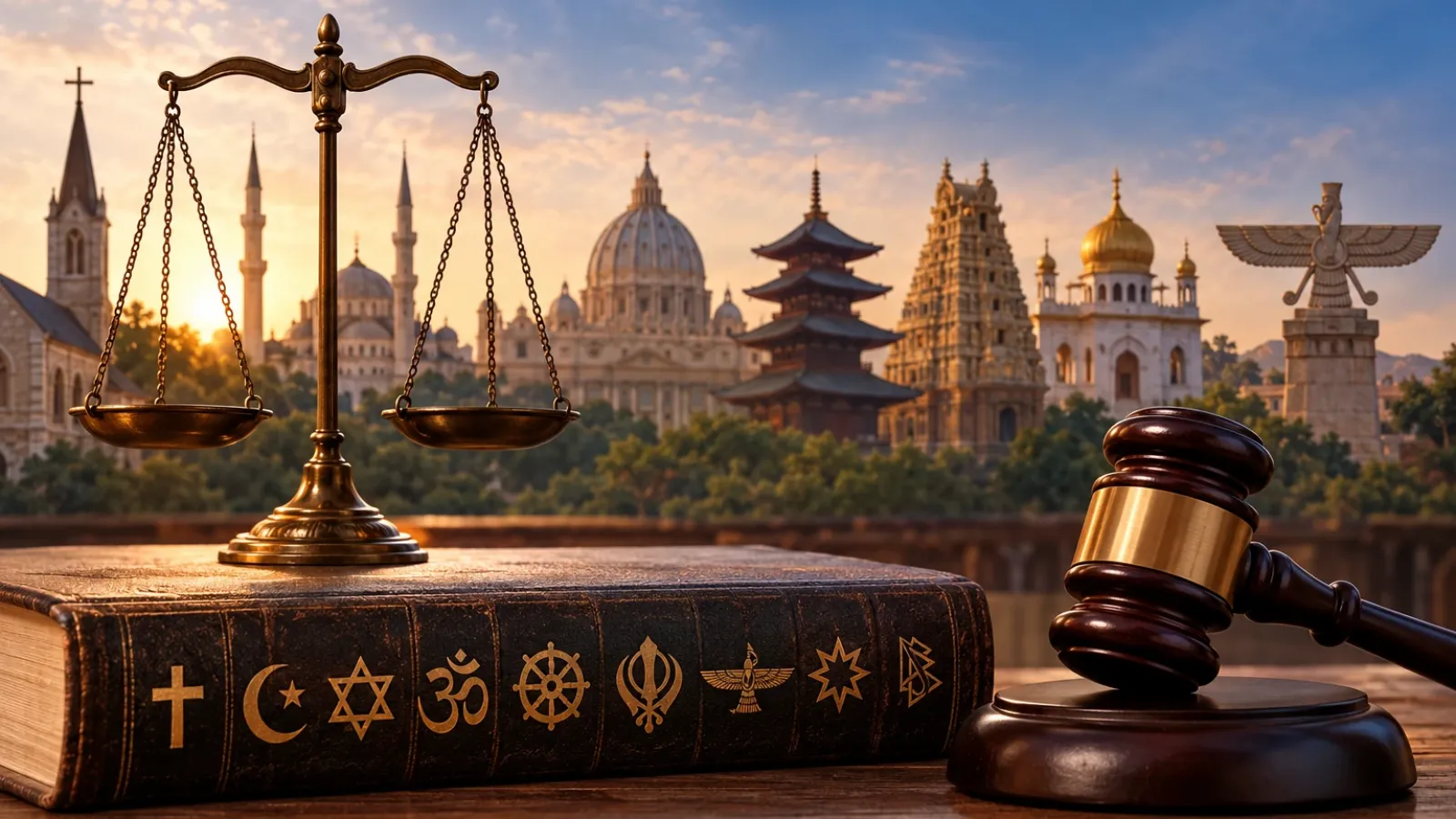
As Pope Leo XIV reaffirms Catholic opposition on World Day Against the Death Penalty, religious traditions offer sharply different answers to questions of justice, mercy and the right to life.
On October 10, 2026, Pope Leo XIV reaffirmed the Catholic Church’s opposition to capital punishment, describing the death penalty as an attack on human dignity. His statement, delivered on World Day Against the Death Penalty, comes as religious communities worldwide continue to grapple with a question that has divided theologians, spiritual leaders and believers for centuries: can a state legitimately take a human life in the name of justice?
The question has acquired renewed urgency. According to Amnesty International’s latest annual report, at least 2,707 executions were recorded worldwide in 2025, a 78 percent increase over 2024. The figure excludes the thousands of executions believed to have occurred in China, where official statistics remain secret. Yet 145 countries had abolished capital punishment in law or practice by the end of 2025.
This year’s World Day Against the Death Penalty, under the theme “Stories for Life,” highlights the experiences of people affected by capital punishment, including prisoners, victims’ families and communities.
A Changing Christian Understanding of Justice
The statement by Pope Leo XIV reinforces a substantial evolution in Catholic teaching. For centuries, Catholic theology accepted the authority of governments to execute people convicted of particularly serious offences. That position changed progressively, culminating in the revision of paragraph 2267 of the Catechism in 2018 under Pope Francis.
The revised teaching declares capital punishment inadmissible and commits the Church to working for its worldwide abolition. On October 10, Leo emphasized that effective imprisonment can protect society without permanently eliminating the possibility of repentance and redemption.
Other Christian traditions have reached comparable conclusions through different theological arguments. In 2002, the Anglican Consultative Council endorsed the view that the death penalty was theologically immoral and encouraged Anglican churches worldwide to pursue its abolition.
The United Methodist Church opposes executions on grounds including human dignity, discriminatory application and wrongful convictions. The Church of Scotland likewise considers capital punishment unacceptable, even for the gravest offences.
Christianity nevertheless has no universally shared position. The Southern Baptist Convention, for example, adopted a resolution in 2000 supporting capital punishment for certain crimes, provided that guilt is established through clear and overwhelming evidence and that punishment is administered fairly.
Eastern Orthodox approaches also vary. The Russian Orthodox Church’s social doctrine welcomes abolitionist initiatives because they preserve opportunities for repentance and avoid irreversible judicial errors, while leaving the ultimate decision to civil society.
Judaism and Islam: Ancient Laws, Modern Interpretations
In Judaism, the Torah includes capital penalties for certain offences. Rabbinic tradition, however, developed demanding procedural and evidentiary requirements that substantially restricted their application. The Mishnah preserves debates in which sages expressed deep reservations about courts imposing death sentences.
Contemporary Jewish movements differ in their reasoning and emphasis. The Union for Reform Judaism adopted a formal abolitionist position in 1959, arguing that society should develop alternatives to execution. Conservative or Masorti Jewish institutions have likewise opposed capital punishment, while some Orthodox interpretations continue to recognize its theoretical legitimacy under traditional religious law.
Islamic jurisprudence also requires careful distinctions. Classical Islamic law recognizes capital penalties in certain circumstances, including intentional murder. The principle of qisas, or retributive justice, nevertheless operates alongside provisions allowing forgiveness and financial compensation, known as diya, in appropriate cases.
Debates become particularly significant when religious conversion or apostasy is involved. Some classical jurists supported capital punishment for apostasy, while contemporary Muslim scholars distinguish a personal change of faith from conduct understood as political rebellion. Egypt’s Dar al-Ifta, for example, states that merely leaving Islam entails no worldly punishment, while separately discussing acts threatening public order.
These differences underline why the laws of individual Muslim-majority countries cannot automatically be presented as the position of Islam as a whole.
Non-Violence and the Traditions of Asia
For Buddhism, Hinduism and Jainism, the principle of ahimsa, or non-violence, provides an important ethical starting point. Yet the relationship between spiritual teachings and historical systems of criminal punishment has not always been straightforward.
In Buddhism, the first of the five precepts discourages the taking of life. The Dalai Lama has explicitly opposed capital punishment, emphasizing that even those responsible for serious wrongdoing remain capable of personal transformation. Nevertheless, states historically influenced by Buddhism have sometimes retained executions.
Hindu traditions emphasize non-violence while also recognizing, in certain classical legal and political texts, a ruler’s responsibility to maintain order and punish wrongdoing. Without a single centralized religious authority, Hindu interpretations of capital punishment remain diverse.
Jainism places an exceptionally strong emphasis on avoiding harm to living beings. Capital punishment therefore conflicts with the central ethical principles of Jain non-violence, although historical political practices have not invariably reflected the strictest religious ideals.
Sikh teachings emphasize justice, compassion and the protection of the vulnerable, while acknowledging the legitimate use of force in certain circumstances. Sikh religious institutions and leaders have expressed different positions on capital punishment, including appeals for clemency.
Minority Religions Reveal Further Differences
A genuinely international comparison must also consider religious communities whose positions are often absent from mainstream discussions.
The Bahá’í Faith provides a distinctive example. Its central scripture, the Kitáb-i-Aqdas, permits capital punishment for murder and arson while explicitly allowing life imprisonment as an alternative. The details of applying these provisions in a future society are left to the Universal House of Justice, the Faith’s international governing institution.
The Church of Scientology has adopted an explicitly abolitionist institutional position. Its 2003 Proclamation on Religion, Human Rights and Society, issued in Brussels, states: “No person should be executed. States should abolish capital punishment.” The declaration emphasizes the irreversible consequences of executing an innocent person.
Other communities distinguish religious teaching from the state’s responsibility for criminal law. The Church of Jesus Christ of Latter-day Saints expressly neither supports nor opposes capital punishment, considering its application a matter for civil legal processes.
Jehovah’s Witnesses similarly maintain political neutrality. Their religious publications acknowledge biblical passages recognizing capital punishment but do not advocate a political campaign either for or against its use.
Beyond the Question of Punishment
A comparative survey published by the French religion news outlet ReligActu on October 10 illustrates the importance of separating ancient religious prescriptions, later theological interpretations and contemporary institutional statements. These three dimensions do not necessarily produce identical conclusions.
For religious traditions opposing the death penalty, the central argument often involves the continued dignity of the offender, the possibility of repentance and the irreversible character of execution. Traditions that retain conditional acceptance may instead emphasize the protection of society, the gravity of particular crimes and the responsibility of legitimate authorities to administer justice.
Neither approach removes the suffering of victims and their families, nor the obligation of societies to protect people from violence. What differs is the understanding of whether execution can ever constitute a just response.
As the international community marks World Day Against the Death Penalty, the religious debate demonstrates that ancient sacred texts do not always determine contemporary positions in a simple or predictable way. Across traditions, the enduring questions concern not only how wrongdoing should be punished, but also how justice, mercy, human dignity and the possibility of change can coexist.