


From medieval Anatolia to modern Albania, the Bektashi path combines Islamic mysticism, devotion to Ali and a distinctive emphasis on human dignity and coexistence.
For centuries, Bektashism has occupied a distinctive place in the religious landscape stretching from Anatolia through the Balkans. Yet outside the countries where it took root, the tradition remains unfamiliar to many people, even as renewed international attention has brought the Bektashi name increasingly into public discussion.
Bektashism is at once a Sufi path, a religious community and a cultural tradition. It emerged from the complex spiritual environment of medieval Anatolia and takes its name from Haji Bektash Veli, the 13th-century mystic whose memory became the centre of a religious movement that would later spread widely through the Ottoman world.
Its history is one of migration, suppression and survival. Its theology brings together Islamic mysticism and an especially strong reverence for Ali and the family of the Prophet Muhammad. And in its modern Albanian expression, it has become closely associated with an ideal that its leaders repeatedly emphasise: harmony among people of different religions.
A path within Islamic mysticism
Bektashism belongs historically to the broad world of Sufism, the mystical dimension of Islam. Like other Sufi paths, it emphasises spiritual transformation and the search for a deeper relationship with the divine rather than understanding religion exclusively through outward observance.
At the same time, Bektashism does not fit comfortably into a simple Sunni-Shi’a division. The tradition developed within the Islamic world while giving a particularly important place to Ali, cousin and son-in-law of the Prophet Muhammad, the Twelve Imams and the memory of Imam Husayn.
The martyrdom of Husayn at Karbala in 680 carries particular spiritual significance. Themes of sacrifice, justice, loyalty and resistance to oppression that surround Karbala have become deeply embedded in Bektashi devotional culture.
Over the centuries, Bektashi theology and ritual absorbed influences from several currents circulating through Anatolia and the wider Islamic world. This produced a tradition recognisably Islamic and Sufi, but with characteristics that distinguish it from many better-known Muslim communities.
For Bektashis themselves, such external classifications do not necessarily capture the essence of the path. The religious journey concerns knowledge of God, ethical conduct, love, spiritual development and the transformation of the individual.
Haji Bektash Veli and the growth of an order
The historical Haji Bektash Veli lived in 13th-century Anatolia, although the details of his life are partly obscured by centuries of devotional tradition. He eventually settled near the village that would later carry his name, Hacıbektaş, in present-day Türkiye.
The organised Bektashi order developed progressively after his lifetime. Later generations created an institutional structure, spiritual hierarchy, ceremonies, poetry and teachings around the path associated with him.
The tekke, or Sufi lodge, became central to Bektashi religious life. Spiritual teachers known as babas instructed followers and transmitted the teachings of the order, while successive stages of initiation marked the believer’s progress along the spiritual path.
Bektashism also became closely associated with the Ottoman Janissaries. That relationship helped the order expand but later exposed it to political repression. When Sultan Mahmud II abolished the Janissary corps in 1826, the Bektashis were suppressed as well. Lodges were closed, transferred to other orders or destroyed, and members faced exile and persecution.
The tradition nevertheless survived.
From Anatolia to the Balkans
By then, Bektashism had already developed deep roots across the Balkans. Communities and tekkes appeared in territories that today form parts of Albania, Kosovo, North Macedonia and neighbouring countries.
Albania became particularly important. Bektashi institutions developed there to such an extent that the community came to represent much more than simply one Sufi order among many.
Another turning point came in 1925, when the Turkish Republic abolished Sufi orders and closed their lodges. Organised Bektashi leadership subsequently shifted towards Albania, where the headquarters of the Bektashi community was established in Tirana.
But refuge did not mean security. Albania’s communist regime progressively restricted religious life and in 1967 prohibited religious practice altogether. Bektashi tekkes, like the country’s mosques and churches, were closed, confiscated or converted to other purposes.
After the fall of communist rule, Bektashi religious life re-emerged. The Tirana headquarters reopened, sacred sites were restored and religious leaders began rebuilding institutions after decades during which public transmission of the tradition had been almost impossible.
An Albanian faith community with a wider reach
Modern Albania offers an unusual religious landscape in which Muslim, Orthodox, Catholic, Bektashi and other identities have long existed alongside one another. The country’s 2023 census counted 115,644 residents who identified specifically as Muslim-Bektashi, distinguishing Bektashism from the broader Muslim category.
Bektashi history has also become intertwined with Albanian culture and national development. Tekkes functioned not only as religious centres but at different moments as places of hospitality, learning, poetry and preservation of the Albanian language and identity.
This experience of coexistence has become an important element of how contemporary Bektashi leaders present their tradition to the wider world.
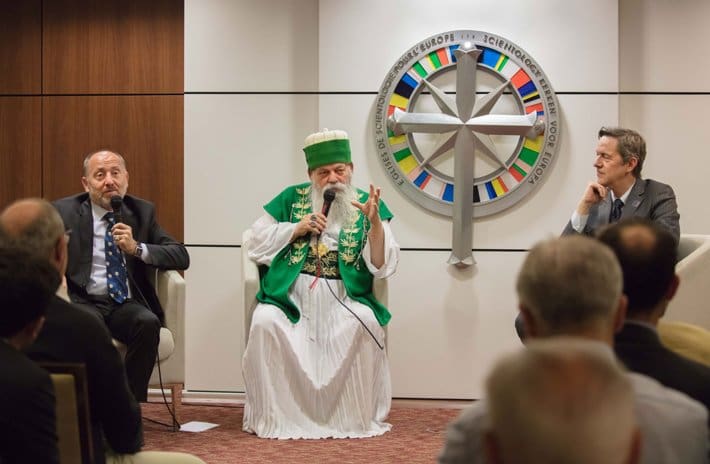
A revealing example took place in Brussels in 2019. Baba Mondi, the Dedebaba and leader of the Tirana-based Bektashi community, was the featured speaker at a forum hosted by the Church of Scientology European Office for Public Affairs and Human Rights. Entitled “What is Bektashism?”, the gathering was intended to introduce participants from other backgrounds to the beliefs and social role of the Bektashi tradition.
Rather than concentrating on theological differences, Baba Mondi spoke about respect for people regardless of religion, nationality, culture or background, and about the experience of religious coexistence in Albania. He presented that experience not simply as an Albanian peculiarity but as something that could contribute to greater harmony elsewhere in Europe.
His description condensed the idea into a striking phrase: “The universal value of Bektashism is the human.”
The setting gave the words an additional significance. A Bektashi Muslim spiritual leader was explaining his faith inside an institution belonging to another minority religion. The encounter required neither side to minimise its own beliefs. Instead, it demonstrated another model of interreligious dialogue: understanding a different tradition on its own terms while identifying areas where religious communities can cooperate.
Religious harmony and religious freedom
The Brussels discussion also revealed that dialogue between religions is not only about ceremonial expressions of friendship. Baba Mondi used the occasion to speak about difficulties faced by Bektashis seeking legal recognition in North Macedonia.
Those concerns had already reached the European Court of Human Rights. In 2018, in a case involving the Bektashi Community, the Court found a violation of freedom of association interpreted in light of the right to freedom of thought, conscience and religion after domestic authorities refused to recognise the association’s continuing legal status or register it anew.
The episode gives another dimension to the Bektashi emphasis on coexistence. Harmony between religions is easier to celebrate when communities are socially accepted. Its harder test comes when an unfamiliar or minority faith encounters legal obstacles, public suspicion or exclusion.
Interfaith dialogue can therefore serve two purposes at once: allowing religious communities to know one another better and creating relationships through which the principle of freedom of religion or belief can extend beyond one’s own community.
Ali, Karbala and spiritual renewal
The outward emphasis on coexistence should not obscure the particular religious identity that Bektashis seek to preserve.
Among their most visible celebrations is Sultan Nevruz, observed in Albania on March 22 and associated in Bektashi tradition with the birth of Imam Ali as well as with spring, renewal and spiritual rebirth.
The remembrance of Ashura carries a more solemn character, recalling Imam Husayn and those killed with him at Karbala. Commemoration, devotional poetry and reflection on suffering and moral courage form part of the religious memory surrounding the event.
Bektashi tradition has also historically emphasised the spiritual value of the human person. Religious practice has developed differently across periods and communities, and the Bektashi world should not be treated as completely uniform. Nevertheless, an emphasis on inner spirituality rather than rigid external distinctions has remained one of its recognisable characteristics.
One tradition, several histories
Bektashism itself contains diversity. Historical scholarship identifies different branches within the tradition, and communities in Albania and Türkiye have not always shared the same institutional structures or understanding of spiritual authority.
The Tirana institution describes itself as the World Bektashi Headquarters and occupies a central position within Albanian Bektashism, but the wider Bektashi and Alevi-Bektashi landscape extends beyond a single institution.
This matters increasingly as international interest in Bektashism grows. A tradition formed over centuries across different regions cannot be understood solely through its contemporary leadership or one national experience.
A tradition shaped by survival
Few religious communities illustrate the complexity of Europe’s religious history quite like the Bektashis. The tradition emerged in Anatolia, travelled through the Ottoman Balkans, acquired particularly deep roots among Albanians, survived imperial suppression, endured the closure of Sufi institutions in Türkiye and then faced the complete prohibition of religion under communist Albania.
Yet Bektashism survived each rupture.
Today its tekkes, ceremonies and spiritual leadership continue alongside a renewed effort to explain the tradition beyond the communities that have known it for generations. Encounters such as the Brussels gathering show how Bektashi leaders have sought to translate their own historical experience into a wider message of religious coexistence without abandoning the distinctiveness of their faith.
In an age when religious identities are often compressed into broad categories, Bektashism is a reminder that the map of belief has always been more intricate. It sits at the intersection of Islamic mysticism, devotion to Ali, Balkan history and Albanian religious culture—and offers a living example of how a community can preserve a distinctive spiritual identity while seeking constructive relations with people whose beliefs are very different from its own.