


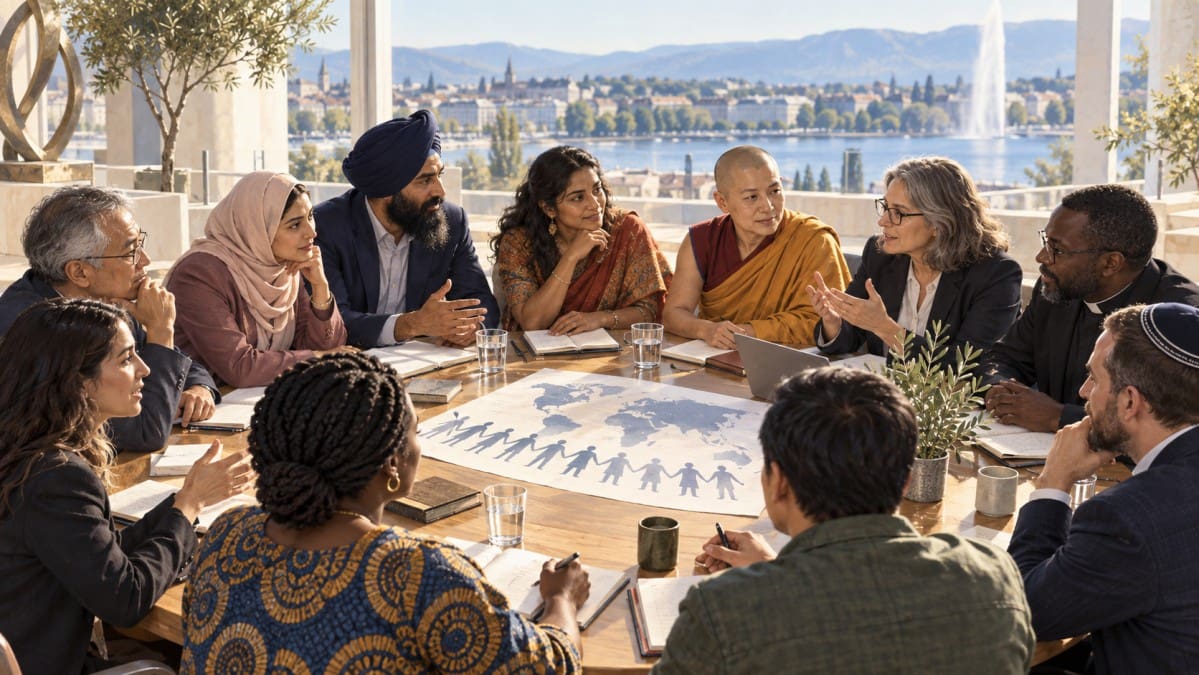
The UN framework asks religious and non-religious actors to defend everyone’s dignity—not only the interests of their own communities.
Religious leaders are often invited to speak after violence has erupted or a community has already been targeted. The United Nations’ “Faith for Rights” framework asks something more demanding: that people of faith and conscience use their influence before, during and after a crisis to protect the rights of others, including people whose beliefs they do not share.
More accurately, “Faith for Rights” is not a UN agency, a new treaty or an accreditation scheme. It is a voluntary framework, a practical learning toolkit and a growing community of practice supported by the Office of the UN High Commissioner for Human Rights. Its central question is simple but uncomfortable: if religion can shape public attitudes, can religious influence be directed consistently toward universal human dignity?
From preventing hatred to defending rights
The framework was launched at an OHCHR expert workshop in Beirut on 28–29 March 2017. Thirty faith-based and civil-society actors, drawn from the Middle East and North Africa as well as international human-rights circles, unanimously adopted the Beirut Declaration and its 18 commitments on “Faith for Rights”.
The initiative grew out of the Rabat Plan of Action, developed in 2012 to address advocacy of national, racial or religious hatred that amounts to incitement to discrimination, hostility or violence. Rabat described responsibilities for religious leaders in confronting incitement. Beirut extended the idea across the full range of human rights.
That shift is important. “Faith for Rights” does not merely ask leaders to avoid inflammatory speech. It calls on them to challenge discrimination, resist the political manipulation of religion, protect minorities, advance gender equality, include children and young people, defend critical voices and oppose coercion in matters of conscience. It also asks communities to examine interpretations and practices within their own traditions when these conflict with universal human-rights standards.
The declaration is deliberately broader than religion in the conventional sense. It addresses believers described as theistic, non-theistic, atheistic or otherwise. Humanists and non-religious organisations therefore belong within the framework, not outside it. Freedom of religion or belief protects the right to hold, change, reject or refrain from professing a belief.
A toolkit, not a sermon
The project’s most practical element is the #Faith4Rights toolkit. Its 18 peer-to-peer modules mirror the commitments and cover freedom of conscience, inclusive interaction, constructive readings of religious texts, pluralism, gender equality, minority rights, incitement to hatred, political instrumentalisation, education, non-coercion and creative outreach.
The method is participatory. Groups unpack a commitment, compare it with experiences in their communities, discuss difficult cases and translate the principle into local language and action. The toolkit includes scenarios involving blasphemy accusations, radicalisation, economic and social rights, environmental harm and epidemics. Storytelling, art, music and child-friendly explanations sit alongside international law.
This is not the UN deciding theology. Participants draw on their own religious, ethical or philosophical sources, while universal human rights remain the common baseline. Nor is theological agreement required. The Beirut Declaration expressly moves beyond dialogue as an end in itself: the point is cooperation that produces measurable change.
A community stretching beyond its Beirut roots
“Faith for Rights” has gradually developed from a declaration into what participants call a “commUNity of practices.” At its fifth annual meeting in 2024, OHCHR brought together more than 200 participants in Geneva and online. They shared 27 initiatives involving universities, faith-based organisations, parliamentarians, civil society and UN mechanisms, while a second edition of the toolkit was launched in Chinese, English, French and Spanish.
The following year, the sixth annual meeting moved beyond Geneva to Siem Reap and Bangkok. The resulting Bangkok Declaration on Dharmic Perspectives on Faith for Rights marked the first time the global community had met in a predominantly Dharmic setting. It sought to give greater space to Buddhist, Hindu, Indigenous and other perspectives that had been underrepresented in earlier discussions.
In 2026, OHCHR also placed a Faith for Rights activation within its new Global Alliance for Human Rights. A June peer-engagement jointly convened with the Vatican and Al-Azhar connected participants in Cairo, Rome and Geneva to discuss war and polarisation, artificial-intelligence-generated falsehoods, hate speech and the political use of religion to incite violence.
From commitments to practical projects
The framework was designed to be adapted rather than administered as a single, centrally controlled programme. Its 2024 review recorded projects in education, research, peacebuilding, minority protection and public policy. They included university courses on religion and human rights, training involving religious leaders, a community-based initiative in Nigeria, cooperation with parliamentarians and creative projects using music and storytelling.
At community level, applying “Faith for Rights” can mean reviewing teaching materials that reinforce prejudice, preparing religious leaders to recognize incitement, documenting discrimination, creating safe encounters between divided groups or designing humanitarian work that serves people without regard to belief. It can also mean supporting women, young people and minority voices within religious communities, rather than treating established leaders as the only legitimate participants.
The framework’s hardest principle is solidarity beyond one’s own circle. Defending only one’s co-religionists may be understandable, especially when a community faces persecution, but it does not fulfil the project’s broader ambition. “Faith for Rights” calls on religious and belief actors to stand up for the rights of all, including people with whom they may have profound theological or philosophical disagreements. The framework does not enumerate every community to which that responsibility applies. It follows from its universal principle—rather than from any express reference to particular groups—that equal protection must extend to Scientologists, Bahá’ís, Hindus and followers of other Dharmic traditions, humanists, atheists, and other minority religious or belief communities, just as Christians should oppose anti-Muslim hatred and Muslims should confront antisemitism.
That approach also distinguishes the initiative from ceremonial interfaith dialogue. Shared photographs and declarations of harmony may have symbolic value, but the Beirut framework expects follow-up: changes in education, public advocacy against incitement, assistance to vulnerable people and cooperation across religious or belief boundaries. Its credibility depends on what happens after the conference ends.
The 18 commitments are not legally binding, and “Faith for Rights” has no enforcement arm. It cannot replace governments’ obligations under international law, independent courts or remedies for victims. A workshop can produce generous language without changing discriminatory laws, funding structures or behaviour on the ground.
Yet its voluntary character gives the framework a different kind of reach. It can enter seminaries, schools, congregations, universities and local networks where a legal judgment may be little known and political debate may already be polarised. It asks influential actors to translate human-rights norms into moral vocabularies their communities understand—while refusing to let culture or doctrine become an excuse for violating those norms.