


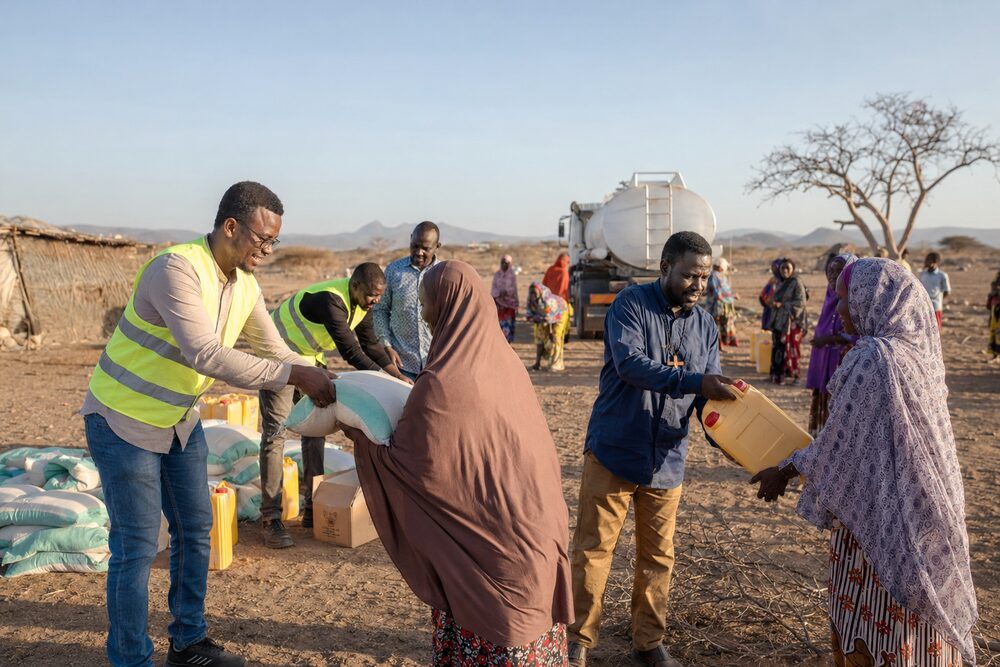
AI-generated illustrationTransparency information
AI-generated images: One or more images accompanying this report were generated or substantially modified using artificial intelligence. They are illustrative and should not be understood as documentary photographs unless explicitly stated otherwise.
A partnership between Muslim leaders and members of The Church of Jesus Christ of Latter-day Saints has delivered emergency food and clean water to thousands of families in the arid reaches of northern Kenya, demonstrating how interfaith cooperation can translate shared values into practical assistance.
From May 28 to May 30, teams representing the Church and Kenya’s National Muslim Leaders Forum, known as NAMLEF, traveled to isolated pastoralist communities in and around Korr. According to the Church’s Africa Newsroom account of the operation, the teams distributed 250 tons of food to 3,011 households in 24 villages. Water deliveries reached 16 locations and directly served 2,142 households.
The figures were subsequently reported by Church News, which described the partnership as a response to severe food and water insecurity among nomadic communities in northeastern Kenya.
Relief Across Difficult Terrain
Reaching the villages required more than assembling supplies. Heavy seasonal rain and flash flooding had washed out a principal route shortly before the deliveries began. Trucks carrying food and water were diverted across rough volcanic terrain, where repeated tire damage forced crews to make roadside repairs.
Once the vehicles arrived, volunteers organized individual piles of provisions for each registered household. Women were designated as the recipients for their families, helping distribution teams account for the supplies and reduce the risk that any household would be missed.
The humanitarian work took place amid persistent environmental pressure in Marsabit County. Kenya’s National Drought Management Authority published a new Marsabit drought bulletin in July, reflecting the continuing need for close monitoring and coordinated assistance in the region.
Different Traditions, Shared Responsibility
NAMLEF and the Latter-day Saint humanitarian team approached the project from distinct religious traditions, but both framed service to vulnerable families as a moral responsibility. Christian participants spoke of following Jesus Christ’s example of doing good, while the Muslim organization emphasized solidarity and collaborative care for communities facing hardship.
That cooperation continued after the deliveries. On June 27, NAMLEF hosted Church representatives at a gathering in Nairobi where leaders expressed mutual appreciation and discussed the relationships strengthened through the project.
The operation offers a useful model for faith-based humanitarian work. Religious organizations often possess trusted community networks, volunteers and local knowledge, but their impact can grow when those resources are shared across institutional and religious boundaries.
Interfaith cooperation does not require communities to minimize their beliefs or pretend that all traditions are identical. In northern Kenya, it meant allowing those beliefs to motivate a common response to hunger, water scarcity and human vulnerability. The result was not simply a dialogue about solidarity, but food and water placed directly into the hands of families who needed them.